Russia, Sanctions, and a War Longer Than World War I: Why Economic Pressure Has Failed to Change Moscow’s Course in Ukraine
The Ukraine war has outlasted World War I, exposing how sanctions can impose costs on a major power without necessarily changing its strategic behaviour in an increasingly multipolar world.
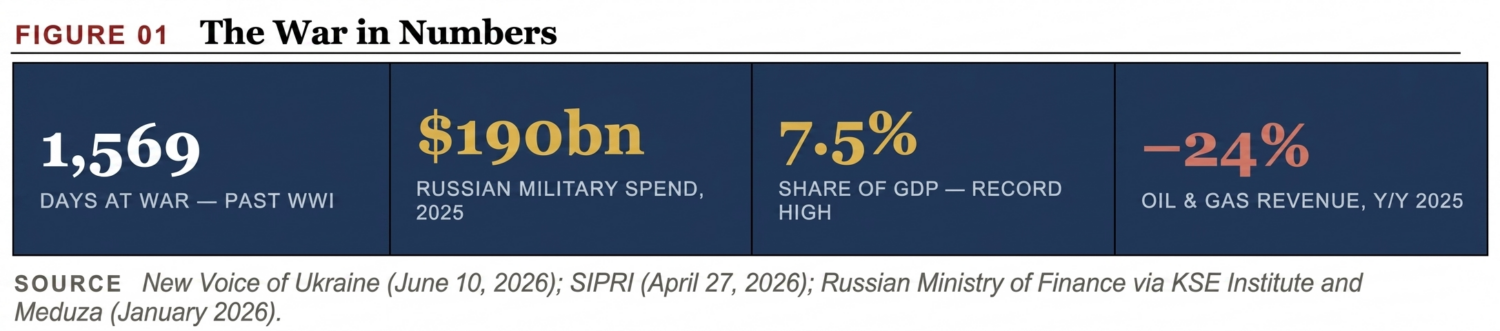
On June 11, 2026, the war in Ukraine crossed a threshold few predicted in February 2022: it outlasted the First World War. At 1,569 days and counting, the conflict has now exceeded the 1,568 days of a war that destroyed four empires, reordered Eurasia, and briefly convinced the men who signed the Armistice at Compiègne that they had made the last great European catastrophe. They were wrong. And so, it turns out, were the Western officials who believed that an unprecedented economic blockade could compel a major power to abandon its strategic objectives before the fighting had time to entrench.
The theory behind Western sanctions was stated with unusual confidence. Russia’s deep integration into globalised finance and energy markets was its Achilles’ heel; sever that access sharply enough, and the shock would compel a strategic retreat. Officials described the freeze of approximately $300 billion in Russian central bank reserves and the exclusion of Russian banks from the SWIFT interbank network as a “financial nuclear option.” The coalition was real, the coordination unprecedented, and the logic — for about six weeks — apparently compelling.
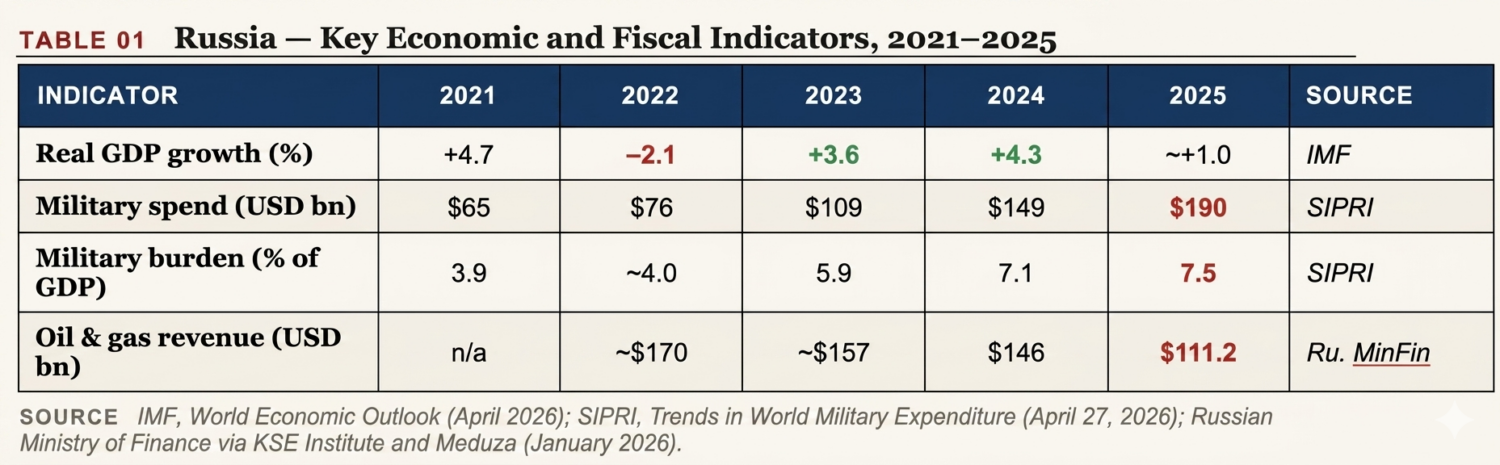
Four years and four months later, that logic has been tested and found insufficient on its central premise, though not on every front. Russia’s GDP contracted by only 2.1 percent in 2022, recovered to 3.6 percent growth in 2023, expanded by 4.3 percent in 2024, and slowed to roughly 1.0 percent in 2025 as the Bank of Russia’s 21 percent key rate began extracting a real toll on civilian activity. The front lines remain contested. The war has not ended.
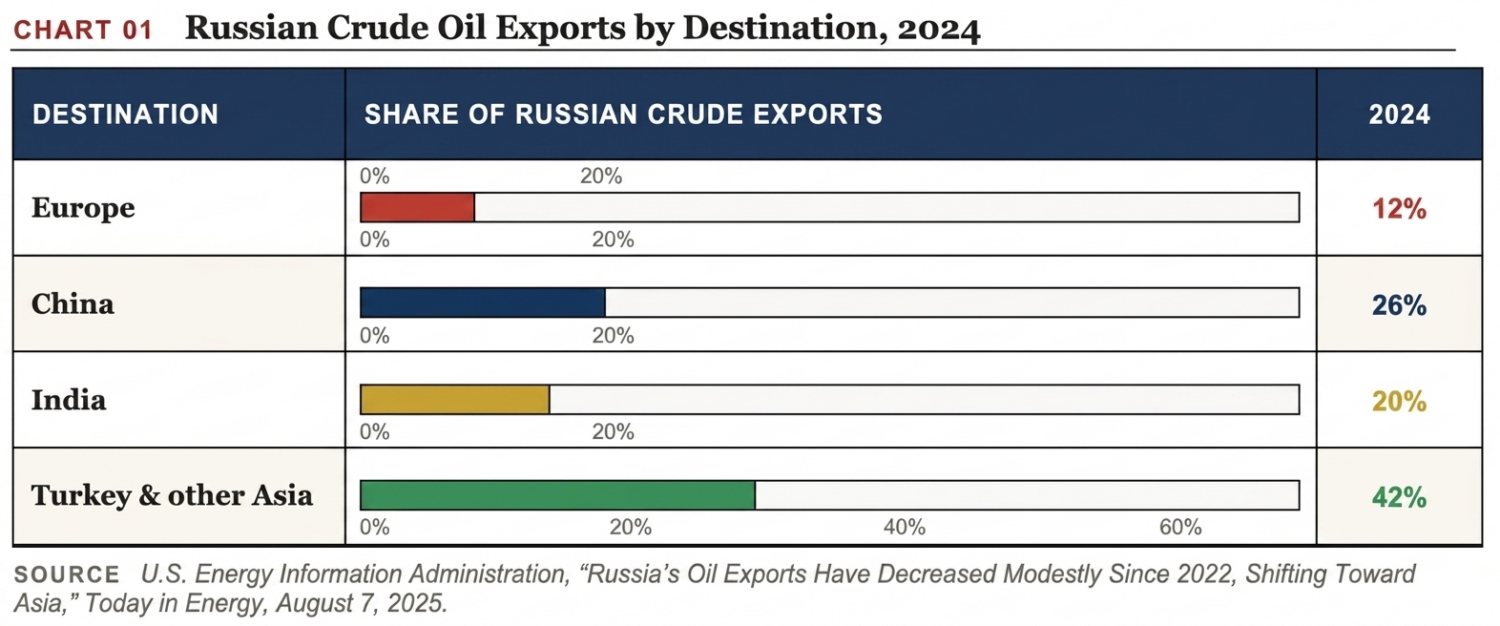
The sanctions architecture is, by historical comparison, extraordinary: more than 16,000 measures from the EU, the United States, the United Kingdom, and their partners, targeting financial liquidity, energy revenue through the EU’s crude embargo and the G7’s $60-per-barrel price cap, and technological access via export controls on semiconductors and dual-use components. The structural flaw was not administrative but geopolitical. The coalition excludes states representing roughly 60 percent of global GDP by purchasing-power parity. When Russia could not sell oil to Europe, it sold it to Asia.
Russia’s crude exports to India grew from roughly 50,000 barrels per day in 2020 to about 1.7 million by 2024. Europe’s share of Russian crude collapsed from 51 percent to 12 percent over the same period, while Asia absorbed the difference through a shadow fleet of over 560 tankers operating under flags of convenience, allowing crude to clear the price cap.
Yet the picture is not one of unbroken success for Moscow. Russia’s oil and gas revenue, the fiscal core of the war effort, fell 24 percent in 2025 to $111. 2 billion from $146 billion in 2024, and the federal deficit widened to 5.6 trillion rubles — its highest in over a decade. Oil-and-gas income now covers under 23 percent of the federal budget, the lowest share in two decades. The financial response — capital controls, an emergency rate rise, and a pivot to yuan-denominated trade now covering 99 percent of Russia–China commerce — bought time rather than immunity.
The third mechanism, military Keynesianism, has so far outpaced the fiscal strain. Russia spent $190 billion on its military in 2025 — 7.5 percent of GDP, the highest share ever recorded in the relevant database. That injection drove industrial output in metallurgy and munitions and sustained the shell and drone production behind the current front. The costs are severe: persistent inflation, civilian under-investment, and the emigration of hundreds of thousands of workers. But in the attritional medium term it has done what the Kremlin required — for now.
Military historians would recognise the battlefields of eastern Ukraine without difficulty. Trench systems near a thousand kilometres, artillery exchanges rivalling the Somme, gains measured in hundreds of metres — an attritional logic twentieth-century doctrine was meant to have superseded. “In many respects, this war in Ukraine is the one that most closely resembles World War I,” French historian Michel Goya told the New York Times in June 2026. The difference is the transparent battlefield: drone surveillance and AI-processed satellite imagery now make any troop concentration detectable within minutes, foreclosing the kind of breakthrough that ended 1918’s stalemate.
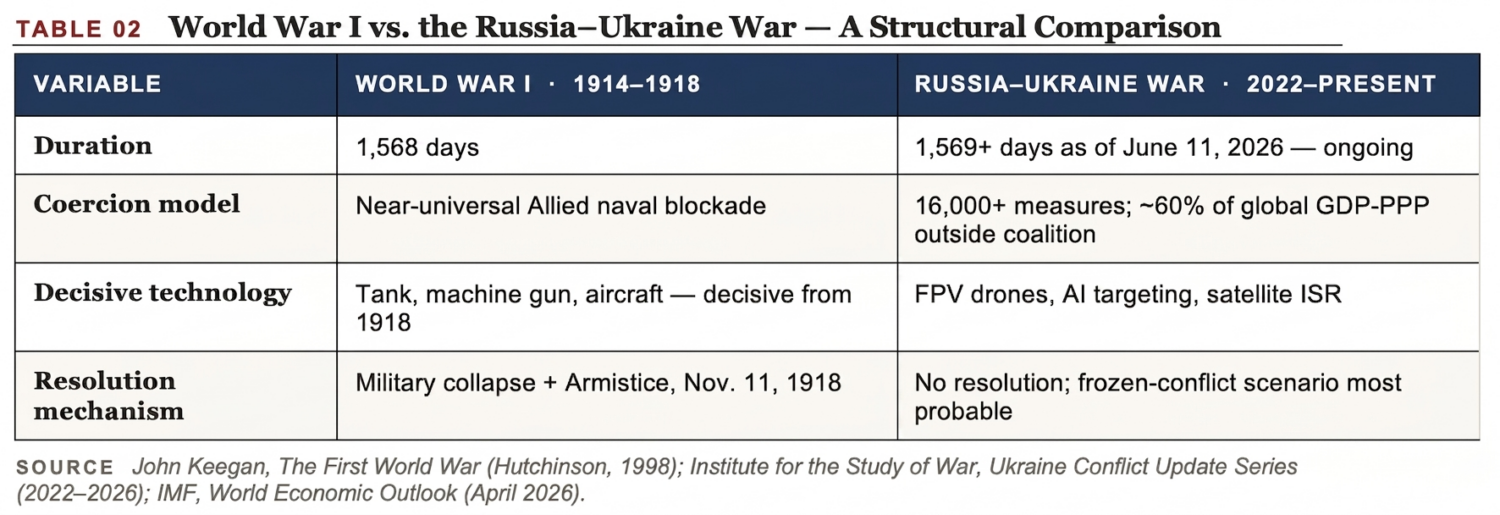
The Allied naval blockade of Germany succeeded partly through near-universality: few neutral economies traded meaningfully with the Central Powers after 1914. The Russia sanctions regime is not universal. China and India — close to three billion people between them — have deepened, not curtailed, their commercial engagement with Moscow. That is a feature of a multipolar world, not an enforcement failure.
Economic coercion works best when near-universal, when the target lacks alternative markets, and when pressure outlasts the runway war-economy mobilisation buys. Russia met none of those conditions, though the 2025 fiscal data show the runway has limits. The comparison with Iran or North Korea, often invoked by sanctions advocates, collapses: neither has Russia’s resource base or its position beside two non-aligned giants. Sanctions have weakened Russia for a generation. They have not, on their own, coerced it.
The lesson of 1,569 days is specific and structural at once. The bypass infrastructure built during this conflict — alternative payment messaging, non-Western shipping insurance, yuan settlement architecture — already exists and is expanding, even as Russia’s own fiscal cushion thins. Sanctions are a legitimate auxiliary instrument of statecraft, not a substitute for military deterrence or alliance cohesion, and not sufficient on their own in a genuinely multipolar world. Recognising that distinction, rather than designing the next package on the old assumption, is the actual strategic task ahead.
Sources
Brookings Institution. (2025, February 28). Where did Russia’s shadow fleet come from?
Institute for the Study of War. (2022–2026). Ukraine conflict update series.
International Monetary Fund. (2026, April). World economic outlook: Global economy in the shadow of war.
Keegan, J. (1998). The First World War. Hutchinson.
Kyiv School of Economics Institute. (2026, January). Russia chartbook: Spending cuts keep budget on target; Russian oil prices continue to plunge.
Meduza. (2026, January 28). Russia’s oil and gas revenues are shrinking: What that means for the Kremlin’s war chest.
Ministry of Finance of the Russian Federation. (2026, January). Federal budget execution report, 2025.
New Voice of Ukraine. (2026, June 10). Russia’s full-scale invasion of Ukraine reaches 1,568 days.
S&P Global. (2025, September 3). Factbox: Shadow fleet expands to maintain sanctioned oil flows.
Stockholm International Peace Research Institute. (2026, April 27). Global military spending rise continues as European and Asian expenditures surge [Press release].
The New York Times. (2026, June). Interview with Michel Goya on attritional parallels with World War I.
U.S. Energy Information Administration. (2025, August 7). Russia’s oil exports have decreased modestly since 2022, shifting toward Asia. Today in Energy.