Between Trump’s Diplomacy and Putin’s Missiles: Ukraine’s Economic Endgame
Two numbers frame this article. The first is $588 billion: what the World Bank, the UN, the European Commission and Kyiv itself now say Ukraine needs to rebuild, as of the most recent joint damage assessment released in February 2026. The second is 6 July 2026, the date a Ukrainian drone travelled roughly 2,500 kilometres to hit Russia’s largest oil refinery. One number is a bill. The other is a strike. Neither is really about winning the war anymore, and that is the argument this piece wants to make.
Trump’s diplomatic effort gets most of the headlines, and Putin’s missile and drone campaign gets most of the daily news coverage. Less discussed, though arguably more decisive, is the number sitting quietly underneath both: Ukraine’s reconstruction bill, which has grown every single year of this war and shows no sign of levelling off. Nobody’s talking about it much. I want to look at what that bill actually says about who is winning the economic side of this conflict, since the military and diplomatic stories, told on their own, tend to miss it.
The Rising Bill: Ukraine’s Reconstruction Endgame
Since 2023, the World Bank Group, the Ukrainian government, the European Commission and the UN have jointly published four Rapid Damage and Needs Assessments, essentially an annual audit of what the war has cost and what rebuilding will require. The trend across those four reports is not subtle. Needs stood at $411 billion in February 2023. A year later, $486 billion. By February 2025, $524 billion. The most recent assessment, released in February 2026, puts the figure at $587.7 billion, now equivalent to close to three times Ukraine’s entire annual economic output.
Direct physical damage, a narrower measure than the full reconstruction estimate, has followed the same climb: $152 billion in the 2024 report, $176 billion in 2025, $195.1 billion in the 2026 release. Every single year, up. Socioeconomic losses, which the World Bank tracks separately and which capture the broader disruption to commerce, industry and daily life rather than physical destruction alone, were assessed in the newest report at $666.7 billion, up 13 per cent from the year before.
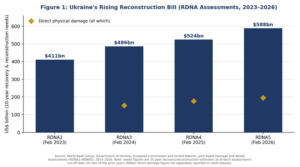
Figure 1: Ukraine’s reconstruction needs by assessment wave, 2023–2026. Source: World Bank Group, Government of Ukraine, European Commission, United Nations, joint Rapid Damage and Needs Assessments (RDNA2–RDNA5). Note: RDNA2 direct-damage figure was not separately reported in the cited releases.
What strikes me most in this data isn’t the size of the number, it’s the shape of it. This is a bill that grows roughly $60–75 billion a year, largely regardless of how the front line itself moves. Energy infrastructure explains a lot of that growth: the 2025 assessment recorded a 70 per cent jump in damaged or destroyed energy assets compared with the year before, and the 2026 assessment recorded a further 21 per cent increase on top of that, driven by what the assessment itself calls a winter of record intensity in Russian strikes. Housing tells a similar story: 10 per cent of the national stock damaged or destroyed as of the 2024 report, 13 per cent a year later, 14 per cent, affecting more than three million households, by early 2026.
None of this is being paid for quickly, either. Ukraine’s government and its donors allocated $7.37 billion against 2025’s priority needs and still left a financing gap of just under $10 billion for that year alone. Multiply that shortfall out over a decade and the arithmetic of “who pays for this” starts to look at least as important as anything happening at the front.
Table 1: Ukraine’s Economic Endgame, Three Assessment Waves
| Indicator | RDNA3 (Feb 2024) | RDNA4 (Feb 2025) | RDNA5 (Feb 2026) |
| Reconstruction needs (10-yr) | $486bn | $524bn | $588bn |
| Direct physical damage | $152bn | $176bn | $195.1bn |
| Socioeconomic losses | n/r | n/r | $666.7bn |
| Housing stock damaged/destroyed | 10% | 13% (2.5m households) | 14% (3m+ households) |
| Energy assets damaged/destroyed | baseline | +70% vs RDNA3 | +21% vs RDNA4 |
| Annual financing gap (year noted) | $9.5bn (2024) | $9.96bn (2025) | n/r in cited release |
Compiled from World Bank Group / Government of Ukraine / European Commission / United Nations joint Rapid Damage and Needs Assessments, RDNA3–RDNA5, 2024–2026. “n/r” indicates a figure not separately reported in the cited release.
Putin’s Missiles: The Other Half of the Ledger
Russia’s own energy system has not escaped this dynamic, even if the mechanism runs in the opposite direction. Crimea and Sevastopol have lived under intermittent gasoline rationing since September 2025, and gasoline prices in Sevastopol briefly touched around 199 rubles a litre in early July 2026, nearly two and a half times the official regional average. Then, on 6 July, Ukrainian Special Operations Forces struck the Omsk refinery, Russia’s largest, the deepest strike inside Russian territory of the entire war. Russian officials have alternated, in the days since, between admitting the strain and insisting the country’s energy system retains ample safety margins. Both can be true. Fuel queues in occupied Crimea and quiet reassurances from Moscow are not contradictory; they are two symptoms of the same underlying condition.
Russia’s broader fiscal position has moved in step. Sanctioned by more than 16,000 separate measures, the Russian economy nonetheless contracted only 1.4 per cent in 2022 and grew a healthy 4.1 per cent in both 2023 and 2024, according to Rosstat’s own (twice-revised) figures, feeding a now-familiar narrative of sanctions-proof resilience that some Russia-watchers trace to roughly fifteen years of adversarial crisis management inside Russian economic institutions, well predating this war. That narrative needs updating. Growth slowed to around 1 per cent in 2025, and in the first quarter of 2026 Russia’s GDP actually contracted, 0.2 per cent year on year, its first quarterly contraction in three years.
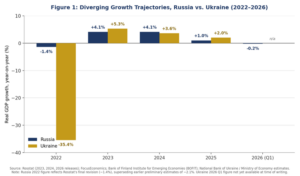
Figure 2: Diverging growth trajectories, Russia vs. Ukraine (2022–2026). Source: Rosstat; FocusEconomics; BOFIT; National Bank of Ukraine / Ministry of Economy estimates. Note: Russia’s 2022 figure reflects Rosstat’s final revision (−1.4%), superseding the earlier preliminary estimate of −2.1%.
Put the two halves of the ledger side by side and an asymmetry appears that neither government much likes to advertise. Russia’s problem is a ceiling. It mobilised its war economy years ago, and there isn’t much room left to grow output further without new capital or workers, both scarce under sanctions and wartime demographics. Ukraine’s problem is a floor. Its economy remains something like 15 to 20 per cent smaller in real terms than before the invasion, so its GDP growth numbers look larger than they actually are in absolute terms, they’re recovering from a much deeper hole, not expanding from a healthy base. Two very different economic problems, in other words, even when the headline growth percentages sit close together on a chart.
Between the Two: Where Trump’s Diplomacy Actually Fits
This is the context Trump’s diplomacy operates in, whether or not his team frames it that way publicly. US policy toward the war has effectively flipped since 2024. The Biden administration treated support for Kyiv as close to unconditional, some $175 billion in assistance by early 2024 according to contemporaneous US budget tracking. The current administration has walked back nearly every part of that: warmer relations with Moscow, no more “as long as it takes,” open talk of withdrawing support while separately squeezing Russia economically, and public skepticism about NATO’s own guarantees. Washington wants Kyiv to accept territorial concessions and has not offered any real path to NATO membership, even while quietly letting Ukraine build its own Patriot systems at home. Trump himself keeps describing both Putin and Zelensky as difficult to deal with while claiming progress behind closed doors. Read together, it looks less like confusion than a calculated hedge: pressure both sides just enough to keep a process alive, without committing to an outcome either side would actually accept.
Whether that hedge can produce peace, rather than just manage a stalemate, seems to hinge on something outside Trump’s control altogether: whether Russia’s own numbers keep deteriorating. Moscow can afford to let talks drag, or even collapse, for exactly as long as it can treat Ukrainian strikes on its energy system as a cost worth absorbing. That’s the whole ballgame, really. Early 2026’s GDP contraction is the first real sign that assumption might not hold much longer.
Table 2: Four Trajectories — Diplomacy and Missiles Together
Neither Trump’s diplomacy nor Putin’s missile campaign moves in isolation. The table below crosses the two variables against each other, since most commentary tends to discuss them separately when the real question is how they interact.
| Trajectory | Likelihood | What it would look like | What it means for Ukraine’s endgame |
| Diplomacy advances, strikes continue | Rising | Trump secures a partial ceasefire while Russia keeps hitting energy targets to preserve leverage during talks | Frozen conflict; Ukraine’s reconstruction bill keeps compounding even as fighting eases |
| Diplomacy stalls, strikes intensify | Rising | Talks collapse; both sides revert to infrastructure attrition, Omsk-style deep strikes become routine | Deeper economic war; RDNA6 (due ~Feb 2027) likely shows another jump past $588bn |
| Diplomacy advances, strikes ease | Low but not zero | A genuine, mutually verified de-escalation accompanies the talks | Best case for Ukraine’s endgame; reconstruction financing gap becomes the central postwar problem instead |
| Diplomacy stalls, strikes ease | Low | Russia pauses strikes unilaterally for reasons unrelated to the talks (e.g. its own refining constraints) | Ambiguous; would suggest Russian capacity constraints matter more than Trump’s diplomacy |
Author’s analytical assessment, based on trends identified in Table 1, Figure 1 and Figure 2, as of July 2026. Likelihood classifications reflect qualitative judgment, not a formal probabilistic model or polling data.
The table’s least comfortable finding for Washington is probably the top-left cell. Even in the scenario where Trump’s diplomacy is working, on its own terms, strikes continuing through a partial ceasefire still leaves Ukraine’s reconstruction bill compounding in the background. A ceasefire stops the war from getting worse militarily; it does not, by itself, stop RDNA6 from posting another increase over $588 billion when it’s published, probably around February 2027. Peace, in other words, and an end to Ukraine’s economic endgame are not automatically the same event.
Conclusion
Set side by side, Russia’s fuel crisis and Ukraine’s reconstruction bill tell a story neither government’s public messaging quite captures. Russia can still outlast Ukraine militarily, but its fiscal cushion is thinner than it was even a year ago, and Q1 2026’s contraction suggests that cushion is now actually shrinking rather than merely plateauing. Ukraine can still impose real cost on Russian energy infrastructure through its drone campaign, but it is rebuilding against a bill that grows faster than any single ceasefire could plausibly pay down. Trump’s diplomacy sits between these two trends rather than above them. It isn’t steering the outcome so much as narrating it. The more useful question for anyone watching this war closely, at this point, probably isn’t what Washington proposes next. It’s whether Moscow’s balance sheet or Kyiv’s reconstruction bill gives way first. Whichever number breaks first will likely decide what any settlement actually looks like.
References:
Bank of Finland Institute for Emerging Economies (BOFIT). “Russia’s GDP Growth Last Year Higher than Expected; Lower Growth Ahead.” BOFIT Weekly Review, February 2024.
Castellum.ai / Center for Strategic and International Studies (CSIS). “How Sanctions Have Reshaped Russia’s Future.” CSIS Analysis, February 2025.
European Commission / EU Neighbours East. “Fourth Rapid Damage and Needs Assessment in Ukraine: Total Cost of Reconstruction and Recovery Estimated at €506 Billion.” February 2025.
Fischer, Sabine. “‘Everything about Ukraine without Ukraine’: Peace Negotiations in Trump’s Brave New World.” SWP Comment No. 14/2025, German Institute for International and Security Affairs, April 2025.
FocusEconomics. “Russia GDP Outlook: Current Forecast.” Consensus Forecast Data, updated 2026.
Government of Ukraine, Cabinet of Ministers. “Ukraine’s Recovery Needs Estimated at USD 486 Billion: Updated RDNA3.” 15 February 2024.
Interfax. “Russian GDP Grows 4.1% in 2024, as in 2023 — Rosstat.” Interfax News, 2025.
Joyce, Philip, and Olha Krupa. “Budgetary Responses by the USA to Support Ukraine during and after the War.” Public Money & Management, 2024.
Katz, David J. “Toward a Strategic Art for Sanctions.” Parameters 54, no. 1 (2024).
Ministry for Development of Communities and Territories of Ukraine. “Ukraine’s Restoration Needs over the Next Ten Years Will Amount to US$588 Billion.” 23 February 2026.
Modern Diplomacy. “Is the Russian Economy Strong or Just Under Pressure?” Modern Diplomacy Briefing, April 2026.
Prokopenko, Alexandra. “Permanent Crisis Mode: Why Russia’s Economy Has Been So Resilient against Sanctions.” ZOiS Report 4/2023, Centre for East European and International Studies, Berlin, November 2023.
World Bank Group / Government of Ukraine / European Commission / United Nations. “Third Rapid Damage and Needs Assessment (RDNA3): February 2022–December 2023.” 15 February 2024.
World Bank Group / Government of Ukraine / European Commission / United Nations. “Fourth Rapid Damage and Needs Assessment (RDNA4): February 2022–December 2024.” UNDP, 25 February 2025.
World Bank Group / Government of Ukraine / European Commission / United Nations. “Fifth Rapid Damage and Needs Assessment (RDNA5): February 2022–December 2025.” UNDP/World Bank, 23 February 2026.
News outlets (Kyiv Post, Euronews, CNBC, RBC-Ukraine, News.az, the Moscow Times), field reporting on the Omsk refinery strike (6–7 July 2026) and the Crimea/Sevastopol fuel crisis (September 2025–July 2026); individual articles available on request.