The Two-Track Model Reshaping Power in Africa
Western debates over African security remain focused on visible power: troops, bases, and flags. The central question is usually framed as a contest over territorial influence: whether Russia is displacing Western actors in the Sahel, or whether Western governments can regain lost ground. Yet durable leverage is increasingly built not through territorial presence but through control over economic corridors, resource flows, and the information that governs them.
In many African states, resource income moves through a hybrid landscape of formal institutions and entrenched elite networks: military factions, brokers, border operators, business intermediaries, and quasi-state actors. Control over production figures, transport routes, customs revenues, and export volumes is not merely an economic advantage. It shapes how rents are distributed, which coalitions gain influence, and which actors are marginalized. Monitoring production and logistics therefore does more than improve compliance. It restructures power.
A recent audit identified approximately $16.8 billion in underreported mining revenue in the Democratic Republic of Congo between 2018 and 2023. The figure predates any specific private initiative, yet it illustrates the scale of informational asymmetry embedded within extraction economies. In such environments, control over information becomes a source of political leverage in its own right.
Initiatives associated with Erik Prince in the Democratic Republic of Congo and Haiti illustrate an emerging model of intervention in fragile states. This is no longer the classic private military company. Instead, security provision, revenue administration, and intelligence collection are increasingly being integrated into a single operational architecture.
Agreements concluded in 2025 transformed what initially appeared to be isolated private security engagements into a broader experiment in corridor governance. In Congo, entities associated with Prince have been linked to efforts aimed at combating mining sector underreporting and smuggling, securing logistics corridors, and deploying ISR capabilities to monitor production and exports. In Haiti, security deployments have increasingly been discussed alongside customs and fiscal-administration functions. The significance of this model lies not in the individual actor but in the convergence of functions that were once separated between military contractors, customs agencies, and intelligence services.
Control over real production figures and transport routes becomes a structural advantage in intra-elite bargaining. It can alter how rents are allocated, weaken established patronage networks, and generate resistance from actors whose off-book income streams are threatened. The political significance of such systems therefore extends well beyond efficiency or anti-corruption. They reshape the balance of power within the state itself.
This model depends on remaining formally private. Institutional distance from U.S. policy enables access to informal circuits that would narrow if such ventures were overtly integrated into Washington’s critical-minerals strategy or sanctions machinery. The trade-off is structural: tighter political ownership reduces operational access to the gray zones where rents are generated and increases exposure to geopolitical backlash.
Running alongside this model is a different track.
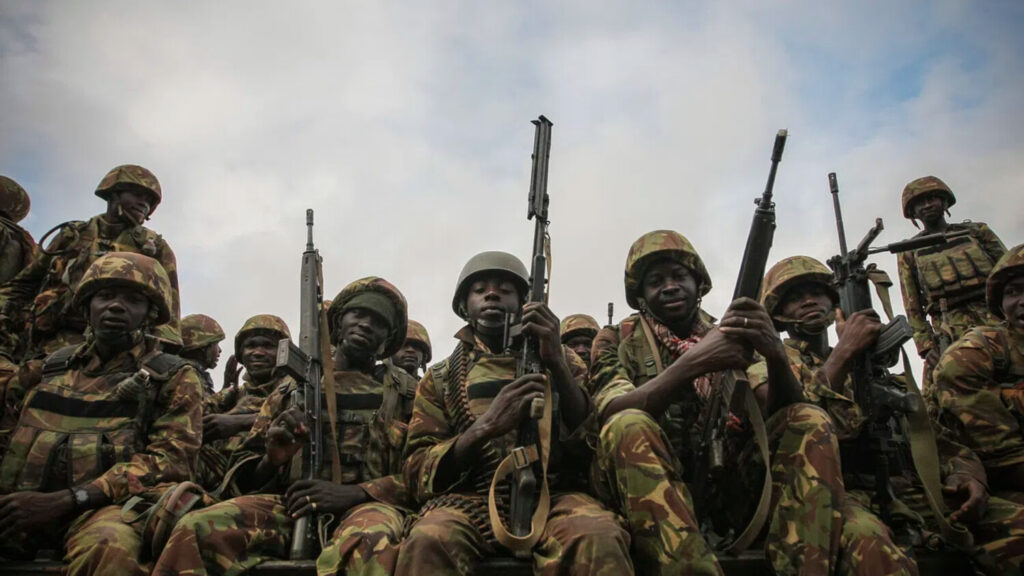
In the Sahel, Russia’s presence has become increasingly institutionalized. Africa Corps operates as an official arm of the Russian state and remains focused primarily on regime security. Its mission centres on military assistance, training, protection of strategic sites, and support for allied governments.
Russian personnel also protect selected mines, logistics nodes, and transport routes. Yet these activities remain extensions of the security mission rather than components of a broader system for governing economic flows. The central limitation of the Russian model is not military effectiveness but institutional scope. Security can preserve a regime. It cannot by itself govern the economic circuits that sustain it.
There is limited evidence that Moscow has developed a comparable framework integrating production monitoring, export oversight, revenue administration, and intelligence collection into a unified instrument of influence. Africa Corps has increasingly shifted toward escort and protection duties on key supply routes—a reactive posture that illustrates the limits of its mandate. Tactical protection has not translated into structural control over the financial lifelines it was ostensibly deployed to secure.
Economic flows are addressed tactically through the protection of specific assets and routes rather than through sustained management of the systems that generate and distribute rents. Mali illustrates the ceiling of this approach: while the regime’s security core has been reinforced, transport arteries remain vulnerable and attacks on commercial convoys continue to expose the fragility of corridor governance based primarily on force protection.
What is emerging is a two-track configuration.
The first track is coercive and state-anchored. It ensures regime survival and operates within formal chains of command.
The second track is rent and information driven. It operates across extraction sites, logistics corridors, customs systems, and export routes, shaping who controls the flows that finance coercion itself. Its durability depends on how far entrenched interests are willing to tolerate external intrusion into existing revenue structures.
This is not a story of Russia being forced out. It is a story of structural segmentation; different external actors increasingly occupy different layers of the same political economy. The key geopolitical divide is no longer between those who control territory and those who do not. It is increasingly between actors that provide security and actors that govern flows. In the emerging political economy of intervention, those who govern flows ultimately shape the choices of those who merely provide security.