The Sudan War’s Impact on African Diaspora Arts and Culture
The Civil War in Sudan has not received the global attention it deserves.
Although suffering should never be compared, racism often determines whose lives are seen as ‘valuable’. This disparity is evident when comparing the international response to Sudan with that to Ukraine. Russia’s illegal invasion of Ukraine displaced millions and killed over 100,000 people, prompting swift action from Western governments (Cooper, Helene 2022). The United Kingdom alone accepted over 200,000 Ukrainian refugees, and global fundraisers raised more than $10 billion in two months (Global Citizen Stand Up for Ukraine 2022). This response proves that rapid action is possible when political will exists.
Recently, President Trump captured the president of Venezuela, Nicolás Maduro. This action could lead to the deployment of U.S. ground troops in the country. In addition, during the conflict with Iran, a bombing reportedly struck a girls’ school, killing more than 175 people, mostly middle school girls (Democracy Now 2026). The bombing raised international concern and criticism. The situation escalated further when Iran’s Supreme Leader, Ayatollah Ali Khamenei, was killed during airstrikes connected to the conflict. Following these events, the Trump administration did not rule out the possibility of a ground invasion of Iran. This will bring even less media attention to what is already the world’s worst humanitarian crisis.
This is not Sudan’s first Civil War. In February 2003, the Darfur Civil War broke out against the Sudanese government, driven by Arab-backed militia groups known as the Janjaweed. This conflict, much like the current one, suffered from the same issues. During the Darfur War, global media attention was minimal because the Iraq War dominated headlines. In June 2004, the United Nations and international officials labeled the conflict in Darfur “the world’s worst humanitarian crisis” (Maggie Farley 2004). Reports included murders, abductions, village burning, and widespread looting. More than 100,000 Sudanese were killed, and over one million fled to neighboring Chad. Due to international pressure, Secretary of State Condoleezza Rice and the CIA pushed for a peace agreement known as the Sudan Comprehensive Peace Plan.
In 2025, the RSF (Rapid Support Forces) replaced the Janjaweed. The RSF are the primary perpetrators of these mass atrocities. Many RSF members trace their origins to the Janjaweed (Elian Peltier and Abdi Latif Dahir, 2023). Those who fail to learn from history jeopardize the future. Once again, Sudan faces one of the worst humanitarian crises in the world: widespread human rights violations, cholera outbreaks, war crimes, sexual violence, torture, and extrajudicial executions. More than 13 million people have been displaced by the most recent conflict (Al Jazeera, 2025).
Beyond the humanitarian crisis, Sudan faces the destruction of its cultural heritage. Thousands of artifacts and ancient sites dating back over 4,000 years have been looted or destroyed. This heritage is not only vital to the Sudanese people but to the global African diaspora. Many Black Americans have been taught, through a racist education system, that Africa had no history before slavery. This false narrative fuels internalized racism and perpetuates myths of Black inferiority.
Many Black Americans struggle with internalized racism, reinforced by a racist, systemic education system that falsely teaches that Africans had no history before the transatlantic slave trade. In the United States, many textbooks portray Africa as a “dark continent” with no history, knowledge, or innovation. This lie causes psychological harm and encourages the acceptance of inferiority, even when it is self-destructive. Florida state representative Kimberly Daniels has even claimed, “I thank God for slavery. If it wasn’t for slavery, I might be somewhere in Africa worshipping a Tree” (David Bauerlein 2023). This reflects a widespread misconception in America and around the world that Christianity did not exist in Africa until Europeans arrived to colonize it.
In reality, northern Sudan includes the ancient city of Old Dongola, founded in 600 AD, which served as the capital of Christian kingdoms (Livia Gershon 2021). The Smithsonian Museum has documented a cathedral in Sudan that is over 1,000 years old, long before European colonization.
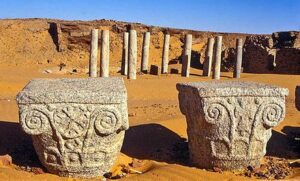
The Church of the Granite Columns in Old Dongola
Africans were kidnapped not to expand Christianity, but for capitalist reasons. One of the main reasons Africans were targeted was herd immunity. Africa, Europe, and Asia had long been exposed to diseases such as smallpox, whooping cough, chickenpox, and mumps (Gilbert, Erik, and Jonathan T Reynolds 2012). Before scientific advancement, herd immunity was the only defense available, and many Africans, Europeans, and Asians died as a result.
When Europeans arrived in the Americas, these diseases decimated Indigenous populations, particularly in the Caribbean where there had been no prior exposure. Secondly, Africans possessed advanced agricultural knowledge. They knew how to cultivate crops in different soil conditions, unlike Indigenous populations, who did not practice the agriculture Europeans wanted to impose. West Africans had thousands of years of farming experience with the crops Europeans wanted, and these crops were therefore kidnapped and brought to South America, North America, and the Caribbean. Clearly, the exploitation of African labor succeeded in economic terms, as it propelled the United States into becoming the richest country in the world.
Lastly, Africans were chosen because West Africa was geographically closer to the Caribbean than Europe or Asia. The Atlantic Ocean was the primary means of transportation, and Cape Verde, off the coast of West Africa, was one of the closest points to the Caribbean. The transatlantic slave trade was rooted in economics.
Sudan’s cultural heritage has been severely damaged by widespread looting. Sudan Cultural Museum estimates that around 60% of the artifacts from Sudan’s National Museum have been stolen (Eissa Dafallah, 2026). The looting of cultural artifacts in the region dates back to prehistoric times, including the Paleolithic era. For example, Sudanese mummies dating back more than 2,000 years have been taken. In recent years, stolen items from Sudan have even been sold online through platforms such as eBay (Eissa Dafallah, 2026). These priceless artifacts are essential for understanding Sudan’s history and its contributions to the world.
The preservation of these cultural and historic sites plays a crucial role in Sudan’s economy. Once the Sudan Civil War ends, the country will face limited options for economic recovery. One of the most promising opportunities is tourism. For example, the Giza Pyramids in Egypt generate $15 billion in revenue annually (Hatem Maher, 2025), and National Geographic has documented that Sudan has twice as many pyramids as Egypt. Tourism revenue could help rebuild schools, hospitals, and homes for Sudanese communities.
However, Sudan’s ancient pharaohs, pyramids, and hieroglyphics are under threat. The deliberate destruction of heritage sites by the Rapid Support Forces not only endangers the nation’s identity but also erases historic truths that empower people of African descent worldwide. The Pharaoh Taharqa Statute was looted during the Sudan War. Pharaoh Taharqa was mentioned in the Bible as “Tirhakah” in 2 Kings 19:9. This plays a huge role in Sudanese history. Sudan is also the birthplace of pottery dating back 8,000 years and contains hieroglyphics over 3,000 years old within its pyramids.
This history must be protected. Preserving Sudan’s cultural heritage is essential not only for the country’s future but also for restoring dignity, historical awareness, and self-worth to the African diaspora.
Bibliography
Cooper, Helene. “Russia and Ukraine Each Have Suffered over 100,000 Casualties, the Top U.S. General Says.” The New York Times, 2022, www.nytimes.com/2022/11/10/world/europe/ukraine-russia-war-casualties-deaths.html.
Global Citizen. “$10.1B of Impact Announced at Stand up for Ukraine.” YouTube, 9 Apr. 2022, www.youtube.com/watch?v=MGo2_kR2L88. Accessed 1 Apr. 2026.
Democracy Now. “Who Bombed Girls’ School in Iran? Reporter Nilo Tabrizy on What We Know about Massacre, 175 Killed.” Democracy Now!, 4 Mar. 2026, www.democracynow.org/2026/3/4/nilo_tabrizy.
Farley, Maggie. “How a Crisis Catches World’s Attention.” Los Angeles Times, 28 Oct. 2004, www.latimes.com/archives/la-xpm-2004-oct-28-fg-crisis28-story.html. Accessed 1 Apr. 2026.
Peltier, Elian, and Abdi Latif Dahir. “Who Are the Rapid Support Forces, the Paramilitaries Fighting Sudan’s Army?” The New York Times, 17 Apr. 2023, www.nytimes.com/2023/04/17/world/africa/paramilitary-rsf-explainer.html.
Jazeera, Al. “Millions Displaced as Sudan War Enters Third Year.” Al Jazeera, 15 Apr. 2025, www.aljazeera.com/gallery/2025/4/15/millions-displaced-as-sudan-war-enters-third-year.
Bauerlein, David. “State Rep. Kim Daniels Says State Must Change Message of Black History Standards.” The Florida Times-Union, Florida Times-Union, 30 July 2023, www.jacksonville.com/story/news/local/2023/07/30/florida-house-member-says-black-history-message-is-wrong/70476422007/. Accessed 1 Apr. 2026.
Gershon, Livia. “Ruins of Monumental Church Linked to Medieval Nubian Kingdom Found in Sudan.” Smithsonian Magazine, 9 July 2021, www.smithsonianmag.com/smart-news/ruins-large-nubian-church-found-sudan-180978136. Accessed 1 Apr. 2026.
Gilbert, Erik, and Reynolds, Jonathan T. Africa in World History. Pearson College Division, 1 July 2012.
Dafallah, Eissa. “Museums Looted of Priceless Artifacts as Sudan Counts the Cost of a Deadly Conflict.” NBC News, 8 Mar. 2026, www.nbcnews.com/world/africa/museums-looted-priceless-artifacts-sudan-counts-cost-deadly-conflict-rcna260473.
Maher, Hatem. “Egypt Hopes Vast New Museum by the Pyramids Will Accelerate Tourism Revival.” Reuters, 30 Oct. 2025, www.reuters.com/world/africa/egypt-hopes-vast-new-museum-by-pyramids-will-accelerate-tourism-revival-2025-10-30/.