The Donroe Doctrine: Geoeconomic Conditionality and the New Logic of American Power
What do seemingly different forms of US intervention—from military operations to financial assistance—tell us about the evolution of American geopolitical strategy?
The term ‘Donroe Doctrine’ was coined in 2025 but quickly adopted by the US president himself to describe the new American foreign policy purporting to reassert American dominance in the Western Hemisphere (Bell, 2026). It takes its name from the Monroe Doctrine, an approach employed by James Monroe to establish American pre-eminence in the Latin American region. While Monroe in the 19th century was concerned with European colonisers in the Americas, Donald Trump appears to be wielding a similar approach but based on his ‘America First’ principles and a reduced reliance on multilateral institutions to be proactive (Ali, 2026).
For many, Trump’s willingness to intervene directly in Latin America represents a direct and sobering threat. The European Council on Foreign Relations, after the kidnapping of Venezuelan President Nicolas Maduro, stated that Europe in 2026 faces a more unilateral and unpredictable US foreign policy based on domestic interests (Aydintasbas and Herrmann, 2026). The events of the days that preceded sustain this idea, but also overlook an equally important development; the increasing fusion of military and financial means into a single framework of US geopolitical influence.
The Donroe Doctrine represents more than a simple revival of the Monroe Doctrine. Instead, it removes obfuscation surrounding the newly developing model of American statecraft. Military intervention and financial assistance are increasingly deployed as complementary instruments of geopolitical influence, with access to American power becoming implicitly conditional upon political and ideological alignment. Rather than assessing interventions in isolation, global observers should recognise this broader pattern of geoeconomic conditionality, which is redefining and recontextualising investment incentives, sovereign risk, PRI and military might throughout Latin America and the Western Hemisphere more broadly.
From Military Intervention to Geoeconomic Conditionality
In historical instances of US interventions and relations in Latin America, power was largely exercised through two channels: military intervention and diplomacy (Chu et al., 2026). Increasingly, the current form of the Donroe Doctrine is including financial rescue packages (Wells, 2025), sanctions (Stewart, 2026), currency support (Norton, 2025) and investment incentives (Iglesia, 2025). In order to benefit from these new tools of intervention while avoiding the negative impacts of sanctions, we are increasingly seeing Latin nations bending to or being rent by this ‘Geoconomic Conditionality’. This is the use of financial or military assistance that is contingent upon political and ideological alignment with US strategic interests. There has been a rippling wave of right-wing, pro-Trump candidacies in Latin America in recent years including in Peru, Colombia Chile and Ecuador alongside the premier example in Argentina, indicating the influence of this new form of US statecraft (Stewart, 2026).
Venezuela: Military Power as Economic Statecraft
Trump’s first usage of geoeconomic conditionality in 2026 was not subtle. On January 3rd, US special forces invaded Caracas and captured Venezuelan President Nicolas Maduro and extricated him to the United States (Ali, 2026). Trump has repeatedly invoked ‘America First’ principles for much of his erratic-seeming decision making with Venezuela being no exception; Maduro was charged with drug trafficking and narco-terrorism threatening the US within hours of his capture (Slack et al., 2026).
A domestic motivator for the intervention was Trump’s political signalling; his repeated aggressive posturing surrounding his desire for acquiring Greenland that was largely dismissed by the international community, including threats to annexe the country by military force, appeared much more valid and imposing after the intervention in Venezuela (Bell, 2026).
His rhetoric now reinforced by displayed willingness to brandish economic pressures and military heft, Trump sent signals of intent to other international heavyweights. This American pre-eminence in the Western hemisphere was exacted by Trump with military fervour for domestic interests but also to establish unquestionable American regional dominance.
The immediate consequences of Maduro’s kidnapping were striking. Trump’s claim that the US would ‘run’ Venezuela caused significant diplomatic tensions (Este, 2026). This was due to the lack of international validity of the intervention as Venezuela did not pose a clear military threat to the US and international permission for cross-border force was not sought, sending the international community into disarray about how to manage this new, aggressive US foreign policy (Matkovic, 2026).
This uncertainty led to limp condemnation that ensured Trump’s actions did not abolish sovereignty from an uneven regional distribution, but illustrate that sovereignty can be set aside without consequence for certain states (Ibid. 2026). The sovereign risk that followed this was matched only by the surge in demand for Political Risk Insurance. Firms considering investment sought increased protection due to concerns over expropriation, political violence and instability possible in the wake of US intervention that the Trump administration would have been well aware of (Francisco, 2026).
The intervention illustrates that military force is increasingly employed alongside economic considerations to influence political outcomes and reshape investment conditions within the US sphere of influence.
Argentina: When Financial Support Becomes Political Leverage
Ahead of the October midterm elections in Argentina, the US offered a lifeline to President Javier Milei. Argentina was in the midst of a liquidity crisis resulting predominantly from the 40% drop in the value of the peso in 2025 and investor confidence in the country was rapidly dwindling as they burned through their foreign currency reserves at a lightning pace (Norton, 2025). Milei’s electoral position, from conditions generated by his ‘chainsaw austerity’ had become increasingly precarious.
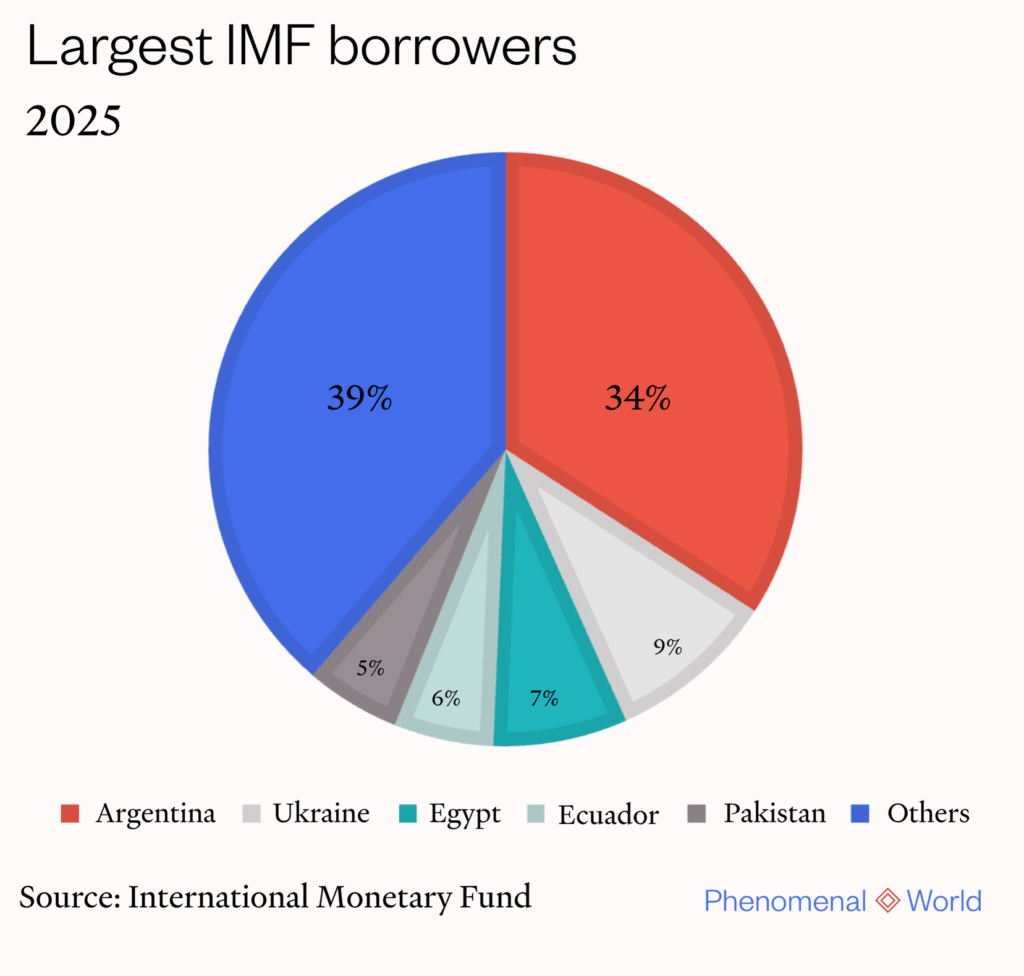
This chart clarifies Argentina’s willingness to entertain US economic intervention due to significant financial precariousness already involving external institutions.
Trump’s administration offered Milei a rescue package: a $20bn currency swap with a promise of a further $20bn in debt investment facilities (Sherman, 2025). Crucially, this second round of financial stimulus was predicated on Milei remaining in power as Argentinian leader (Wells, 2025). The growth of Milei’s strength following the landslide midterm result is widely considered a direct result of Trump’s promise and the electoral momentum it provided as a ‘bridge to the election’ to help an aligned right-wing government (Steele, 2025).
Trump’s promise and Milei’s success helped to bring investor confidence back to Argentina, as it had in Venezuela along with substantial market stabilisation (Francisco, 2025). What it also generated, however, was a precedent in which access to US financial support became closely associated with continual ideological alignment; the impetus to vote for Milei as the ‘American candidate’ grew, where the US was able to maintain close ties with an administration that would continue to be aligned. Trump wanted Milei to ‘keep political momentum’ for this reason, thusly without purely economic rationale.
This clarifies that the action was less a technocratic bailout than a geopolitical intervention, and more than a financial rescue but a test case for economic diplomacy rooted in ideological alignment. Unlike Venezuela, this intervention relied on financial leverage rather than military force, yet both pursued the same strategic objective of reshaping regional political alignment.
One Doctrine, Two Instruments
Although different on the surface, these two examples of the Donroe Doctrine in action share four key characteristics. First, they both include direct US military or financial intervention expressed clearly as having US domestic interests in mind. Second, there are political objectives to be achieved for the US in removal of alleged narco-criminals or financially bolstering an ideological ally. Third, there have been economic instruments used strategically to both weaken Chinese positions in terms of energy access in Venezuela and debt bailouts to make one political candidate more attractive to the electorate in Argentina. Finally, direct political alignment appears increasingly valuable, as Venezuela also possesses longstanding military relations with Russia and the Milei administration in Argentina has sought close proximity to the US over growing Chinese interest.
From this, we can observe that these two interventions are not isolated events, but instead represent an evolving model of integrated American statecraft in which military force, debt relief, investment and capital all become variable geopolitical tools for the US to utilise for domestic interests. This is what distinguishes the Donroe Doctrine from previous US regional policy.
The Donroe Doctrine should not be understood solely as a revival of American regional interventionism, but as a signal for the emergence of geoeconomic conditionality as an organising principle of US foreign policy. Military action and financial assistance increasingly operate as complementary tools designed to secure and sustain political alignment and regional influence.
In light of this, all observers should expand political risk assessments beyond conventional measures of conflict and sanctions. Monitoring the forms of geoeconomic conditionality attached to military assistance, financial rescue packages, investment commitments and diplomatic engagement may provide earlier and more accurate indicators of sovereign risk and investment uncertainty than traditional geopolitical analysis alone. Incorporating these dynamics into political risk frameworks will better equip decision-makers to anticipate how strategic competition increasingly shapes economic outcomes.
If the Monroe Doctrine sought to define America’s sphere of influence, the Donroe Doctrine appears to redefine the means by which that influence is exercised; the most significant political risks may no longer stem from intervention itself, but from the increasingly conditional deployment of American power.
References
Ali, S. (2026, February 11). The Donroe Doctrine—How an old policy was revived, renamed, and turned into a tool of power. Medium. https://medium.com/@owstudies/the-donroe-doctrine-how-an-old-policy-was-revived-renamed-and-turned-into-a-tool-of-power-2f1983a5a392
Bell, J. (2026, January 20). The Donroe Doctrine and the cost of foreign policy by spectacle. FPIF.
Chu, K., et al. (2026, February 28). The current chaos of US-Latin America relations.
Foroohar, R. (2025, October 13). The limits of the ‘Donroe Doctrine’. The Straits Times. https://www.straitstimes.com/opinion/the-limits-of-the-donroe-doctrine
Francisco, M. (2026, July 21). Westwood insight—Venezuela’s onshore energy reawakening post Maduro: Reality or rhetoric? Westwood. https://www.westwoodenergy.com/news/westwood-insight/westwood-insight-venezuelas-onshore-energy-reawakening-post-maduro-reality-or-rhetoric
Herrmann, C., & Aydintasbas, A. (2026, January 4). Venezuela, Trump’s ‘Donroe Doctrine’ and three dilemmas facing Europe. European Council on Foreign Relations.
Iglesia, F. (2025, November). Escape forward: Why Argentines voted for Javier Milei.
Matković, A. (2026, January 6). Maduro’s abduction and the future global order. Transnational Institute.
Norton, B. (2025, October 25). Why Trump is bailing out Argentina’s libertarian leader Javier Milei with $40 billion.
Ott, A. (2026, January 15). It’s geoeconomics, stupid. Verfassungsblog. https://verfassungsblog.de/greenland-geoeconomics/
Sherman, N. (2025, October 31). The US bet big on Argentina bailout—is it paying off? BBC News. https://www.bbc.co.uk/news/articles/c4g3mdvle78o
Slack, D., et al. (2026, January 5). What is Maduro charged with and what is the evidence? BBC News. https://www.bbc.co.uk/news/articles/cwyndnqqey5o
Steele, G. (2025, December). What tariffs and the Argentina bailout can tell us about the perils of financial statecraft. Just Security. https://www.justsecurity.org/125738/what-tariffs-and-the-argentina-bailout-can-tell-us-about-the-perils-of-financial-statecraft/
Stewart, P. (2026, July 9). From ‘America First’ to ‘Donroe Doctrine?’ Trump’s Latin America pivot raises eyebrows. The Independent. https://www.independent.co.uk/news/world/americas/us-politics/trump-monroe-doctrine-colby-latin-america-b3011685.html
The Conversation. (2026, January 6). The ‘Donroe Doctrine’: Maduro is the guinea pig for Donald Trump’s new world order. https://theconversation.com/the-donroe-doctrine-maduro-is-the-guinea-pig-for-donald-trumps-new-world-order-272687
Wells, I. (2025, October 27). Argentina elections: Javier Milei and his ‘chainsaw’ austerity win big. BBC News. https://www.bbc.co.uk/news/articles/c4gw8qpyvqdo