Techno-Economic Evaluation of Hydrogen Fuelled Turbines in India’s Electricity Transition
Assessing the economic viability of hydrogen turbine for grid-scale energy storage in India
India’s pursuit of its national energy security goals of reaching 500 GW of non-fossil fuel electrical capacity by 2030 has precipitated radical changes in India’s national grid framework (CEA, 2023). Though Solar PV and Wind have emerged as inexpensive, emissions-free sources of electric generation, their power production profiles can fluctuate based on weather patterns and diurnal cycles. This inconsistency can be overcome for short durations by battery energy storage systems; however, there is a requirement for large-scale and long-duration energy storage capacity that can dispatch large amounts of power over longer durations (days), when the variability is expected (days of no wind or persistent clouds). Within this evolving energy landscape, hydrogen-fuelled gas turbines present a vital technical alternative. The process involves capturing excess renewable power during periods of low grid demand and running it through water electrolysers to create green hydrogen. This hydrogen is then compressed, stored in large tanks or underground formations, and combusted in gas turbines when grid demand surges or renewable generation drops. By upgrading the country’s existing fleet of natural gas turbines to run on clean hydrogen, grid operators can secure reliable energy without building new coal-fired units or relying on volatile, imported natural gas markets.
Techno-Economic Framework of Hydrogen Generation
To evaluate the economic feasibility of hydrogen-fuelled electricity generation, we look at its levelized cost of electricity (LCOE), which is the total net present value of operational costs divided by the total amount of electricity generated over the full life of the generation plant. The financial model can be broken down into three main cost components:
- Capital Costs (CAPEX): This includes the initial investments required to build water electrolysis units, construct high-pressure hydrogen storage tanks , and retrofit existing natural gas turbines with special combustors capable of safely consuming hydrogen at high volumes.
- Operational Expenses (OPEX) and Fuel Supply: The day-to-day cost of running a hydrogen turbine facility is dominated by the purchase price of the hydrogen itself. Because green hydrogen currently trades at high price points in India, fuel alone accounts for roughly three-quarters of the total lifetime operational expenditure of a hydrogen power plant (Biswas & Yadav, 2024).
- Round-Trip Efficiency: This metric tracks total energy loss across the entire system by measuring the cumulative amount of energy that is lost when converting power into hydrogen via electrolysis, during gas transport and storage, and again when combusting the hydrogen to spin a turbine generator. The total round-trip efficiency of a green hydrogen gas turbine setup typically ranges between 35% and 45%, meaning more than half the original electrical energy is lost in conversion (IRENA, 2022). Despite lower round-trip efficiency compared to batteries, hydrogen turbines offer distinct economic advantages when storing energy at scale. Expanding the capacity of an electrochemical battery system requires purchasing expensive additional battery cells, causing costs to rise linearly with storage size. In contrast, expanding a hydrogen storage system requires larger storage vessels or underground storage facilities, making it far cheaper to store large volumes of energy over long durations.
Comparative Economic Evaluation
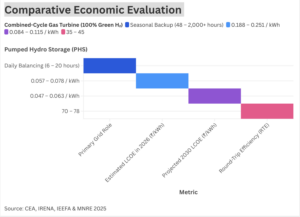
To understand where hydrogen turbines fit within India’s broader grid strategy, they must be benchmarked directly against Pumped Hydro Storage (PHS)—currently the cheapest and most commercially mature long-duration energy storage technology operating at utility scale. Pumped hydro energy storage offers a much cheaper form of generation, but typically requires long development lead times, faces significant issues with environmental permitting, and has tight geographical constraints, including requirements for suitable mountain terrain and a supply of water. Hydrogen turbines can offer flexibility, can be built on a variety of different site types, and benefit from direct use of the grid infrastructure and the sites of existing gas power stations (IRENA, 2022). The chart below provides the comparative economic evaluation.
Critical Commercial and Infrastructure Bottlenecks
Transitioning hydrogen-fuelled power generation from small-scale pilots to commercial utility application in India faces three primary operational hurdles:
- Delivered Fuel Price Premium: The greatest obstacle to economic feasibility is the cost of green hydrogen fuel. If hydrogen-powered turbines are to reach a target electricity cost of less than ₹10 per kilowatt-hour, then green hydrogen has to be supplied to the power plants at a price of ₹150 per kilogram ($1.50/kg) or below (Gulia et al., 2024). Present domestic market prices are more than twice the amount of this target figure. Unless production costs do drop considerably, it will remain financially difficult for power distribution companies to operate hydrogen turbines for basic grid support.
- Technical and Combustion Limitations: Standard natural gas turbines cannot operate on pure hydrogen unless they undergo substantial technical modifications. Hydrogen has a flame temperature that is much higher than that of natural gas and burns with a flame propagation speed almost seven times faster. Because of these physical characteristics, there are risks involved in the form of flame flashback, intense thermal wear of the internal turbine blades, and a greater amount of harmful Nitrogen Oxide emissions being produced. Modern utility gas turbines can burn a blend of up to 20% hydrogen with natural gas with only minor hardware adjustments. A shift to pure hydrogen fuel, however, requires more substantial modifications, including: special dry low-Nytrogen Oxide (DLN) combustor, advanced cooling systems, and improved internal metallurgy (IRENA, 2022).
- Transport and Logistics Infrastructure: Since hydrogen has a low physical density, transporting it over long distances is complicated and costly. The process of moving compressed hydrogen gas in special tube trailers along highways results in considerable delivery expenses. Delivery logistics will keep increasing fuel prices unless there is a dedicated network of pipelines connecting the areas where renewable energy is generated, the green hydrogen manufacturing plants, and the thermal power stations.
Strategic Policy Recommendations and Solutions
To reduce costs and to create a viable operating environment for hydrogen power generation in India, policy initiatives and market reforms should go hand in hand with technical developments.
- Mandate Incremental Co-Firing Targets: The Ministry of Power ought to set mandatory targets for the blending of green hydrogen in natural gas power plants that are already in operation, starting with a requirement for a 5 per cent blend by 2027 and increasing this to 20 per cent by 2030. Such a clear regulatory requirement will provide green hydrogen producers with a steady and foreseeable buyer base and at the same time motivate plant operators to slowly upgrade their equipment without having to make large initial capital outlays.
- Establish Capacity Remuneration Markets: Generators in the Indian wholesale markets are paid on how much energy in kWh is fed to the grid. Hydrogen turbines predominantly serve the purpose of providing flexible peak power when needed, during critical periods, or when renewable energy sources do not provide enough power for the grid. These operate for a low number of hours each year and cannot cover their operating costs within an energy market-based system. Therefore, a Capacity Remuneration Mechanism (CRM) needs to be introduced under the Central Electricity Regulatory Commission (CERC). Under a capacity market system, operators of power plants receive fixed payments for keeping their generation capacity available to help maintain grid stability, which in turn ensures their long-term financial viability.
- Develop Co-Located Energy Parks: The government should provide incentives for the development of integrated hydrogen energy hubs in major industrial areas, for example in the coastal regions of Gujarat and Tamil Nadu. Co-locating renewable power generation, water electrolysis plants, hydrogen storage facilities, and converted gas power stations within a single site eliminates the requirement for long-distance transport, allows the use of the same power connections, and can reduce final fuel delivery costs by as much as 30%.
- Extend Inter-State Transmission System Waivers: The Ministry of New and Renewable Energy (MNRE) is currently granting waivers on the Inter-State Transmission System (ISTS) charges for projects involved in the production of green hydrogen. These exemptions from transmission charges should be extended to clean energy generation facilities that supply electrolysers devoted to utility-scale energy storage. This would reduce the total cost of operating long-duration grid storage assets. India will be able to systematically lower the cost of hydrogen energy storage by introducing blending mandates, setting up capacity remuneration mechanisms, and supporting the co-location of infrastructure. This strategic move will enable the country to transform its current natural gas assets into a solid, low-carbon foundation for ensuring the security of the national grid.
Conclusion
Hydrogen-powered gas turbines provide a feasible means of producing dispatchable, low-carbon electricity while at the same time keeping the power grid stable. Even though the cost of fuel is a short-term obstacle, the expansion of electrolyser manufacturing and the introduction of supportive market arrangements will enhance the economic competitiveness of this approach. By incorporating hydrogen turbines into its long-term plans for capacity expansion, India can protect its power grid and speed up its shift to clean energy.
References
Biswas, Tirtha and Deepak Yadav. 2024. Green Hydrogen: India’s Billion-Dollar Opportunity. India’s Energy Revolution. Routledge eBooks. https://doi.org/10.4324/9781003281818
CEA (2023) Report on Optimal Generation Capacity Mix for 2029-30. New Delhi: Central Electricity Authority (CEA), Ministry of Power, Government of India. https://cea.nic.in/wp- content/uploads/irp/2023/05/Optimal_mix_report__2029_30_Version_2.0__For_Uploading.pdf
CEEW. (2024). How Can Hydrogen Electrolysers Be Made in India? https://www.ceew.in/sites/default/files/how-can-india-indigenise-and-boost-domestic-hydrogen-electrolyser-manufacturing.pdf
Gulia, J., Gupta, K., Garg, V. and Konda, C. (2024) India’s $2.1bn leap towards its green hydrogen vision. New Delhi: Institute for Energy Economics and Financial Analysis (IEEFA). Available at: https://ieefa.org/resources/indias-21bn-leap-towards-its-green-hydrogen-vision
IRENA (2022) Green hydrogen for industry: A guide to policy making. Abu Dhabi: International Renewable Energy Agency (IRENA). Available at: https://www.irena.org/-/media/Files/IRENA/Agency/Publication/2022/Mar/IRENA_Green_Hydrogen_Industry_2022_.pdf
Lei, J., Ma, H., Qin, G., Guo, Z., Xia, P. and Hao, C., 2024. A Comprehensive Review on the Power Supply System of Hydrogen Production Electrolyzers for Future Integrated Energy Systems. Energies, 17(4), p.935. https://doi.org/10.3390/en17040935
PIB (2025) Extension of Inter-State Transmission System (ISTS) Charges Waiver for Green Hydrogen and Energy Storage Projects. Press Information Bureau, Ministry of New and Renewable Energy, Government of India. Available at: https://www.pib.gov.in/PressReleasePage.aspx?PRID=2241170