Redirecting Engagement: Energy Investment as ASEAN’s Pragmatic Response to the Myanmar Crisis
Myanmar’s post-election trajectory has exposed the limits of ASEAN’s consensus-driven diplomacy while deepening China’s strategic foothold in Southeast Asia. As conflict, displacement, and regional insecurity intensify, the future of Myanmar may depend less on political isolation than on whether ASEAN can transform energy investment and economic integration into instruments of regional stability.
In January 2026, Myanmar’s military government staged a controlled electoral exercise and won, as few doubted it would. The outcome is poised to prolong a civil conflict that has already displaced 3.6 million people internally and driven another 1.5 million across borders (UNHCR, 2025). Beyond the humanitarian toll, the junta’s consolidation of power carries significant strategic consequences for the wider region. At a moment when Southeast Asia is grappling with overlapping pressures, from tensions in the South China Sea to the erosion of post-Cold War multilateral frameworks, Myanmar’s trajectory has become both a test and an opportunity for ASEAN.
ASEAN’s Fragmented Response and China’s Strategic Opening
ASEAN’s response to the February 2021 coup was neither swift nor unified. The Five-Point Consensus, negotiated in April 2021 and endorsed by the European Union, represented a rare attempt at collective diplomatic pressure. Yet when Myanmar’s junta repeatedly failed to honour its commitments, particularly the cessation of armed conflict, the bloc’s only recourse was to exclude the junta from regional summits for three consecutive years. Exclusion without enforcement, however, is not leverage; it is symbolism. ASEAN’s sustained preference for dialogue-based, soft-pressure diplomacy produced no measurable change in the junta’s conduct and offered no meaningful accountability for the devastating human costs of the conflict.
The economic dimension compounds the crisis. Myanmar’s economy has contracted by an estimated 18 percent since the coup (Global Finance Magazine, 2026), yet the burden has fallen disproportionately on civilians and on neighbouring states absorbing refugee flows, cross-border illegal labour networks, and the spillover effects of Myanmar’s growing role as a hub for online scam operations. These are now recognised regional security problems and ones that ASEAN, by its own structural design, has proven unable to address.
Member states remain divided in their post-election posture. Cambodia, Thailand, and Vietnam prioritise negotiated settlement between warring parties; the Philippines has signalled readiness to engage the junta directly; Singapore and Malaysia are preoccupied with maritime security and the anticipated refugee crisis respectively; Brunei and Timor-Leste have outright condemned the results; while Indonesia focuses on preventing further escalation. This fragmentation is not merely a diplomatic inconvenience; it is a structural vulnerability that China has been quick to exploit.
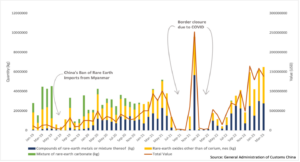
Fig. 1: China’s Rare Earth Imports from Myanmar
Source: China Global Newsletter (in Inclusive Development International)
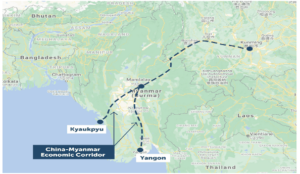
China’s engagement with Myanmar operates on an entirely different logic, one unburdened by normative conditions, sanctions architecture, or democratic prerequisites. Beijing extends investment, technology, and military support to Naypyidaw under a single condition: political stability. The China-Myanmar Economic Corridor exemplifies this approach: a $15 billion-plus infrastructure project connecting Yunnan Province to the Kyaukphyu deep-sea port, firmly embedding Myanmar within the Belt and Road Initiative and pushing China’s total approved investment past $21 billion (Abb, 2025; Myers, 2020). Myanmar’s rare earth reserves, valued at over USD 624 million in annual exports, and its petroleum gas supplies, already flowing through the completed Sino-Myanmar Oil and Gas Pipelines since 2017 (Sin, 2024; China Global Newsletter, 2023), make this partnership strategically indispensable for Beijing. Crucially, the Kyaukphyu port provides China with direct maritime access to the Indian Ocean, reducing its dependence on the Strait of Malacca, a chokepoint through which roughly 80 percent of Chinese oil imports have historically transited (Abuza, 2023). By securing this partnership, China has surpassed India, which has long sought comparable influence over Myanmar’s energy sector.
Fig 2: Belt Initiative Road: Route Between China and Myanmar
Source : Tearline/NGA
Beijing has also simultaneously leveraged its position as a conflict broker: in late 2024, China brokered ceasefire deals between the Myanmar military and armed groups in northern Shan State, including the MNDAA and TNLA, that had disrupted key China-Myanmar trade routes (Martin & Hogan, 2025). This action, for Beijing, is not a normative aspiration but an operational requirement for maintaining the functions of Belt and Road assets.
Development as Prevention: The Case for Energy Investment
Given prevailing political realities, regime change in Myanmar is not a realistic near-term objective. ASEAN’s primary strategic concern must therefore shift to preventing further conflict escalation, a trajectory that risks destabilising shipping lanes, intensifying refugee flows into Malaysia and Thailand, and extending humanitarian crises into Bangladesh and India. In this context, ASEAN would do well to take a page from China’s playbook: investment as statecraft.
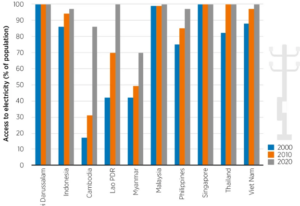
Myanmar’s electricity sector presents an under-examined but strategically significant entry point. The country faces a severe internal deficit in electricity supply and access, a structural vulnerability that the junta itself has acknowledged by establishing a dedicated Ministry of Electricity and Energy. Yet Myanmar continues to struggle with weak governance capacity and opaque market entry procedures that deter foreign investment (Vakulchuk et al., 2020). This gap is precisely where ASEAN can act and where its existing frameworks offer a credible foundation.
Fig 3: Comparison of Access to Electricity in 10 ASEAN countries
Source: International Renewable Energy Agency
ASEAN already has the institutional scaffolding to move. The Financing ASEAN Power Grid programme, a $7 billion cross-border connectivity initiative targeting completion by 2040, demonstrates that regional energy cooperation is not aspirational but operational. The success of the Lao PDR–Thailand–Malaysia–Singapore Power Integration Project further validates multilateral electricity trade as a proven model (International Energy Agency, 2026). Integrating Myanmar more substantively into these initiatives would transform it from a peripheral actor into a strategic energy node, creating economic interdependencies that reduce the incentives for continued conflict.
Importantly, ASEAN’s foundational principle of non-interference, often cited as a constraint, can be reframed here as a constructive diplomatic tool. Rather than directly confronting the junta, ASEAN can redirect Myanmar’s governance priorities toward productive cooperation. This requires sustained, structured engagement among international donors, the ASEAN epistemic community, and prospective investors, all working collectively with Myanmar’s government on a blueprint for strengthening institutional capacity in electricity sector governance, with a focus on building transparent, efficient, and investor-friendly regulatory frameworks for permits and sector management.
Investors are the most critical stakeholder group in this dialogue. Their contribution extends well beyond capital: it encompasses the infrastructure requirements for scaling electricity production, mechanisms for knowledge transfer, and the bridge between local human capital and the technical and managerial expertise that external partners bring. ASEAN should also actively cultivate partnerships with foreign investors beyond the region, particularly Central European countries that have demonstrated growing engagement with Asia and deep expertise in renewable energy. Between 2019 and 2024, these countries nearly increased their cumulative solar output sixfold, from 5 TWh to 29 TWh (Ember, 2025), a trajectory that offers both financing potential and scalable technical knowledge for Myanmar’s energy transition. Sustained and structured dialogue must continue until Myanmar’s government demonstrates the governance maturity needed to provide clear, efficient, and transparent procedures for foreign investors, thereby unlocking the country’s considerable energy potential for poverty reduction and human development, to the benefit of its people and the broader region alike.
Bibliography
- Abb, P. (2025) ‘The China-Myanmar Economic Corridor and the Limits of China’s BRI Agency’, The Diplomat, 3 February. Available at: The Diplomat.
- Abuza, Z. (2023) ‘Zoned out: China-Myanmar Economic Corridor still going nowhere’, Radio Free Asia, 30 September. Available at: Radio Free Asia.
- Ember (2025) Turning to the Sun: Solar Rise in Central Europe. Available at: Turning to the Sun: Solar Rise in Central Europe PDF.
- Global Finance Magazine (2026) Myanmar GDP and Economic Data. Available at: Myanmar GDP and Economic Data.
- ‘Chinese Investment in Myanmar After the Coup’ (2023) China Global Newsletter, Edition 8, May. Inclusive Development International. Available at: China Global Newsletter Edition 8.
- International Energy Agency (IEA) (2026) Financing the ASEAN Power Grid. Paris: IEA. Available at: Financing the ASEAN Power Grid.
- International Renewable Energy Agency (IRENA) (2023) Socio-economic Footprint of the Energy Transition: Southeast Asia. Abu Dhabi: IRENA. ISBN 978-92-9260-534-6. Available at: Socio-economic Footprint of the Energy Transition: Southeast Asia.
- Martin, P. and Hogan, L. (2025) ‘China brokers ceasefire deal between Myanmar junta and rebel group’, ABC News, 21 January. Available at: ABC News article.
- Myers, L. (2020) ‘The China-Myanmar Economic Corridor and China’s Determination to See It Through’, Wilson Center: Asia Dispatches, 26 May. Available at: Wilson Center article.
- Sin, K. (2024) ‘Securing the China-Myanmar Economic Corridor: Navigating Conflicts and Public Scepticism’, ISEAS Perspective, No. 79, 4 October. Singapore: ISEAS – Yusof Ishak Institute. Available at: ISEAS Perspective 2024 No. 79 PDF.
- Tearline/National Geospatial-Intelligence Agency (NGA) (2024) China’s Investments in Myanmar: Analyzing the Status of Key Projects. Available at: China’s Investments in Myanmar report.
- United Nations High Commissioner for Refugees (UNHCR) (2025) Global Trends: Forced Displacement in 2024. Geneva: UNHCR. Available at: Global Trends: Forced Displacement in 2024.
- Vakulchuk, R., Chan, H-Y., Kresnawan, M.R., Merdekawati, M., Overland, I., Sagbakken, H.F., Suryadi, B., Utama, N.A. and Yurnaidi, Z. (2020) ‘Myanmar: How to Become an Attractive Destination for Renewable Energy Investment?’, ASEAN Centre for Energy Policy Brief, No. 09. Jakarta: ASEAN Centre for Energy (ACE). Available at: DOI link.