NATO’s 2026 Ankara Summit: Beyond the 5% Pledge
NATO’s Ankara Summit centred on whether the alliance’s recent defence spending commitments are translating into tangible military capabilities. While allies demonstrated progress in defence investment and support for Ukraine, the gathering also exposed entrenched institutional challenges over burden-sharing, industrial capacity, strategic cohesion, and the alliance’s long-term direction.
A Summit Defined by Delivery
European allies and Canada increased core defence investment by more than USD 139 billion in 2025 alone, representing a year-on-year increase of almost 20%. Updated NATO estimates released ahead of the summit placed combined European and Canadian core defence spending at 2.53% of GDP in 2026, compared with 2.3% in 2025 and 1.4% in 2014 (NATO, 2026). This acceleration represents a significant shift in allied defence policy, effectively compressing a decade of incremental increases into a two-year period. However, the alliance remains nearly one percentage point below the 3.5% core defence spending benchmark agreed for 2035. The challenge ahead is therefore moving beyond budget expansion towards the more complex task of sustaining long-term procurement cycles, strengthening defence-industrial capacity, and ensuring that increased spending produces operationally relevant capabilities.
The summit’s most consequential developments emerged from the parallel Defence Industry Forum rather than the leaders’ meeting itself. Convened on 7 July, the forum generated more than USD 50 billion in new procurement agreements focused on deep precision strike capabilities, integrated air and missile defence, uncrewed systems, and intelligence capabilities (NATO, 2026). The decision to channel major capability announcements through an industry-focused forum rather than the political declaration is strategically significant. The latter reflects a growing recognition within the alliance that credibility will increasingly depend on tangible military output and industrial capacity, while symbolic commitments alone will carry limited and insufficient weight, particularly from Washington’s perspective.
Taken together, the summit’s political and operational tracks indicate a deliberate separation between alliance reassurance and capability delivery. The political track continues to reinforce cohesion by reaffirming collective defence commitments and maintaining a unified strategic posture, with the operational track designed to demonstrate that increased burden sharing is producing concrete military resources.
As disparities over defence contributions remain a central source of transatlantic friction, this distinction between political signalling and capability generation is likely to remain a defining feature of future NATO summits.
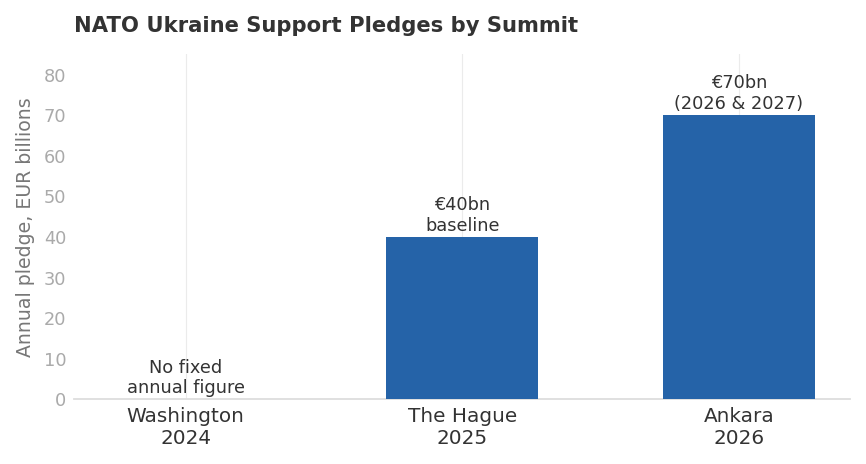 Figure 1: NATO Core Defence Spending, 2026 Estimates, % of GDP. Source: NATO (2026)
The 5% Pledge and Its Gaps
The 2025 Hague framework’s division of the 5% spending target carries critical political and strategic implications, as the structure was likely necessary to secure unanimous approval among allies while also introducing a measurement challenge because the headline commitment may not translate into equivalent increases in vital military capability across all members. By 2025, all 32 NATO members had exceeded the previous 2% defence spending benchmark, a milestone that took nearly a decade to achieve following the Wales Summit in 2014. This highlights the speed and scale at which political commitment has shifted since 2022 compared with the slower pace at which defence-industrial capacity can adapt (Daniels, 2026).
The distribution of spending across the alliance is more strategically significant than the overall average. Five members, Lithuania (5.33%), Estonia (5.11%), Latvia (4.92%), Poland (4.68%), and Greece (3.65%), have already exceeded the 3.5% core defence threshold established for 2035, increasing from three members the previous year (Daniels, 2026). These figures correspond closely with geographic exposure to Russia and Belarus and demonstrate the emergence of a de facto two-speed alliance. Frontline states are increasingly adopting defence postures shaped by long-term deterrence requirements and worst-case planning assumptions, while many western and southern allies remain closer to traditional peacetime defence models.
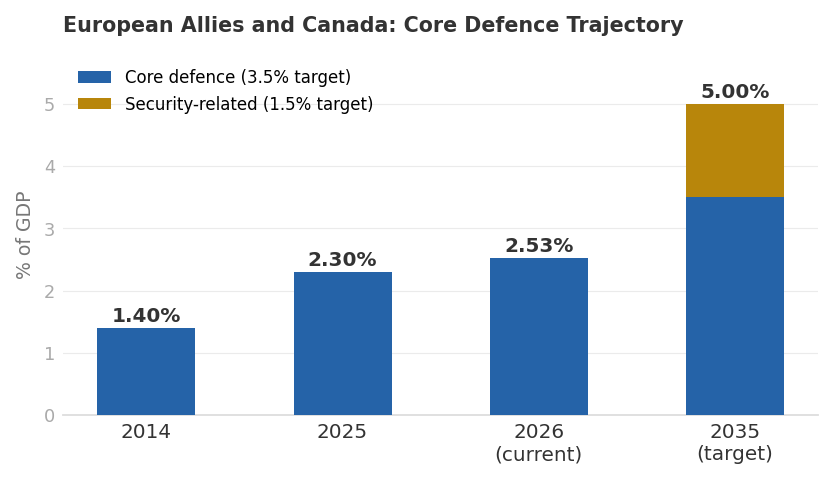 Figure 2: European Allies and Canada, Core Defence Trajectory (% of GDP). Source: NATO (2026)
Beyond the spending commitments themselves, the summit exposed deeper tensions over how burden-sharing should be enforced and politically managed. Washington’s pressure on Spain demonstrated the possibility of using bilateral economic coercive measures to influence alliance-level defence commitments, raising questions about whether such approaches could challenge NATO’s traditional consensus-based mechanisms. Renewed US interest in Greenland foregrounded a separate but related dilemma: the difficulty of preserving alliance cohesion when strategic priorities intersect with questions of sovereignty among members. Turkey’s role as host mirrored this broader pattern, showing NATO’s continued willingness to accommodate politically difficult but strategically important allies when maintaining organizational unity remains the overriding priority.
Ukraine’s Expanded Role
Ukraine’s position at Ankara marked a shift from the ambivalence of previous summits. The final declaration described Ukraine as contributing to ‘transatlantic security’, language NATO has historically reserved for prospective members under Article 10, though it stopped short of the ‘irreversible path’ formulation used at the 2024 Washington summit.
Allies pledged €70 billion in military equipment, assistance, and training for Ukraine in 2026, with a sovereign commitment to sustain at least equivalent levels in 2027, financed entirely by European allies and Canada. A proposal to fix Ukraine assistance at a standard 0.25% of members’ GDP was rejected by five states, including the United Kingdom, leaving the burden-sharing formula unresolved beyond the headline figure (Koval, 2026). Washington’s most consequential gesture was non-financial: President Trump indicated the United States would grant Ukraine a licence to manufacture Patriot air defence systems domestically, a step assessed as more strategically significant for Kyiv’s long-term air defence capacity than any single dollar figure.
In sum, these major decisions represent a managed middle path between full alliance integration and limited partnership. By positioning Ukraine as a transatlantic security contributor without extending Article 5 guarantees, NATO can incorporate Kyiv’s battlefield experience while limiting the risk of geopolitical escalation. The European and Canadian funding model for the €70 billion pledge also reinforces the burden-sharing approach Washington seeks across the alliance, while the Patriot licence signals a long-term commitment to embedding Ukraine within Europe’s defence-industrial architecture. Rather than temporary assistance, the Ankara outcomes suggest the gradual construction of a durable security and intelligence ties that provide many benefits of accession while leaving formal membership unsettled (Dubenko, 2026).
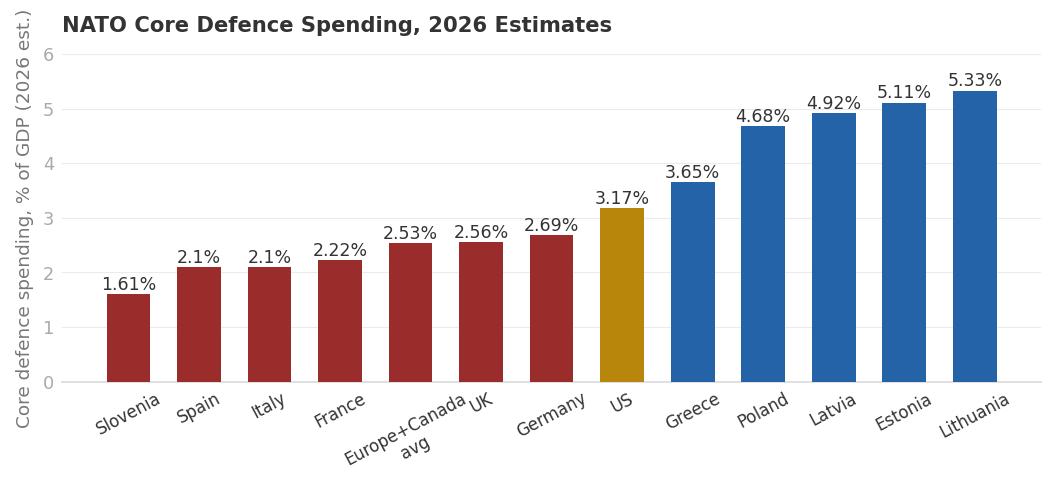 Figure 3: NATO Ukraine Support Pledges by Summit Year. Source: NATO (2026)
Strategic Outlook
Three dynamics will shape NATO’s trajectory after Ankara. First, the durability of the defence spending surge remains ambiguous, as current commitments rely on national implementation rather than binding obligations, with the 2029 review creating a potential point of political divergence among less committed allies. Second, the future of the US military posture in Europe remains unresolved, as pending force reviews and limited adjustments place greater pressure on European allies to demonstrate both the capacity and political will to absorb a reduced American role (Hertling, 2026). Third, Ukraine’s position within the alliance is likely to deepen through expanded security cooperation, but the membership question remains constrained by the lack of consensus and internal unanimity. The absence of a confirmed date or location for the next summit introduces additional uncertainties over NATO’s strategic trajectory (Jozwiak, 2026). Arguably, Ankara produced measurable and tangible commitments; whether it generated lasting institutional direction remains the key question for 2027.
References
Daniels, S. (2026) ‘What does NATO defense spending look like heading into the Ankara Summit?’, Center for Strategic and International Studies, 6 July. Available at: https://www.csis.org/analysis/what-does-nato-defense-spending-
Dubenko, L. (2026) ‘€140B for Ukraine, Patriot license and Trump drama: what came out of NATO’s Ankara summit’, Kyiv Post, 8 July. Available at: https://www.kyivpost.com/analysis/79865
Hertling, M. (2026) ‘The NATO defense spending canard’, The Bulwark, 8 July. Available at: https://www.thebulwark.com/p/the-nato-defense-spending-canard-…
Koval, N. (2026) ‘The Ankara NATO summit – a reality check on words and deeds’, Kyiv Independent, 11 July. Available at: https://kyivindependent.com/the-ankara
NATO (2026). The Ankara Summit Declaration, NATO official text, 8 July. Available at: https://www.nato.int/en/about-us/official-texts-and-resources/…
NATO (2026). Defence expenditure of NATO countries (2014–2026). Available at: https://www.nato.int/content/dam/nato/webready/documents/finance21/
Jozwiak, R. (2026) ‘NATO’s ‘tremendous unity’ and other takeaways from the summit in Turkey’, Radio Free Europe/Radio Liberty, 8 July. Available at: https://www.rferl.org/a/nato-unity-takeaways-summit-turkey-rut…