Inside the Mekong Cyberscam Corridor: Myanmar, Cambodia, Laos
This piece discusses that the Myanmar–Cambodia–Laos corridor has become a major hub for transnational organized crime. As enforcement intensifies, criminal networks increasingly disguise themselves as legitimate businesses, posing serious investment and governance risks across Southeast Asia.
The Myanmar–Cambodia–Laos corridor has increasingly evolved from a traditional route of human mobility and cross-border commerce into a strategic hub for transnational organized crime. This transformation presents a growing challenge to human security across Southeast Asia and beyond, as criminal networks exploit weak governance, porous borders, regulatory loopholes, and digital technologies to expand illicit activities.
Over the past decade, border areas and special economic zones within these countries have become focal points for cyber-enabled criminal enterprises, including online gambling, money laundering, financial fraud, identity theft, phishing operations, and large-scale scam centers. International organizations have identified the region as one of the world’s fastest-growing centers for cyber fraud, generating billions of dollars in illicit revenues annually while targeting victims across Asia, Europe, North America, and Oceania.
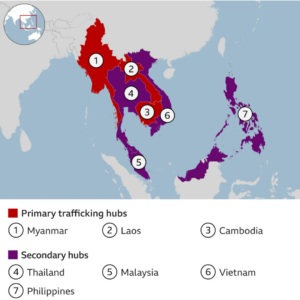
Picture from Perera and Praithongyaem (BBC)
A “Spider Web” of Scam Hubs in Southeast Asia
Most of these networks are controlled by the Chinese mafia with significant capital, who find it difficult to operate such businesses in their home country, so they work together with local gangs in many countries in Southeast Asia (IISS, 2025; The Guardian, 2025). A key feature of these operations is their reliance on human trafficking and labor exploitation. Criminal organizations recruit workers from neighboring countries—including Indonesia, the Philippines, Vietnam, and Thailand—through fraudulent employment schemes. An estimated 305,000 individuals were unlawfully engaged in cyberfraud activities based in the Mekong region in 2023 (The Guardian, 2025). Victims are often promised legitimate jobs in tourism, customer service, hospitality, or technology sectors but are subsequently transported to scam compounds where they are forced to participate in online fraud and illegal gambling operations. These practices blur the line between cybercrime and modern slavery, creating a complex law enforcement and humanitarian challenge.
The persistence of these networks reflects deeper structural vulnerabilities within Southeast Asia. High youth unemployment, limited economic opportunities, labor migration pressures, and uneven levels of (digital) literacy increase susceptibility to fraudulent recruitment and financial scams (Davy, 2023). At the same time, criminal organizations capitalize on public demand for rapid financial gains through investment fraud, bank account hacking, online gambling, and other deceptive schemes. Consequently, both workers and consumers become vulnerable to exploitation within the same criminal ecosystem.
Technological developments further amplify the threat. Criminal groups increasingly employ artificial intelligence (AI), deepfake technologies, voice-cloning systems, and automated communication tools to enhance the sophistication of scams (UNODC, 2024). These technologies enable criminals to impersonate family members, government officials, financial institutions, or business representatives with increasing accuracy, making detection and prevention significantly more difficult. As a result, cyber-enabled fraud has become a rapidly evolving security threat with transnational implications in Southeast Asia.
Another concern is the reported convergence between cybercrime, human trafficking, and other illicit markets. Although evidence regarding direct links to organ trafficking remains limited and difficult to verify independently, multiple investigations have documented severe forms of abuse against trafficked workers, including physical and psychological violence and debt bondage, if they fail to complete the targets . These practices even demonstrate that the issue extends far beyond financial crime and even constitutes a seriously illegal organ removal and trafficking (The Strait Times, 2024).
Cyberfraud Revenue in the Mekong Region – 2023
Looking ahead, one of the most significant emerging risks is the potential transformation of scam-based criminal networks into seemingly legitimate business entities. As governments intensify enforcement efforts and international scrutiny increases, criminal organizations may increasingly adopt legal corporate structures to conceal the illicit origins of their operations, given annual revenues of each country reaching around $5-$20 billion only on 2023 (The Guardian, 2025). Through their investments in sectors such as legal casinos, tourism, real estate, entertainment, technology services, logistics, and special economic zone developments (Naing, 2025), these networks may create a veneer of legitimacy while continuing to benefit from illicit revenues.
This evolution presents a substantial governance and investment risk. By operating under legally registered companies and business ventures, criminal organizations may attract foreign investors, commercial partners, and financial institutions that are unaware of the true nature of their activities. The integration of illicit capital into the formal economy not only facilitates money laundering but also creates significant reputational, regulatory, and financial risks for host countries. More importantly, it allows criminal actors to become embedded within legitimate economic structures, making them increasingly difficult to identify and dismantle.
Over time, the normalization of such business models could contribute to the emergence of a parallel economy in which legal and illegal activities become deeply intertwined. This risks undermining market integrity, distorting investment flows, weakening regulatory oversight, and creating incentives for corruption among officials responsible for licensing, investment approvals, and law enforcement. In the worst-case scenario, criminal enterprises could evolve from isolated scam operations into influential economic actors capable of shaping local business environments, influencing governance structures, and exploiting legal frameworks while maintaining a façade of legitimacy.
The adaptive nature of these networks further complicates enforcement efforts. When one operational center is dismantled, activities can quickly relocate across borders, diversify into new sectors, or re-emerge under different legal and commercial identities. Consequently, isolated national responses are unlikely to achieve sustainable outcomes.
Without stronger regional coordination and sustained vigilance from both governments and private-sector stakeholders, the Myanmar–Cambodia–Laos corridor is likely to remain a major center of transnational organized crime. Beyond the immediate human security implications, the gradual integration of criminal capital into the formal economy may emerge as a significant source of foreign investment risk, with consequences for market integrity, regulatory credibility, and long-term economic stability across Southeast Asia.
Thus, for foreign investors, these developments underscore the importance of adopting a more cautious approach when assessing business opportunities in high-risk sectors and jurisdictions across the region. As criminal organizations increasingly seek to legitimize their operations through formal corporate structures, investors should not rely solely on regulatory approvals or company-provided information. Instead, independent assessments conducted by their own legal and compliance teams may become increasingly necessary. Such reviews should examine a company’s ownership structure, business activities, financial performance, profit and loss records, and operational history over several years to identify inconsistencies or indicators of potential exposure to illicit activities. Particular attention should be paid to sectors such as real estate, tourism, entertainment, digital services, logistics, and businesses operating within special economic zones, where the integration of illicit capital into legitimate economic activities may be more difficult to detect.
References
Davy, D. (2023) Casinos, cyber fraud and trafficking in persons for forced criminality in Southeast Asia: Policy Brief – Summary Overview. Bangkok: United Nations Office on Drugs and Crime (UNODC) Regional Office for Southeast Asia and the Pacific. Available at: https://www.unodc.org/roseap/uploads/documents/Publications/2023/TiP_for_FC_Summary_Policy_Brief.pdf (Accessed: 8 June 2026).
International Institute for Strategic Studies (IISS). (2025) ‘Regional Spotlight: Asia’, in Armed Conflict Survey 2025. London: IISS. Available at: https://www.iiss.org/publications/armed-conflict-survey/2025/armed-conflict-survey-2025/regional-spotlight-asia/ (Accessed: 8 June 2026).
Naing, S. (2025) ‘What are Southeast Asia’s scam centres, and why are they being dismantled?’, Reuters, 4 March. Available at: https://www.reuters.com/world/asia-pacific/what-are-southeast-asias-scam-centres-why-are-they-being-dismantled-2025-03-04/ (Accessed: 9 June 2026).
Perera, S. and Praithongyaem, I. (2024) ‘My hell in Myanmar cyber slavery camp’, BBC News, 21 April. Available at: https://www.bbc.com/news/articles/cw076g5wnr3o (Accessed: 10 June 2026
The Guardian. (2025) ‘Age of the “scam state”: how an illicit, multibillion-dollar industry has taken root in south-east Asia’, The Guardian, 2 December. Available at: https://www.theguardian.com/technology/2025/dec/02/scam-state-multi-billion-dollar-industry-south-east-asia (Accessed: 8 June 2026).
The Straits Times. (2024) ‘Trafficking victims in Myanmar forced to sell organs, says charity’, The Straits Times, 12 November. Available at: https://www.straitstimes.com/asia/se-asia/trafficking-victims-in-myanmar-forced-to-sell-organs-charity (Accessed: 8 June 2026)
United Nations Office on Drugs and Crime (UNODC). (2024) ‘Billion-dollar cyberfraud industry expands in Southeast Asia as criminals adopt new technologies’, UNODC Regional Office for Southeast Asia and the Pacific, 7 October. Available at: https://www.unodc.org/roseap/en/2024/10/cyberfraud-industry-expands-southeast-asia/story.html (Accessed: 8 June 2026).