Ceasefire Or Pause? Why Europe Cannot Guarantee What It Cannot Enforce
European constraints in supporting Ukrainian security commitments
False Truce
During the Orthodox Easter, April 20th 2026, Vladimir Putin announced a temporary ceasefire (aljazeera, 2026). Although lasting for only 32 hours, both sides have accused each other of thousands of violations. This is not an isolated incident. In March of 2026, Russia launched an average of over 200 drones per day in their routine attacks on Ukrainian civilian life. UK Ambassador to the OSCE Neil Holland stated, “This relentless increase stands in contrast to Ukraine’s consistent call for a permanent ceasefire. A call the Kremlin continues to reject” (Holland, 2026). Can EU leaders guarantee a settlement and create a security framework to bind the party that has historically demonstrated its unwillingness to honour agreements?
Frozen In Time, Yet To Be Resolved
The Korean armistice of 1953 is a perfect example of what happens if peace is poorly designed, a conflict frozen in time. No formal peace treaty was signed (UNC, no date). The Korean peninsula remains one of the most militarized borders on earth, although being contained, peace has not formally been reached to this day, technically meaning that the two countries are still at war. A ceasefire without a political resolution postpones the conflict, resetting it without lowering the threat. In the case of the Ukraine war, Russia will have a chance to gather resources and prepare for a greater attack. Considering Ukraine’s geography, the Korean case should be strategically alarming for Europe.
The 2014 and 2015 Minsk agreements were signed to end the conflict in Donbas. However, three days after the Minsk II was signed, Russian-financed separatist forces occupied Debaltseve. Russia implemented no provisions as Western mediators allowed the country to maintain a fiction of non-involvement, making it structurally impossible to enforce anything against it. Although Ukraine also failed to implement political provisions, the ECFR notes this was structurally impossible under continued Russian military presence (ECFR, 2024). Considering that Russia has disregarded the Minsk agreement on multiple occasions, Ukraine cannot solely rely on Russia’s “parchment promise” (Carnegie, 2025). Putin declared Minsk dead in February 2022, after launching the full-scale invasion, exposing the agreement to be just a tactical pause.
Exhausted, But Not Defeated
The Russian full-scale invasion of Ukraine has now entered its fifth year, making it the longest conventional war on European soil since World War II, and it has had a massive toll on the population. In 2022, 73% of Ukrainians believed that the country should continue fighting until it wins the war; however, in 2025, the number dropped to 24% (See Figure 1; Gallup, 2025).
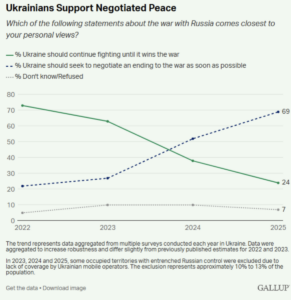 Source: Gallup (2025), ‘Ukrainian Support for War Effort Collapses.
This is not a sign of weakness or defeat, but honest exhaustion after years of drone and missile attacks, heavy casualties on the battlefield, economic strain and no visible end. The shift towards negotiations is clear and legitimate, but Ukrainians maintain a strong position on the NATO/EU membership future and are unwilling to allow Russia to recognise occupied territory (Zelenskyy, 2025). The gap between exhaustion and capitulation is narrowing with each day of the war, and only strong external mediation can bring a fair peace to Ukraine.
Russia Against The Consensus
Moscow has publicly voiced its demands for any peace settlement, for Ukraine not to join NATO, international recognition of the occupied territory and all sanctions lifted. Considering that Russia explicitly refused NATO-like security guarantees for Ukraine and rejected any involvement of on-the-ground peacekeeping presence, it exposes the EU’s proposed frameworks as unenforceable even before the formal talks have begun. As Carnegie noted, Russian commitments are no more than a “parchment promise” (Carnegie, 2025). In order to achieve a working security guarantee mechanism, it must be pre-agreed, legally binding and immune to external interferences like veto power or Russian consent.
No Middle Ground
The deeper issue of the whole negotiating process and any single agreement lies in the incompatibility of Russian demands and Ukraine’s red lines. Zelenskyy categorically refuses to remove NATO membership from the table (Zelenskyy, 2025). This is a categorical contradiction that no compromise can solve, as one side will have to capitulate. Both sides are approaching negotiations with fundamentally incompatible frameworks, pushing their demands beyond what the opponent can accept. To prevent managed ambiguity from being mistaken for progress, Western mediators must publicly define non-negotiable red lines before entering formal talks.
A Promise Without Enforcement
Even if an agreement were reached, the EU lacks a reliable enforcement mechanism. Through unanimous voting, any single state can use their veto power to block military action should Russia resume military aggression towards Ukraine. Hungary alone has wielded its veto 19 times since 2011, since 2022 using it in particular to block sanctions against Russia (CER, 2025). Additionally, Russia’s explicit rejection of a European peacekeeping presence inside Ukraine complicates it even further, leaving enforcement in the hands of the party it is meant to constrain. Zelenskyy identified this issue in his speech during the Munich Security Conference in February 2025: “This is why we cannot just agree to a ceasefire without real security guarantees, without pressure on Russia, without a system to keep Russia in check” (Zelenskyy, 2025). The collective security responses reform through qualified majority voting is not a long-term plan but an immediate and crucial foundation for any guaranteed commitments to Ukraine.
A Framework Built To Fail
The EU cannot guarantee what it cannot enforce against a party that is known for not honouring the agreements it signs. The EU and US are directly responsible, as the leading guarantors of the rule-based international order, for placing terms that will withstand both time and political pressure. Ukrainian exhaustion is real, and the pressure for a deal is growing, but without structural guarantees, it is only a matter of time before the war erupts again. Without reforming its own decision-making architecture first, any security guarantees the EU promises to Ukraine will be no more than parchment promises.
Bibliography:
Al Jazeera (2026) ‘Russia-Ukraine Orthodox Easter ceasefire begins’, Al Jazeera, 11 April. Available at: https://www.aljazeera.com/news/2026/4/11/russia-ukraine-orthodox-easter-ceasefire-begins [Accessed: 01.05.2026].
Carnegie Endowment for International Peace (2025) ‘In the Shadow of the Minsk Agreements: Lessons for a Potential Ukraine-Russia Armistice’, February. Available at: https://carnegieendowment.org/research/2025/02/ukraine-russia-ceasefire-security-agreement [Accessed: 01.05.2026].
Centre for European Reform (2025) ‘Does EU enlargement require voting reform?’ Available at: https://www.cer.eu/insights/does-eu-enlargement-require-voting-reform [Accessed: 30.04.2026].
European Council on Foreign Relations (2024) ‘Ukraine, Russia and the Minsk agreements: a post-mortem’. Available at: https://ecfr.eu/article/ukraine-russia-and-the-minsk-agreements-a-post-mortem/ [Accessed: 30.04.2026].
Holland, N. (2026) ‘Russia’s approach to the Easter ceasefire demonstrates its contempt for peace: UK statement to the OSCE’, UK Government, 16 April. Available at: https://www.gov.uk/government/speeches/russias-approach-to-the-easter-ceasefire-demonstrates-its-contempt-for-peace-uk-statement-to-the-osce [Accessed: 01.05.2026].
United Nations Command (no date) ‘Armistice negotiations 1951–1953’. Available at: https://www.unc.mil/History/1951-1953-Armistice-Negotiations/ [Accessed: 01.05.2026].
Vigers, B. (2025) ‘Ukrainian support for war effort collapses’, Gallup, 7 August. Available at: https://news.gallup.com/poll/693203/ukrainian-support-war-effort-collapses.aspx [Accessed: 29.04.2026].
Zelenskyy, V . (2025) ‘I really believe that time has come: the Armed Forces of Europe must be created’ — speech by the President at the Munich Security Conference, Office of the President of Ukraine, 15 February. Available at: https://www.president.gov.ua/en/news/viryu-sho-cej-chas-nastav-neobhidno-stvoriti-zbrojni-sili-ye-96089 [Accessed: 30.04.2026].
Further reading (not cited):
Lough, J. (2024) ‘Four scenarios for the end of the war in Ukraine’, Chatham House, 16 October. Available at: https://www.chathamhouse.org/sites/default/files/2024-10/2024-10-16-scenarios-end-war-ukraine-lough.pdf
UCL News (2025) ‘Are Ukrainians ready for a ceasefire and concessions? Here’s what the polls say’, March. Available at: https://www.ucl.ac.uk/news/2025/mar/comment-are-ukrainians-ready-ceasefire-and-concessions-heres-what-polls-say
Ukrainska Pravda (2025) ‘Poll reveals Ukrainians support 30-day ceasefire but firmly reject Russia’s demands’, 25 March. Available at: https://www.pravda.com.ua/eng/news/2025/03/25/7504415/