Europe’s Fracture Line: Political Fragmentation in the EU
This piece examines how rising political fragmentation across EU member states is affecting the Union’s institutional capacity to act, with a particular focus on the resulting investment and competitiveness costs.
European democracy is not dying quietly. It is fragmenting loudly, and the consequences for the European Union’s (EU) capacity to govern are more dangerous than any single electoral shock.
Democratic backsliding, regression, the rise of illiberal democracies, the exploitation of social cleavages through exclusionary narratives- these are all major concerns that Brussels needs to address. But the deepest, perhaps most enduring challenge to European democratic governance and therefore the EU is the emergence of political fragmentation.
The fracturing of political power into so many different parties and groups is making it difficult for democratic governments to deliver effective governance. But what does this mean for the EU and its capacity to act?
Formally, the EU’s institutions remain intact; the Commission issues directives, the Parliament votes, the Council convenes. Informally, however, the foundations that make European governance functional- coherent and stable national governments capable of building consensus- is quietly eroding. With this challenge at Brussels’ front door, the question facing not only the insitutions’ officials but analysts and investors alike is no longer whether European democracy is under threat, but whether the EU can bridge this fracture line, whether the institutions’ capacity to act remains effective when so many of its member states cannot govern themselves.
This is not a story about the rise of extreme policies, nor about “Euroscepticism” in the abstract. It is a political risk story; one about institutional capacity, collective action failure, and the measurable consequences for investment, regulatory coherence, and the EU’s strategic credibility at a moment when it can least afford uncertainty. It is a story about what Habermas once called the condition in which the nation-state is too small for the large problems of life and too large for the small ones.
Europe: A Continent of Fragile Governments
When taken as a whole, the scale of Europe’s political fragmentation is striking. Of the 44 European countries tracked by Maplecroft’s Political Risk Index, over 60% have seen government stability risk increase over the past five years. This is the highest proportion of any region globally, with nine recording spikes significant enough to warrant reclassification. The trend cuts across the continent’s economic tiers, from emerging markets like Bulgaria, Romania and Slovakia to the core economies of France, Germany and the Netherlands.
The impending causes are well-known: increasing anti-incumbency sentiment, the erosion of traditional party loyalties, and the shared perception that mainstream governments have failed to address widening inequality. Hence, analysing these well-documented causes would serve no purpose. What matters for risk assessment is the structural result of political fragmentation.
Across Europe, the political landscape has shifted toward broad but fragile coalitions creating minority governments chronically unable to deliver coherent policy. For example, Belgium’s federal government spent over 600 days in coalition deadlock before finally reaching agreement in early 2026. Similarly, in 2024 after the dissolution of the National Assembly, France had to navigate through governmental paralysis, producing what analysts described as democratic fatigue. In that same year, Germany’s coalition collapsed amid a weakening Chancellor and a recessionary economy, triggering an early federal election, exposing the limits of coalition governance in Europe’s largest economy at precisely the moment when Berlin’s strategic leadership was most needed.
Individually, domestic factors can explain each of these episodes, collectively, however, they represent an underlying and systemic issue. The consequences are already visible in economic terms: declining business sentiment across the EU due to political volatility, with companies delaying investment and hiring decisions in the face of rising uncertainty. Foreign direct investment into Europe declined 7% year-on-year in 2025, with 41% of surveyed business leaders citing geopolitical tensions and conflict as the top risk to Europe’s attractiveness, up from 27% in the previous year.
This is the investment cost of political fragmentation, and it is only gaining speed.
How Fragmentation Breaks EU Governance
We now understand the economic consequences of political fragmentation, but how does it break EU governance? As a highly interconnected region, national political dysfunction does not stay contained within national borders. It spreads throughout the continent. It travels upward, into the institutions that depend on stable government to function.
When Olaf Scholz’s coalition collapsed in late 2024, it did not merely sideline Germany domestically. It removed Europe’s largest economy from a position of strategic leadership for the better part of a year, leaving a vacuum at precisely the moment difficult decisions on Ukraine, competitiveness and enlargement required German weight behind them. Emmanuel Macron’s weakened domestic position has produced a similar effect in France, leaving the EU’s traditional Franco-German engine running on one cylinder.
Into this vacuum, other dynamics have rushed. Analysts have noted Italian Prime Minister Giorgia Meloni’s growing influence within the European Council, benefiting less from a strengthened Italian position than from the relative weakness of her counterparts. This is not a coincidence; it is structural. When core member states cannot project stable leadership, EU-level bargaining power redistributes toward whoever remains standing.
The effect is compounded by fragmentation inside the European Parliament itself. Since the 2024 elections, the traditional centrist coalition between the European People’s Party and the Socialists and Democrats has been unable to command a majority without reaching either further right or further left, depending on the issue. The result is a Parliament increasingly described by observers as weakened and reactive, a body that ratifies arbitration between national governments rather than driving legislation independently. The European Council’s overcoming of the resistance of one national leader to reach agreement is now a defining feature of EU summitry rather than an exception.
This dynamic carries direct regulatory consequences. The watering down of the EU Deforestation Regulation in December 2025, delayed for the second consecutive year following a joint vote between centre-right and far-right groups, illustrates how a fragmented Parliament increasingly defaults to delay and dilution over difficult votes. The pattern is consistent: when domestic coalitions are too fragile to absorb political risk, EU-level legislation becomes the path of least resistance for retreat.
The Investment and Competitiveness Cost
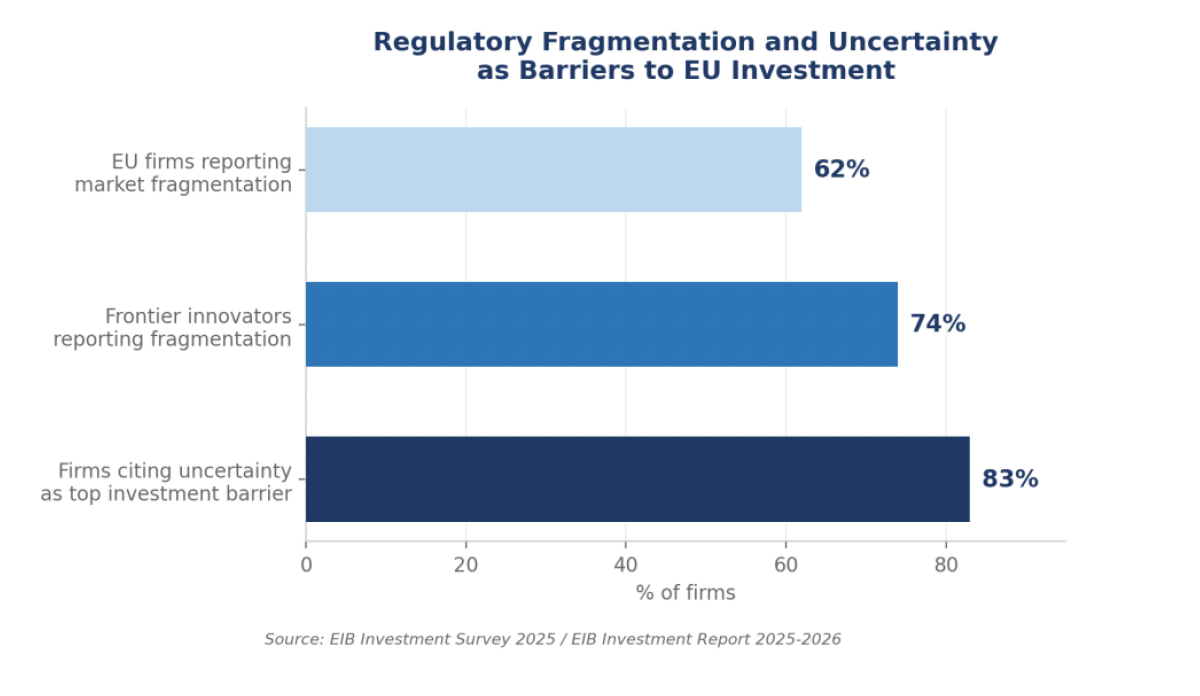
The economic consequences of this institutional strain are measurable and substantial. According to the EIB Investment Survey 2025, 62% of EU firms report that the European market remains fragmented for their main product, a figure unchanged from the previous year despite repeated political commitments to deepen the Single Market. For frontier innovators, the figure rises to 74%, with regulatory inconsistency cited as a direct barrier to cross-border expansion. The EIB’s accompanying analysis estimates that removing these barriers could boost the ratio of firm investment to assets by 10%, with even larger gains for the intangible investment that underpins EU innovation.
This is not a marginal inefficiency. EU firms currently spend the equivalent of 1.1% of turnover navigating regulatory compliance, rising to 1.8% for small and medium enterprises. These are costs that scale poorly for the very firms the EU most needs to compete globally. Uncertainty itself has become the most frequently cited investment barrier among EU firms, named by 83%, ahead of skills shortages and energy costs. Firms are not simply contending with fragmented rules; they are contending with the expectation that political volatility will continue to generate new ones.
The irony is structural: the same national political fragmentation undermining EU-level decision-making also obstructs the policy response, Single Market deepening, that could offset its economic costs. Each is reinforcing the other.
Assessment and Outlook
None of this means the EU’s institutional collapse is imminent, nor that fragmentation is a uniquely terminal condition. The EU has weathered comparable strain before: the eurozone crisis, Brexit negotiations, and the pandemic response. It has historically demonstrated a capacity to act decisively once a crisis becomes acute enough to force consensus. The 2026 agreement on foreign investment screening and the provisional deal on migration policy (reached despite a fractured political landscape), suggest the institutional machinery still functions when stakes are sufficiently high.
However, functioning under acute pressure is a different capability from functioning under chronic strain, and chronic strain is precisely what current trends suggest. Maplecroft’s data indicates the trajectory of European political risk continues upward, not downward, with civil unrest and fiscal pressure compounding the underlying fragmentation. The more realistic outlook, then, is neither collapse nor resolution but persistence: an EU that continues to govern, but does so more slowly, more reactively, and at a higher economic cost than its institutional design was built to absorb.
For investors and policymakers, the risk to monitor is not a single dramatic rupture but the cumulative weight of fragmentation across member states, each individually explicable, collectively eroding the EU’s capacity to act with the speed and coherence that an increasingly volatile geopolitical environment demands.
References
ClientEarth (2026) The EU deforestation regulation weakened, and delayed once again — why it matters. Available at: https://www.clientearth.org (Accessed: 10 July 2026).
E3G (2026) Europe’s 2026 independence moment: the four tests that will define it. Available at: https://www.e3g.org (Accessed: 10 July 2026).
European Investment Bank (2025) EIB investment survey 2025: European Union overview. Luxembourg: European Investment Bank. Available at: https://doi.org/10.2867/4791610 (Accessed: 10 July 2026).
European Investment Bank (2026) EIB investment report 2025/2026: capitalising on Europe’s strengths. Luxembourg: European Investment Bank. Available at: https://doi.org/10.2867/7771807 (Accessed: 10 July 2026).
European Parliamentary Research Service (2025) The European Council in 2024: overview of dynamics, discussions and decisions. Brussels: European Parliament.
EY (2026) EY European attractiveness survey 2026: foreign direct investment trends in Europe. Available at: https://www.ey.com/en_gl/foreign-direct-investment-surveys/ey-europe-attractiveness-survey (Accessed: 10 July 2026).
Verisk Maplecroft (2026) Political risk outlook 2026: government stability index, Europe. Bath: Verisk Maplecroft.ClientEarth (2026) The EU deforestation regulation weakened, and delayed once again — why it matters. Available at: https://www.clientearth.org (Accessed: 10 July 2026).