Collateral Casualties at Sea: India and the Hormuz Crisis
The article examines the growing vulnerability of Indian seafarers, trade interests, and energy security amid escalating tensions in the Strait of Hormuz and assesses the broader implications for India’s maritime and foreign policy.
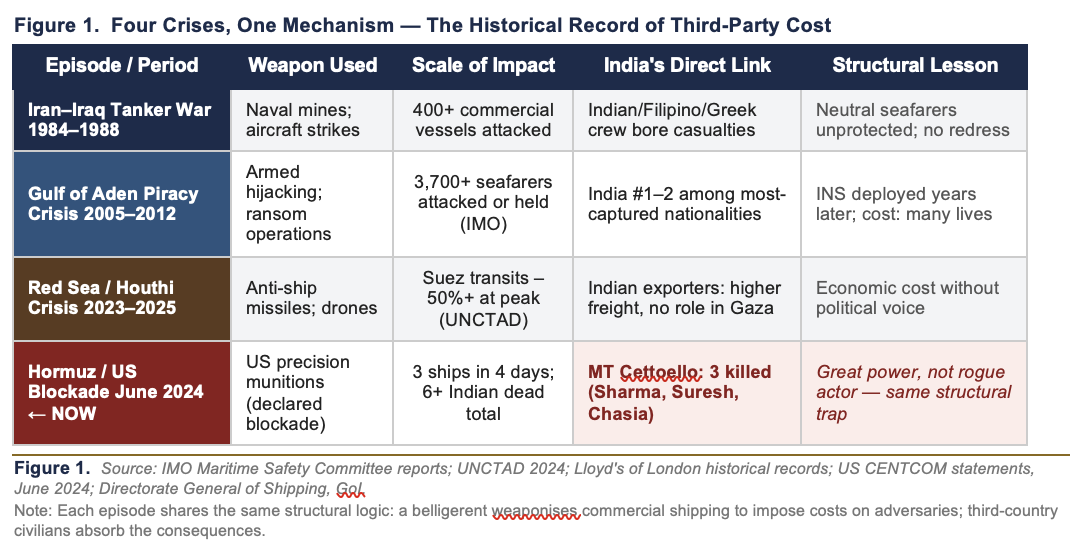
At 11:14 in the evening on June 9th, a US aircraft fired precision munitions into the engine room of the MT Cettoello, a Palau-flagged tanker approximately 20 nautical miles northeast of the Omani port of Suwa. The ship carried 28 sailors. 24 were Indian. Three — deck cadet Aditya Sharma; Chief Engineer Patnala Suresh; and fitter Shivanand Chasia — did not survive. US Central Command stated the vessel had “repeatedly failed to follow directions” in connection with its blockade of Iranian ports. The families of the dead were not consulted about whose directions applied to them. This was the second time in two days that India had summoned the American Chargé d’Affaires.
It was the third vessel with Indian crew attacked within four days — MT Maravves on June 8th (all 24 Indian crew rescued), MT Cettoello on June 9th (3 dead), MT Jalvir on June 10th (20 Indian crew, all safe). At least six Indian seafarers have died in the West Asia crisis in total. India noted at the United Nations that it was the only country to have lost mariners in this conflict. The question these facts raise is not sentimental. It is structural. Why does India — without a quarrel with Iran, an alliance with Israel, or any role in the US military posture — absorb the human cost of a confrontation it cannot shape?
Major Maritime Chokepoints — Why Hormuz Is Not Substitutable
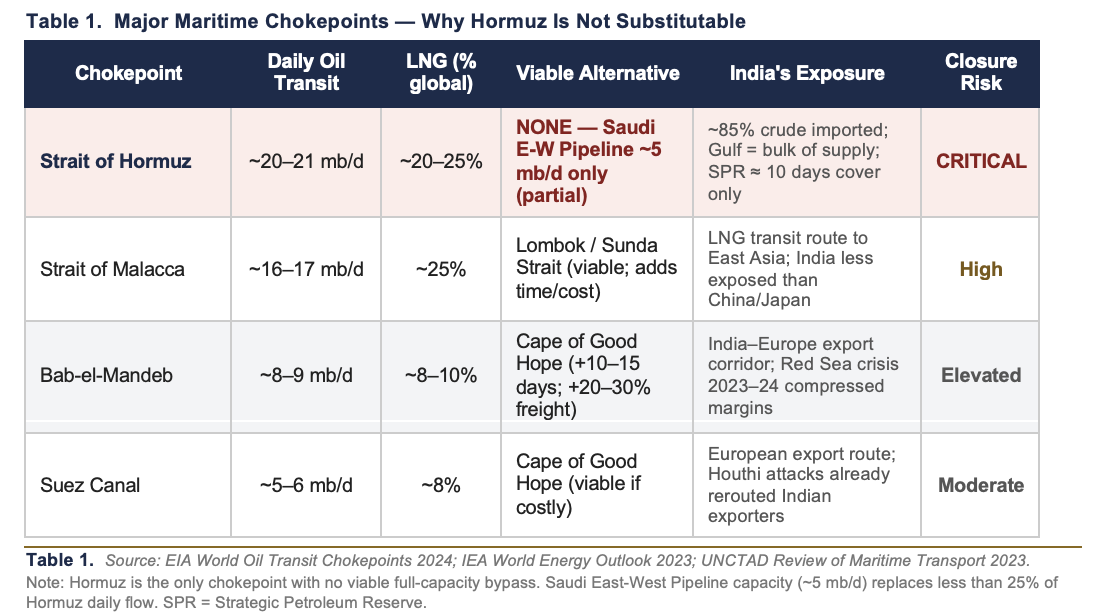
Of the world’s major maritime chokepoints, Hormuz is unique in one decisive respect: it has no viable bypass. When Houthi attacks drove Suez Canal transits down by more than 50% in early 2024 (UNCTAD), vessels rerouted around the Cape of Good Hope at expense but without supply rupture. The Saudi East-West Pipeline handles perhaps 5 million barrels per day against Hormuz’s 20-21 million. India imports approximately 85% of its crude requirements and draws the bulk from Gulf producers per Ministry of Petroleum data. Its strategic petroleum reserve covers roughly 10 days of consumption. Beyond energy: 10 million Indian nationals reside in Gulf states, their remittances forming one of India’s largest foreign exchange inflows. Their safety and India’s fiscal stability are structurally coupled to the same waterway where three sailors died on June 9th.
Indian Seafarers in Global Context
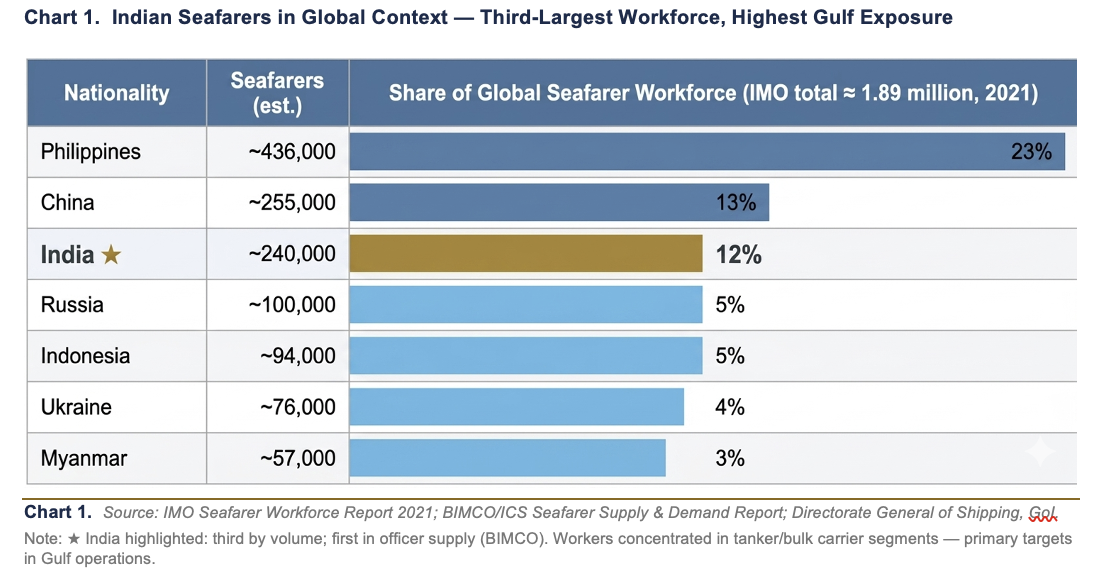
That structural exposure extends into labour in ways that have attracted insufficient strategic attention. India supplies approximately 240,000 seafarers to the global merchant fleet — roughly 12% of the worldwide total and third-largest by nationality, per the IMO’s 2021 Seafarer Workforce Report. BIMCO identifies India as the leading officer-supplying nation. These workers are concentrated disproportionately in tankers and bulk carriers — precisely the categories most targeted in current Gulf operations. Vice Admiral Anil Chawla, former Flag Officer Commanding-in-Chief of the Southern Naval Command, observed that the three attacked vessels were all proceeding toward Iran and had obscured their AIS destination data — a direct consequence of operating in a zone where both sides had incentive to strike. Indian crew members were inside that logic structurally, not accidentally.
Four Crises, One Mechanism
Each exchange in the US–Iran–Israel confrontation — a sanctions round, a proxy strike, a naval interdiction, a public threat against Kharg Island — narrows the space for the next act of restraint. Thomas Schelling’s framework for coercive bargaining describes this dynamic precisely, and its historical failure modes are well-documented: the July 1914 crisis proceeded through a sequence of locally rational retaliations until the sequence acquired its own momentum. President Trump’s stated intention to strike Kharg Island, Iran’s principal oil export terminal, represents exactly the threshold-crossing action that transforms coercive standoff into kinetic conflict. Ambassador Veena Sikri stated plainly on June 9th that preventing all-out war on Iran matters not merely on principle but because it “is going to create huge problems for India’s energy security, food security, and the supply of urea and other fertilizers that move through this route.”
India’s Hormuz Scenarios
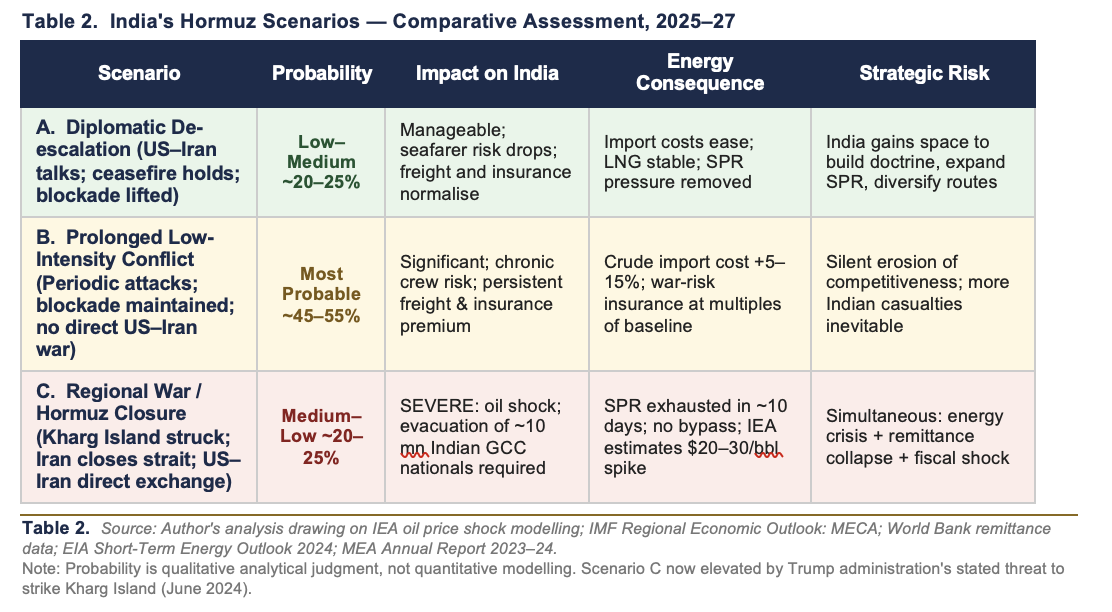
The scenario that India’s current posture implicitly assumes — diplomatic protest modulates American conduct; the situation stabilises below emergency level — is held in place by variables India does not control. A Hormuz closure, triggered by strikes on Kharg Island or an Iranian unilateral decision, would activate simultaneous crises across every dimension of India’s Gulf exposure. For example, an energy shock to an 85% import-dependent system with a 10 day reserve buffer, a remittance collapse from 10 million Gulf-resident citizens, a freight surge across primary export corridors, and potential evacuation requirements exceeding the 1990 Kuwait airlift of 200,000 nationals. These are not sequential problems. They arrive together.
Vice Admiral Chawla’s suggestion — more effective liaison with the US Navy to protect Indian nationals on transiting vessels — identifies the right direction while exposing how far behind India’s institutional architecture has fallen. Ships carrying Indian nationals are not required to notify Indian authorities because they carry flags of convenience. Real-time crew tracking for high-risk transits does not exist. What India needs at minimum: a Maritime Security Operations Centre with mandatory crew-registry coordination for vessels in declared conflict zones; strategic petroleum reserves expanded toward the IEA’s recommended 90 day standard rather than the current 10 day reality; and formal diplomatic protocols requiring notification to crew nations before any strike on a civilian vessel carrying their nationals — protocols that would have saved three families from receiving a phone call none of them were ready for.
The deeper argument is about what non-alignment actually costs in a world where great-power confrontation travels through shipping lanes. Strategic autonomy has genuine value. India’s ability to maintain working relationships with Washington, Tehran, and Riyadh simultaneously is a real asset. But that autonomy purchases nothing for a 23 year-old deck cadet whose ship was struck by an American missile while en route to a port that American policy had decided to blockade. The missiles are aimed at ships. The grief finds its way home. The question for Indian policymakers — the only question that matters after the protests are filed and the diplomats summoned — is whether national strategy will, too.
Bibliography
U.S. Energy Information Administration (EIA),
World Oil Transit Chokepoints; International Energy Agency (IEA);
UNCTAD Review of Maritime Transport 2023–24;
IMO Seafarer Workforce Report 2021;
BIMCO/ICS Seafarer Supply & Demand Report; Lloyd’s of London historical records;
IMB Piracy & Armed Robbery Reports;
Thomas Schelling, Arms and Influence (Yale UP, 1966);
Ministry of External Affairs GoI, Statements June 2024;
Ministry of Petroleum & Natural Gas GoI; Reserve Bank of India;
World Bank Remittance Data; SIPRI Conflict Database;
UN Convention on the Law of the Sea, Arts. 37–44;
US CENTCOM Public Statements, June 2024;
Vice Admiral Anil Chawla & Ambassador Veena Sikri commentary, NDTV, June 2024.