What Fico’s Victory Day Visit Reveals About EU Cohesion
With Slovak Prime Minister Robert Fico’s recent visit to Moscow, the EU’s cohesion is at risk of fragmentation.
On May 9th, 2026, Slovak Prime Minister, Robert Fico, attended Russian President Vladimir Putin’s Victory Day events in Moscow, Russia. Fico was the only EU leader that was present at these events, which prompted a direct rebuke from German Chancellor Friedrich Merz and Polish Foreign Minister Radoslaw Sikorski. While he was en route to Russia, Poland and Baltic states refused to let him through their airspace, forcing Fico to reroute through the Czech Republic (Kyiv Post, 2026). He calls himself the “black sheep” of the EU while stressing the importance of “normal relations” between Slovakia and Russia (Ukrainska Pravda, 2026b). What can the EU do about a member state maintaining an independent diplomatic channel with a country that is waging war on another European state?
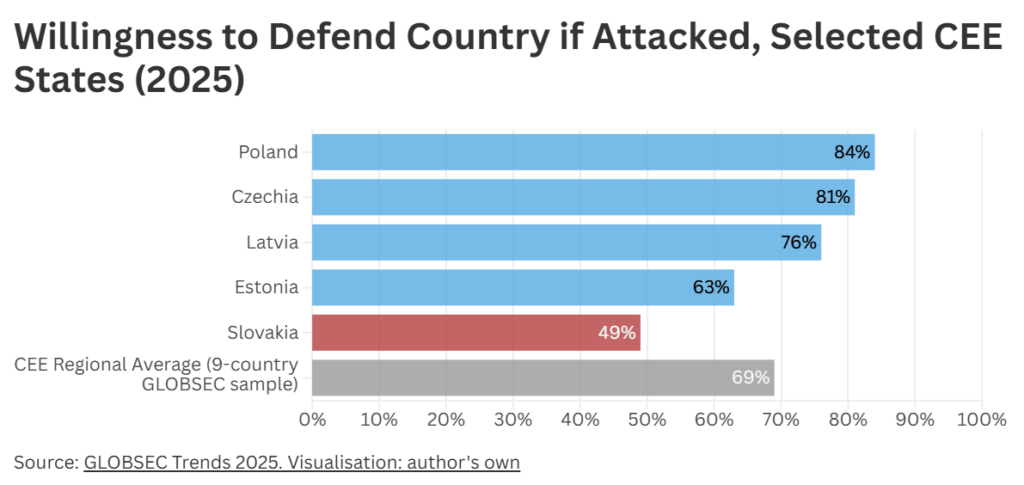
Fico’s visit is part of a documented pattern of obstruction and parallel positioning. The departure of Hungarian Prime Minister Viktor Orbán in April 2026 didn’t fix the problem; rather, it left a place for the next actor in line. Fico threatened to block Ukraine’s €90 billion loan in February 2026 and had consistently obstructed sanctions packages alongside Hungary, calling sanctions “economic sabotage” and opposing the EU’s phase-out of Russian fossil fuels (Ukrainska Pravda, 2026a; EU Perspectives, 2026). Although Russian propaganda plays a significant role in Slovakia’s domestic politics, it is important to highlight the historical and cultural relationship between Russia and Slovakia, which is primarily based on Soviet liberation during World War II and Slavic linguistic similarities. Beyond Fico’s personal alignment with Putin, 32% of Slovaks see Russia as a strategic partner, which is a rise of five percentage points from 2024, and 41% of them would not defend Slovakia if it was attacked (GLOBSEC, 2025). Where Orbán acted against the majority sentiment in Hungary, Fico is amplifying a growing trend of alignment with Moscow’s framing, making this case more challenging for the EU.
On May 4th, 2026, Fico met Zelenskyy in Yerevan, Armenia. Five days later, he traveled to Moscow and briefed Putin on his meeting with Zelenskyy, Kremlin aide Yuri Ushakov directly confirmed. Slovakia’s Deputy Foreign Minister, Rastislav Chovanec, stated that Fico’s role was to liaise between Kyiv and Moscow and “obtain valuable information from the Russian president on how Putin views efforts to end the war” (The Kyiv Independent, 2026). The two leaders also discussed reviving the bilateral Russia-Slovakia commission on cooperation that has been dormant since 2021. Beyond this symbolic visit, Fico and Putin plan to rebuild formal bilateral cooperation between an EU member state and Russia. This approach is a stark contrast to Orbán’s actions. While Orbán obstructed EU policy from within, Fico substitutes the EU’s collective voice with his own official diplomatic channel. This usage of backchannel diplomacy fragments the EU’s negotiating leverage because a single member state undermines its unified stance towards Moscow.
The EU lacks the right to impose collective security on a member state with an opposing democratic view, but alignment with an active aggressor could become a structural threat to its collective defence. The EU’s primary mechanism for addressing value breaches, Article 7, was triggered against Hungary and after years did not lead to anything concrete. Activating it against Slovakia would alienate the country while having a purely symbolic effect. Article 31 TEU is the strongest policy mechanism available without treaty change because Article 31(1) TEU permits member states to abstain from CFSP decisions rather than to block them. This allows decisions on sanctions and financial aid to Ukraine to pass without Slovakia’s consent. This mechanism was used only once between 2008 and 2022, raising a question regarding its infrequent usage (Wessel and Szép, 2022). Another option is to use financial leverage as it worked partially against Hungary when EU funds were tied to rule of law compliance. Financial leverage may be the most viable tool against Slovakia because it receives substantial funds. Additionally, domestic political costs would be significant given high Slovak public support for EU membership. Treaty reform, although necessary, will likely be unrealistic in the near-term as it requires unanimity. Each policy mechanism addresses a different layer of this underlying vulnerability. The EU has used these tools to deal with similar cases before. The problem is not the absence of these mechanisms; rather, it is the inconsistency of their application.
Fico’s visit to Russia exposed a problem that the EU built tools to address but has not deployed consistently. He is not the cause of the EU’s fragmentation on collective Russia policy. Rather, Fico is the most visible symptom of a political architecture that permits it. The EU’s collective security framework is under pressure again and the question remains whether it will survive its next actor. Its response to Fico must carry credible institutional consequences, or else other leaders will read the absence of consequence as a green light.
Bibliography
EU Perspectives (2026) ‘Slovakia fills Hungary’s veto vacuum to stall EU sanctions on Russia’, EU Perspectives, April. Available at: https://euperspectives.eu/2026/04/slovakia-fills-hungarys-veto-vacuum-to-stall-eu-sanctions on-russia/ [Accessed: 11/05/2026].
Fenbert, A. (2026) ‘Fico did not pass messages from Zelensky to Putin during Moscow meeting, Kremlin claims’, Kyiv Independent, 9 May. Available at: https://kyivindependent.com/fico-did-not-pass-messages-from-zelensky-to-putin-during-mos cow-meeting-kremlin-claims/ [Accessed: 11/05/2026].
GLOBSEC (2025) GLOBSEC Trends 2025. Bratislava: GLOBSEC. Available at: https://www.globsec.org/sites/default/files/2025-05/GLOBSEC%20Trends%202025_1.pdf [Accessed: 11/05/2026].
Kyiv Post (2026) “’I Am The Black Sheep’: Slovakia’s Robert Fico Defies EU with Moscow Trip to Meet Putin”, Kyiv Post, 9 May. Available at: https://www.kyivpost.com/post/75752 [Accessed: 11/05/2026].
Ukrainska Pravda (2026a) ‘Slovak PM says his country will block €90bn EU loan to Ukraine if necessary’, Ukrainska Pravda, 8 March. Available at: https://www.pravda.com.ua/eng/news/2026/03/08/8024467/ [Accessed: 11/05/2026].
Ukrainska Pravda (2026b) “Fico in Moscow says war between Russia and Ukraine is approaching its end”, Ukrainska Pravda, 8 May. Available at: https://www.pravda.com.ua/eng/news/2026/05/08/8033876/ [Accessed: 11/05/2026].
Wessel, R. A. and Szép, V. (2022) The Implementation of Article 31 of the Treaty on European Union and the Use of Qualified Majority Voting: Towards a More Effective Common Foreign and Security Policy? Study PE 739.139. Brussels: European Parliament, Policy Department for Citizens’ Rights and Constitutional Affairs. Available at: https://www.europarl.europa.eu/RegData/etudes/STUD/2022/739139/IPOL_STU(2022)7391 39_EN.pdf [Accessed: 11/05/2026].