Türkiye’s Energy Policy is on the Crossroads
As pressure mounts to reduce reliance on Russian gas, Ankara must balance energy security, economic interests and its ambitions to become a regional gas hub.
The Republic of Türkiye is known for its extremely convenient location – Ankara is able to control both maritime trade routes from the Black Sea region via the Straits and the flow of goods, coming from Asian economics to Europe; it also has access to some rare-earth metal deposits, such as chromium, boron and others (Cherashev, 2021). However, Türkiye lacks energy resources (especially natural gas and oil) and, therefore, is heavily dependent on import – since the beginning of the 21st century the amount of natural gas imported by Ankara has increased by 257% alone (IEA, 2026).
Nowadays Türkiye finds itself on the crossroads – Ankara has to choose between mutually beneficial energy trade with Russia and promising economic and political cooperation with the EU amid the ravaging war in Ukraine. The current situation is likely to be one of the greatest foreign policy challenges President Erdoğan has faced since his coming to power in 2003, mostly due to the fact that Türkiye remains an important ally for both Moscow and Brussels, as well as the only NATO state that didn’t impose any sanction on Russia.
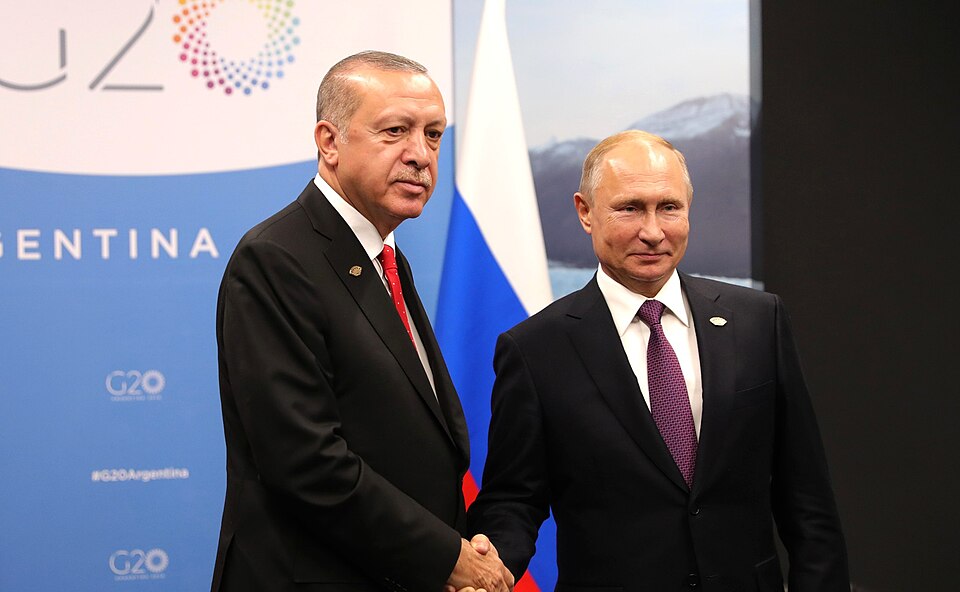
Although Russia and Türkiye do not share same geopolitical goals, with their support to opposing forces in Syria being the best example, both states remain closely linked in economic sense. Since the early 2000s Russia has been the largest exporter of natural gas to energy-deficient Türkiye, controlling over 40% of all Turkish gas imports (IEA, 2026) and providing the Turkish state with more than 20 bln cubic meters of natural gas every year (see Fig. 1); Moscow has also been cooperating with Ankara on issues related to nuclear energy development and helping to build the first Turkish nuclear power plant. On the other hand, Kremlin heavily relies on Türkiye’s intermediary position between Russia, Western countries and Ukraine, as well as gas contracts with Turkish BOTAŞ that keep the war-weary Russian state budget afloat (Reuters, 2026).
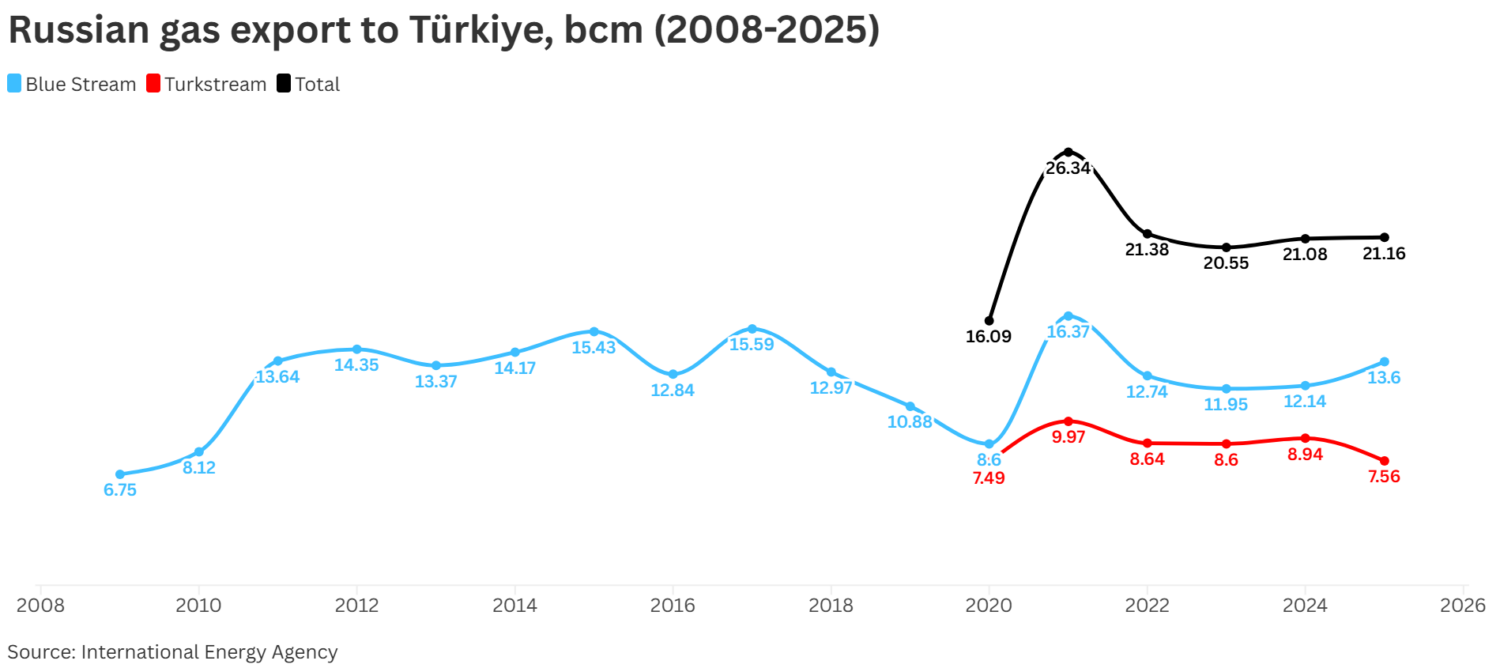
Figure 1. Russian gas exports to Türkiye, bcm (2008-2025).
Source: IEA, 2026.
However, it seems that the delicate balance Türkiye has been trying to maintain since the beginning of the full-scale war in Ukraine is about to be upset. Since Ankara has been an energy transit state for the European Union for several decades, Brussels requested Ankara to stop the transit of Russian gas to the bloc’s territory (РБК, 2026) as a part of its policy of phasing Russian energy sources out of the European energy system (EUR-Lex, 2026). It is clear that in case of Türkiye’s refusal to comply with the Brussels’ request the Turkish state may face secondary sanctions, which may deal significant damage to Türkiye’s economy, weakened by years of rampaging inflation and unorthodox economic policy.
It is also clear that Ankara is unlikely to sacrifice its economic partnership with the EU – after all, Türkiye remains the only non-EU member included in the EU Customs Union. Therefore, Turkish goods and services have access to a unified market, consisting of financially sound states, with total population of 450 mln people; Türkiye also depends on the EU’s foreign investment – since 2003 the volume of foreign investment in the Turkish economy exceeded 288 bln US$, with half of it coming from the EU economies, such as the Netherlands, Germany, Luxembourg, and others (Invest in Türkiye, 2025).
Nevertheless, it is important to understand that it is not yet decided whether Türkiye is going to stop importing Russian gas. Ankara continues to negotiate with Russian Gazprom the terms of gas contracts after 2026; it is also important to note that one of the main goals of Recep Tayyip Erdoğan’s government is to turn Türkiye into a so-called ‘gas hub’ through which the gas supply routes from major producers (Russia, Azerbaijan, etc.) to main consumers (the EU member states) would pass. This would provide Ankara with an effective tool to influence both Brussels and Moscow – and, most importantly, with a chance to pursue its own regional and international policy in the Eastern Mediterranean, MENA and the whole Eurasian region.
Bibliography
Cherashev, D. V. (2021). Prospects for cooperation in mining and metals industry between Russia and developing countries. Russian Foreign Economic Bulletin, 12, 69–81. CyberLeninka article
EUR-Lex. (2026). Regulation (EU) 2026/261 of the European Parliament and of the Council of 26 January 2026. EUR-Lex regulation
International Energy Agency. (2026a). Gas trade flows. IEA Gas Trade Flows
International Energy Agency. (2026b). Türkiye natural gas supply. IEA Türkiye natural gas supply
Invest in Türkiye. (2025). Türkiye’de uluslararası doğrudan yatırım. Invest in Türkiye page
Reuters. (2026, July 16). Russia’s 2026 budget deficit may exceed plans by $12.85 billion due to higher spending. Reuters article
РБК. (2026, June 20). ЕС потребовал от Турции исключить российский газ из новых поставок блоку. РБК article