Mozambique’s Lost Decade
Mozambique is at a crossroads. This January, TotalEnergies restarted construction on its $20 billion LNG (Liquefied Natural Gas) project in the Cabo Delgado province: a remarkable shift from the crippling debt scandal that befell Mozambique a decade ago. However, the long-term risks that embroil President Daniel Chapo’s government will persist despite the lifting of the force majeure declared on Mozambique’s LNG in 2021. Besetting the country are a jihadist insurgency in Cabo Delgado, post-election unrest, debt servicing challenges and frequent natural disasters.
The Cabo Delgado Crisis: Ahlu Sunna Waljama’a Insurgency
When TotalEnergies’ Mozambique LNG, Exxonmobil’s Rovuma LNG, and smaller projects by Eni all come online by 2030, Mozambique will become a major LNG exporter and produce up to 38 million metric tons a year (Hoisch, 2025). But, an insurgency near the planned onshore facilities in Cabo Delgado is harming the prospect of exporting LNG to energy-hungry Asian markets, and with it the hope of Mozambique becoming southern Africa’s energy hub (Tani, 2025). Perpetrating the violence is Ahlu Sunna Waljama’a (ASWJ), a group formed of ethnic Mwani militants resentful of decades of political exclusion, and Tanzanian jihadists who fled to Mozambique after a government crackdown in 2012-17 (Warner et al, 2021, p. 256; Bofin, 2022).
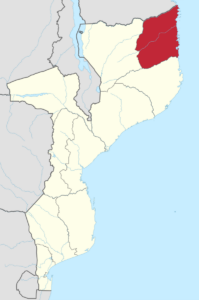
The Cabo Delgado province in Mozambique
Since the insurgency’s outbreak in 2017, attacks in the Palma and Mocimboa da Praia districts have displaced hundreds of thousands of civilians, and the LNG project came to a halt in 2021. ASWJ’s pledge of allegiance to the Islamic State in 2019 combined with the 2021 assault on Palma city sparked global outrage, leading the Mozambican government to solicit the aid of Rwandan and Southern African Development Community (SADC) troops in order to restore order (Hanlon, 2022). Their presence shored up the overstretched Mozambican Defence Armed Forces and dampened the insurgency’s momentum, although ASWJ attacks still managed to spread to mining sites in southern Cabo Delgado (Machado, 2022).
Elections & Political Unrest
Disputed electoral outcomes have resulted in nationwide unrest and contributed to the emergence of ASWJ. The FRELIMO party has held power in Mozambique since the country gained independence from Portugal in 1975. The party was able to retain power in 1994 following a peace deal with the rebels-cum-opposition RENAMO party.
Relations between FRELIMO and RENAMO have remained tense; efforts by FRELIMO elites to co-opt or quash their RENAMO counterparts after the 1999 presidential election resulted in targeted violence, and a yearslong insurgency by disillusioned RENAMO factions followed the 2014 vote (Vines, 2019).
The protests after the 2023 municipal elections were dwarfed by the violence which ensued after the 2024 presidential election, where Daniel Chapo of the FRELIMO party won by a landslide (Nesta Kupemba & Tembe, 2024). Chapo’s victory over RENAMO and the Podemos party candidates was dogged by allegations of fraud and prompted weeks of nationwide unrest (Columbo, 2025). Resentment towards FRELIMO, which was perceived as amassing resources in Maputo at the expense of the provinces, was exacerbated in Cabo Delgado due to apparent favoritism towards Makonde communities at the expense of RENAMO-supporting Mwani communities. Fears of such exclusion also contributed to the outbreak of the ASWJ insurgency in 2017, with concern that Cabo Delgado’s LNG projects would grant all revenue to a biased government (Warner et al, 2021, p. 266).
Financial Instability
Mozambique’s recent economic growth is driven by the extractive and service sectors, whilst the agricultural sector which employs 70% of population remains unproductive and has failed to relieve the inflation of food prices (African Development Bank, 2025, p. 8). The country benefits from both a stable currency against the US Dollar (Mann and Mayer-Cirkel, 2024) and logistical connections to South African industry via the Port of Maputo. However, Mozambique’s growth has been inhibited since the revelation of the Tuna Debt scandal in 2016, where loans equivalent to 10% of Mozambique’s GDP were discovered to have been procured through the bribery of the finance minister and concealed from the International Monetary Fund (IMF) between 2013-16. (Serle Court, 2024).
The revelation of the Tuna Debt scandal led to halts in aid from the IMF and other donors, and Mozambique defaulted on loans in January of 2017 with debt rising to 112% of GDP (Holmes, 2019). Reduced access to credit following the scandal has discouraged foreign direct investment and hindered the government’s ability to address issues such as Mozambique’s large informal sector (Coface, n.d.). Frequent natural disasters courtesy of the country’s long coastline have placed further strain on the state’s finances. Despite progress in developing a national disaster strategy, frequent tropical storms continue to cause flooding and displace hundreds of thousands of people whilst destroying critical infrastructure (UNDRR, 2025; UNRefugees, 2026).
Economic Outlook
Mozambique’s post-pandemic recovery was undermined by the post-election unrest in 2024. Economic growth is forecasted to increase from 1.8% in 2025 to 3% in 2026, with debt as a percentage of GDP being set to decrease from 97% in 2025 to 96.1% in 2026 (World Bank, 2025). Revenue from foreign direct investment in LNG projects that could fund much-needed public infrastructure is vulnerable to project delays and/or escalating ASWJ activity. However, public-private partnerships with multilateral institutions like the African Development Bank are facilitating increased regional trade and greater customs revenue by modernizing transport infrastructure (Games, 2025).
Political instability will overshadow Mozambique’s medium-term outlook. Allegations of electoral fraud, popular support for opposition figurehead Venancio Mondlane, and youth employment will all likely drive further unrest following the municipal and presidential votes in 2028 and 2029 (IISS, 2025, p. 262).
The $500 million estimated financial losses due to post-election unrest comes amid continued ASWJ violence in Cabo Delgado, which will perpetuate the province’s underdevelopment when coupled with attacks on businesses in the province (Massango, 2025; ACLED, 2026).
A lack of clarity over the government’s financial support for TotalEnergies Mozambique LNG may discourage investment into Mozambique’s emerging extractive sector (Africa Intelligence, 2026).
International actors will remain pivotal in combating ASWJ, despite the withdrawal of the South African Development Community mission from Mozambique in 2024. Recent unrest in Tanzania – which may strain its capacity to police its border with Cabo Delgado – has intensified President Chapo’s need to stabilize the province (Kell, 2025). Rwanda is using its presence to inhibit cooperation between ASWJ and an ISIS affiliate in the Democratic Republic of Congo (DRC), and to additionally limit the EU’s diplomatic leverage over its own involvement in eastern DRC (IISS, 2022, p. 305-308). The EU funds the Rwandan presence and runs a training mission for Mozambican troops. Access to Mozambique’s LNG and critical minerals could reduce the EU’s exposure to Russian hydrocarbons and reduce China’s influence over strategic critical mineral supply chains (Pangea-Risk, 2024).
Bibliography:
ACLED (2026) “Mozambique Conflict Monitor Update: 11 February 2026”, acleddata.com, published 11th February 2026. Available at: https://acleddata.com/update/mozambique-conflict-monitor-update-11-february-2026
Africa Intelligence (2026) “Despite restart, TotalEnergies kept hanging on Mozambique LNG audit findings”, Africa intelligence, published 3rd February 2026. Available at: https://www.africaintelligence.com/southern-africa-and-islands/2026/02/03/despite-restart-totalenergies-kept-hanging-on-mozambique-lng-audit-findings
African Development Bank (2025) “Mozambique – Natural Resources Country Analysis : GONAT Diagnostic Report” published 17th December 2025, African Development Bank Group. Available at: https://www.afdb.org/en/documents/mozambique-natural-resources-country-analysis-gonat-diagnostic-report
Bofin, P. (2022) “Tanzania and the Political Containment of Terror”, Hudson, published 24 January 2022. Available at: https://www.hudson.org/node/44710
Coface. “Mozambique: Country File, Economic Risk Analysis.” Coface.com, updated May 2025. Available at: https://www.coface.com/news-economy-and-insights/business-risk-dashboard/country-risk-files/mozambique
Games, D. (2025) “Transport corridors key to Mozambique’s growth plans – African Business”, African Business, published 9th October 2025. Available at: https://african.business/2025/10/trade-investment/transport-corridors-key-to-mozambiques-growth-plans
Nesta Kupemba, D. & Tembe J. (2024) “Mozambique’s ruling party wins landslide in disputed poll”, BBC News, published 24th October 2024. Available at: https://www.bbc.co.uk/news/articles/c14lzy75355o
Columbo, E. (2025) “Implications of the 2024 Presidential Election in Mozambique”, Georgetown Journal of International Affairs, published 17th April 2025. Available at: https://gjia.georgetown.edu/2025/04/17/implications-of-the-2024-presidential-election-in-mozambique-insights-from-emilia-columbo/.
Hanlon, J. (2022). “Mozambique insurgency: Why 24 countries have sent troops”, BBC News, published 23rd May 2022. Available at: https://www.bbc.co.uk/news/world-africa-61464431
Hoisch, M. (2025) “ExxonMobil lifts force majeure on Rovuma LNG in Mozambique: spokesperson” S&P Global, published 20th November 2025. Available at: https://www.spglobal.com/energy/en/news-research/latest-news/crude-oil/112025-exxonmobil-lifts-force-majeure-on-rovuma-lng-in-mozambique-spokesperson
Holmes, H. (2019). “Mozambique Charges 18 in ‘Tuna Bonds’ Scandal” OCCRP, published 9th January 2019. Available at: https://www.occrp.org/en/news/mozambique-charges-18-in-tuna-bonds-scandal
IISS. (2022) “The Armed Conflict Survey” (Routledge).
IISS. (2025) “The Armed Conflict Survey” (Routledge).
Kell, F. (2025) “Tanzania’s election violence: Deflecting blame will only do more harm”, Chatham House, published 4th December 2025. Available at: https://www.chathamhouse.org/2025/12/tanzanias-election-violence-deflecting-blame-will-only-do-more-harm
Machado, Z. (2022). “Hundreds Flee Attacks in Mozambique’s Ruby Mining Region”, Human Rights Watch, published 21st October 2022. Available at: https://www.hrw.org/news/2022/10/21/hundreds-flee-attacks-mozambiques-ruby-mining-region
Mann, S. & Mayer-Cirkel, A. (2024) “Identifying Determinants of FX Stability in Mozambique”, IMF eLibrary, published 8th November 2024. Available at: https://www.elibrary.imf.org/view/journals/001/2024/233/article-A001-en.xml
Massango, A. (2025) “Mass unrest caused losses of more than 500 million dollars”, aimnews.org, published 10th April 2025. Available at: https://aimnews.org/2025/04/10/mass-unrest-caused-losses-of-more-than-500-million-dollars/
Pangea-Risk. (2024) “Growing Demand for Africa’s Critical Minerals Intensifies Geopolitical Rivalries”, published 23rd May 2024. Available at: https://insight.pangea-risk.com/static/post-pdfs/202405/202405_SPECIAL-REPORT-GROWING-DEMAND-FOR-AFRICAS-CRITICAL-MINERALS-INTENSIFIES-GEOPOLITICAL-RIVALRIES.pdf
Serle Court (2024) “Landmark Victory in Mozambique ‘Tuna Bonds’ Case”, serlecourt.co.uk, published 5th August 2024. Available at: https://www.serlecourt.co.uk/news/article/landmark-victory-in-mozambique-tuna-bonds-case
Tani, S. (2025) “TotalEnergies to start production at Asia-serving Mozambique LNG in 2029” Nikkei Asia, published 25th June 2025. Available at: https://asia.nikkei.com/editor-s-picks/interview/totalenergies-to-start-production-at-asia-serving-mozambique-lng-in-2029
Total Energies (2026) “Mozambique LNG announces the full restart of all its activities onshore and offshore in Mozambique”, Totalenergies.com, published 29th January 2026. Available at: https://totalenergies.com/news/press-releases/mozambique-lng-announces-full-restart-all-its-activities-onshore-and-offshore
Undrr.org. (2025) “Mozambique bridges disaster risk reduction and internal displacement strategies to strengthen inclusive risk governance”, Undrr.org, published 30th May 2025. Available at: https://www.undrr.org/resource/case-study/mozambique-bridges-disaster-risk-reduction-and-internal-displacement-strategies
UNRefugees (2026) “Severe floods displace nearly 400,000 in Mozambique, heightening protection risks”, Unrefugees.org, published 6th February 2026. Available at: https://www.unrefugees.org/news/2026/2/severe-floods-displace-nearly-400-000-in-mozambique-heightening-protection-risks/
Vines, A. (2019) “Prospects for a Sustainable Elite Bargain in Mozambique: Third Time Lucky?” Chatham House, published 5 August 2019. Available at: https://www.chathamhouse.org/2019/08/prospects-sustainable-elite-bargain-mozambique-third-time-lucky-0/2-key-features-past-elite
Warner J. O’Farrell & R. Nsaibia, H. Cummings, R. (2021) The Islamic State in Africa. (Hurst Publishers).
World Bank (2025) “Mozambique: Macro Poverty Outlook”, published October 2025. Available at: https://thedocs.worldbank.org/en/doc/bae48ff2fefc5a869546775b3f010735-0500062021/related/mpo-moz.pdf