From Gas to Grain: The Strait of Hormuz and East Asia’s Food Security
Most analyses of the Strait of Hormuz focus on energy security. Yet for Japan and South Korea, the greater long-term risk may lie in food production. As the 2026 disruption demonstrates, interruptions to Persian Gulf gas supplies rapidly translate into fertilizer shortages, higher agricultural costs, and growing food security concerns.
The Strait of Hormuz is commonly described as the world’s most critical energy chokepoint. This is an accurate but incomplete description. For Japan and South Korea, a persistent disruption in the strait is not simply an energy crisis but a food security crisis, with a delay of one to two growing seasons. The mechanism linking the two is nitrogen fertilizer, and its importance is almost entirely absent from mainstream interpretations of Persian Gulf geopolitics.
The Chokepoint in Numbers
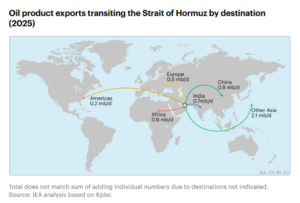
The extent of East Asia’s exposure to Hormuz in terms of energy is well documented. Japan sources more than 93% of its crude oil from the Middle East, and South Korea almost 70% (UNESCAP, 2026). Both countries are among the top four importers of crude oil transiting the Strait of Hormuz, with nearly 15 million barrels per day in 2025, or almost 34% of global crude oil trade (IEA, 2026). For liquefied natural gas, the Strait of Hormuz is equally pivotal: almost 20% of global LNG trade transited through it in 2024, with about 83% of this volume destined for Asian markets (EIA, 2025).
Neither country has deep LNG reserves. South Korea has about 3.5 million tons of reserves; Japan has about 4.4 million tons, enough to sustain about two to four weeks of demand under normal conditions (CNBC, 2026). Price exposure begins long before physical shortages emerge.
The Hidden Transmission: From Gas to Grain
What has received much less attention is the agricultural transmission channel. Nitrogen fertilizers, mainly urea and ammonia, are synthesized from natural gas via the Haber-Bosch process. Natural gas constitutes both the feedstock and the primary energy input. This means that when the price of LNG increases, the costs of fertilizer production also increase proportionately.
The Persian Gulf is the world’s main fertilizer export hub. The Persian Gulf countries accounted for 36% of global urea exports and approximately 29% of global ammonia exports during 2023–2025, with Iran and Qatar being the largest exporters in the urea category (IFPRI, 2026). In 2024 alone, up to 30% of international commercial fertilizer shipments transited through the Strait of Hormuz. The effective closure of the strait in early March 2026 stopped an estimated 3–4 million tonnes of fertilizer per month (FAO, 2026).
The price implications were immediate. In the first week of March 2026, Middle Eastern granular urea prices rose by 19%, and European hub gas (TTF) prices rose by almost 55% in less than a week as Qatar’s Ras Laffan LNG facility halted production, causing ammonia production costs to increase by approximately 48% (CRU Group, 2026; FAO, 2026). FAO predicted that global fertilizer prices could increase by an average of 15–20% in the first half of 2026 if disruptions persist (FAO, 2026).
Japan and South Korea: A Compounding Vulnerability
Both Japan and South Korea are structurally exposed to this transmission mechanism, although in different ways.
Japan’s food self-sufficiency rate in terms of calories was only 38% in fiscal year 2023, one of the lowest among developed economies (OECD, 2025). The country imports 90% of its wheat, 100% of its corn, and 94% of its soybeans, while almost 95% of its urea needs are met through imports (MAFF, 2022). The rice production crisis that preceded the 2026 conflict reduced Japan’s government reserves from 910,000 tons in 2024 to just 100,000 tons by mid-2025, and the country had almost no agricultural reserves (Borgen, 2025). South Korea’s food self-sufficiency rate by value of production is approximately 44% and is therefore heavily dependent on imported nitrogen and potash fertilizers (JIRCAS, 2024; Green Guber Group, 2025). South Korea’s net oil imports account for 2.7% of GDP, and Nomura has identified it as one of the most vulnerable economies in Asia to energy price shocks (CNBC, 2026). The Kiel Institute estimates that a complete closure of the Strait of Hormuz, including Saudi exports, would reduce South Korea’s welfare by 2.5% before taking into account the second-order fertilizer cost effects (Kiel Institute, 2026).
The mixed structure is of great importance. Higher LNG prices simultaneously increase the costs of electricity, irrigation, fertilizer, and transportation, a dual energy and input shock that comes all at once and has the greatest impact on agricultural sectors that are already operating with low profit margins.
Policy Recommendations
Three structural responses require serious consideration by policymakers in Tokyo and Seoul. First, strategic fertilizer reserves should be considered a national security asset, on a par with oil reserves. Japan’s crude oil reserves, as regulated by the International Energy Agency (IEA), are among the deepest in the world, with approximately 254 days of coverage through the end of 2025 (ORF Middle East, 2026). There is no comparable buffer for fertilizers. Building up even 60 to 90 days of urea and ammonia stocks, mirroring the logic of oil reserves, would significantly reduce agricultural vulnerability during future transportation disruptions.
Second, diversifying long-term LNG supplies should explicitly consider the benefits for fertilizer production. Contracts with Australia, the United States, and West African producers would simultaneously reduce vulnerability in both the energy and agricultural input sectors. Japan has made progress, importing record volumes of US crude oil by 2025, but its LNG portfolio remains somewhat vulnerable (ORF Middle East, 2026). Third, both governments need to invest in domestic or regional green ammonia production capacity. China had developed nearly a hundred green ammonia projects by 2024, with a production capacity approaching 20 million tonnes per year (36 million tonnes per year, 2026). Japan and South Korea, both of which have high ambitions for renewable energy, have the technology base to pursue similar capacity. Decoupling nitrogen fertilizer supplies from the Persian Gulf gas flow is a decades-long project, but the 2026 crisis has shown that the lack of such capacity has a measurable cost.
Conclusion
The Strait of Hormuz is not just an energy artery. For Japan and South Korea, it is part of the hidden infrastructure of food production. The 2026 disruption has exposed a transmission channel from Persian Gulf gas to fertilizer and then to crop yields that policy frameworks have consistently downplayed. Addressing energy dependency without addressing fertilizer dependency exposes the agricultural supply chain to the same shock through a different path.
Bibliography
- Borgen Magazine (2025) ‘Japan’s Rice Crisis and Sustainable Farming’, 13 November. Available at: https://www.borgenmagazine.com/japans-rice-crisis/
- CNBC (2026) ‘The Strait of Hormuz is facing a blockade. These countries will be most impacted’, 3 March. Available at: https://www.cnbc.com/2026/03/03/strait-of-hormuz-closure-which-countries-will-be-hit-the-most.html
- CRU Group (2026) ‘Middle East Conflict: Urea supply disruptions could be catastrophic’, 10 March. Available at: https://www.crugroup.com/en/communities/thought-leadership/2026/
- Food and Agriculture Organization of the United Nations (FAO) (2026) ‘FAO Chief Economist warns of severe global food security risks from disruption to Strait of Hormuz trade corridor’, 26 March. Available at: https://www.fao.org/newsroom/detail/fao-chief-economist-warns-of-severe-global-food-security-risks-from-disruption-to-strait-of-hormuz-trade-corridor/en
- Green Gubre Group (2025) ‘East Asia Fertilizer Market Trends 2025’, 12 April. Available at: https://www.greengubregroup.com/blogs/fertilizer-market-trends-and-opportunities-in-east-asia-2025-outlook
- International Energy Agency (IEA) (2026) ‘Strait of Hormuz’. Available at: https://www.iea.org/about/oil-security-and-emergency-response/strait-of-hormuz
- International Food Policy Research Institute (IFPRI) (2026) ‘The Iran war’s impacts on global fertilizer markets and food production’, 2 April. Available at: https://www.ifpri.org/blog/the-iran-wars-impacts-on-global-fertilizer-markets-and-food-production/
- Japan International Research Center for Agricultural Sciences (JIRCAS) (2024) ‘Trends and Outlook of Food Self-Sufficiency Ratio’, 31 January. Available at: https://www.jircas.go.jp/en/program/proc/blog/20240131
- Kiel Institute for the World Economy (2026) The Cost of Closing the Strait of Hormuz. Kiel Policy Brief, March.
- Ministry of Agriculture, Forestry and Fisheries, Japan (MAFF) (2022) FY2022 Summary of the Annual Report on Food, Agriculture and Rural Areas. Available at: https://www.maff.go.jp/e/data/publish/attach/pdf/index-224.pdf
- Observatory Research Foundation Middle East (ORF Middle East) (2026) ‘How Middle East Turmoil Reverberates Through Japan’s Energy System’, 1 May. Available at: https://orfme.org/expert-speak/how-middle-east-turmoil-reverberates-through-japans-energy-system/
- OECD (2025) Japan: Agricultural Policy Monitoring and Evaluation 2025. Available at: https://www.oecd.org/en/publications/2025/10/agricultural-policy-monitoring-and-evaluation-2025
- United Nations Economic and Social Commission for Asia and the Pacific (UNESCAP) (2026) Impact of the Crisis in Western Asia on Asia Pacific: An Initial Analysis, March. Available at: https://www.unescap.org/sites/default/d8files/documents/Presentation_Crisis%20in%20Western%20Asia%20and%20Impact%20on%20Asia-Pacific_2026-M03.pdf
- U.S. Energy Information Administration (EIA) (2025) ‘About one-fifth of global liquefied natural gas trade flows through the Strait of Hormuz’, 24 June. Available at: https://www.eia.gov/todayinenergy/detail.php?id=65584