Escalation of the Nagorno-Karabakh Conflict: Any Hopes for the Peace Process?
Mid-July marked the escalation of hostilities on the Armenia-Azerbaijan border bringing the Nagorno-Karabakh dispute back on the top of the international agenda. The recent fighting which broke on 12 July, claiming at least 16 causalities, appeared to be the most serious outbreak since the Four-Day War in 2016. Even though the main underlying reason for the recent flare-up remains unclear, as both states have traded accusations for launching the first strike, the recent escalation of hostilities has triggered a setback in previous diplomatic efforts to find a lasting solution to the so-called “frozen problem” of the post-Soviet space.
As the Nagorno-Karabakh dispute enters its fourth decade, generating sporadic violence across the line of contact leaving some 30,000 causalities and hundreds of thousands of people displaced, it remains the most dangerous post-Soviet conflict, causing instability in the region and beyond. The conflict has spilled over to communities outside the zone of the Nagorno-Karabakh conflict zone, resulting in the diaspora clashes leading to the aggressive standoffs between the Armenian and Azerbaijani communities in different cities across the world.
Although the violence on the border has subsided, the recent fighting has revealed the failure of the previous mediation efforts to find a long-lasting solution to the conflict. While the frequent ceasefire violations, growing hostilities between the states, and their increased militarization, are further shrinking the space for dialogue and leave far fewer prospects for achieving a peaceful settlement.
Background
The two states have been at odds for about three decades since the Soviet Union’s collapse and have been involved in the frequent sabre-rattling due to the unresolved territorial disputes over Nagorno-Karabakh, Azerbaijan’s breakaway region with a predominantly ethnic Armenian population, claiming independence from Baku. The territorial dispute between two states has reached its breaking point during the war in 1991-1994, which cost more than 20,000 lives and created over a million refugees and internally displaced. In 1994, the ceasefire regime was established under the auspices of the Organization for Security and Co-operation in Europe (OSCE) and the OSCE Minsk Group co-chaired by France, Russia, and the United States, was introduced in order to mediate between the parties and secure a framework for the peaceful solution to the Nagorno-Karabakh dispute.
Even though the Group’s mediation efforts resulted in putting on hold the probability of the all-out war that was looming the region of the South Caucasus, the situation remains unstable. Ever since the 1994 ceasefire was established leaving the territory and the surrounding parts of Azerbaijan under Armenia’s control, the parties have been engaged in occasional skirmishes violating the ceasefire agreement. Such balancing between the “no-war no-peace” situation has not removed the probability of the severe clashes, which have flared up into the deadliest 2016 Four-Day War that caused some 200 victims in the Nagorno-Karabakh conflict zone.
Some hopes for breaking the diplomatic deadlock have emerged following the Velvet Revolution and regime change in Armenia. The coming to office of Nikol Pashinyan in the aftermath of the nationwide protests, which swept the country in spring 2018, was welcomed by Baku as giving a chance to de-escalate tensions and resume the negotiations process. For the first time, a hotline to exchange information between the military commanders was established, which has dropped down to zero the level of hostilities along the ceasefire line. The foreign ministers of both states have even agreed on the necessity to take measures to prepare the populations for peace. The July fighting, however, has wiped out the emerging prospects for peaceful settlement of the conflict and has impugned the previous diplomatic efforts.
The reason for the July escalation remains unclear as each party accuses the other of violating the ceasefire. Armenia’s defense ministry accused Azerbaijan’s army of the breakthrough attempt on the border, targeting civilian infrastructure and using people as human shields. Azerbaijan denied the allegations and made similar accusations blaming Armenia for launching an assault against the frontline troops of Azerbaijan and targeting Azerbaijani villages in the Tovuz district. Even in case the recent flare-up was not a planned military operation by one of the parties to the conflict, it demonstrates that even minor provocations can result in the severe surge of hostilities.
The Failure of the Previous Diplomatic Efforts
Although the recent tension has been eased, the situation in the region remains volatile. The second armed clash over the five years and the spark in hostility between the nationals of both states have demonstrated that the progress in the conflict resolution has long been stalled and the risk of the all-out war in the region is still feasible.
The OSCE has repeatedly stressed that “continuous and direct dialogue” between the parties under the auspices of the OSCE Minsk Group is essential for “building confidence” and reaching the progress in the peaceful resolution of the conflict. However, the Group Co-Chairs’ mediation efforts did not bring the Nagorno-Karabakh conflict closer to a resolution but rather resulted in the growing distrust by the Co-Chairs’ activities and visits to the region referred to as “tourist excursions” by the Azerbaijani media. Azerbaijani authorities have long criticized the Mink Group for the unwillingness to compel Armenia to conform with the United Nations’ four Security Council resolutions (822, 853, 874, 884) which demand the withdrawal of troops from Nagorno-Karabakh and other occupied regions of Azerbaijan. The Minsk Group’s mediation activities, characterized by the low level of involvement of its Co-Chairs driven by their divergent positions and own regional and geopolitical interests, pushed the conflict resolution process into deadlock. So far, the international efforts and particularly the efforts of the Minsk Group Co-Chairs have mainly been focused on maintaining the status quo and avoiding the direct armed confrontations through reducing tensions by means of sporadic diplomatic meetings and visits between the parties to the conflict instead of seeking the solutions to eliminate the root cause of the violence.
Although, the Group Co-Chairs have successfully mediated the ceasefires agreements, set up ceasefire monitoring missions, and put forward highly promising initiatives for the peace settlement of the conflict, including the 2007 Madrid Principles, which however have never been fully implemented by any of the parties, the territorial dispute between Armenia and Azerbaijan remained intractable. The continued upsurge of violence on the border between two states has revealed a clear need for the international community to reinforce efforts to seek for a long-lasting settlement of the conflict, instead of perpetuating the status quo.
The Third Parties’ Involvement in the Region
The fragile neither war nor peace situation might have serious implications for the whole South Caucasus region and beyond as the region has become the hotspot of the growing rivalry between the third parties seeking to reinforce their diverging strategic interests in the region.
The recent outbreak has indirectly pitted Russia and Turkey against each other as backing parties to Armenia and Azerbaijan respectively. As both states are currently involved in the proxy confrontations through supporting the confronting sides in Syria and Libya, there are growing concerns over the possibility of the third parties’ increasing involvement into the conflict between Armenia and Azerbaijan, which might further undermine the prospects for peaceful settlement turning the Caucasus region into the next spot like Syria and Libya.
Due to the strategic importance of the region, the recent escalation might have unleashed a dangerous dynamic in the region. Unlike previous clashes, the July fighting occurred far away from the disputed Nagorno-Karabakh where the clashes have been more common. The skirmishes flared up on the border between Tavush in north-eastern Armenia and the Tovuz district in Azerbaijan, some 300 km to the north of Nagorno-Karabakh in the vicinity to Azerbaijan’s infrastructure near Tovuz region, including several energy projects with Georgia, Turkey, and the EU. In particular, the Tovuz region is close to the strategic South Caucasus pipeline, which channels gas to Turkey’s TANAP pipeline and is a key energy security component of Ankara’s energy diversification efforts as the country is seeking to reduce Russia’s dominance in the Turkish energy market.
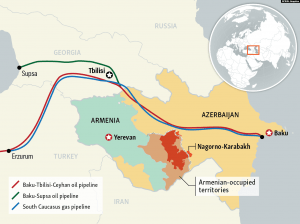
Source: https://www.rferl.org/a/nagorno-karabakh-explainer-conflict-azerbaijan-armenia/27656158.html
Shortly after the border clashes, Russia and Turkey have conducted massive military exercises with their allies in Yerevan and Baku respectively, however denying the links between the military exercises and the recent escalation on the Armenian-Azeri border. Amid the dangerous proxy confrontation between Russia and Turkey in Syria and Libya, the two states’ support for competing parties might trigger the escalation of the Nagorno-Karabakh dispute to a broader conflict involving the foreign intervention.
The Militarization of the Region
The long-running stand-off between Armenia and Azerbaijan has impacted the countries’ military expenditures, which are one of the highest in the world as a percentage of GDP – 4.8% and 3.8% in 2018 respectively.
Between 2009 and 2019 Azerbaijan’s military spending amounted to about $20 billion, according to the Stockholm International and Peace Research Institute. Armenia spent slightly less than $5 billion in the same period. Azerbaijan’s oil revenues permit it to divert considerable resources to the military spending which exceeds Armenia’s military expenditure, which is nevertheless higher as a percentage of GDP. Both states started increasing their military spending which saw some decline in 2016 in the aftermath of the Four-Day War. However, since 2017 the military spending is again on the rise.
Furthermore, both states are investing in the modernization of their weaponry, which is becoming more sophisticated each year. Such trends combined with expansive militaristic rhetoric and stress on the military deterrence are far from contributing to the prospects for restarting a meaningful conflict settlement process.
Conclusion
For several decades, Nagorno-Karabakh remains one of the most intractable and long-standing conflicts in the post-Soviet space. Apart from being a territorial and ethnic dispute between the two former Soviet Republics, the conflict encompasses the clashes between two fundamental principles: the territorial integrity for Azerbaijan and the right to the self-determination for the Armenian population in the region.
Although referred to as “frozen conflict”, its continued escalations indicate otherwise. The recent outbreak of hostilities, as well as some relatively new dynamics in the dispute, including the new flare-up spot, the increased tensions between the third parties to the conflict supporting the rival sides, combined with the both states’ increased military spending and a dangerous spark of hostilities inside the Armenian and Azerbaijani societies, might trigger the conflict spiralling out of control and developing into a major geopolitical confrontation.
As the previous diplomatic efforts, mostly aimed at maintaining the status quo in the region and postponing the military confrontation, proved to be inefficient, the broader international community’s involvement is needed to bring about a long-lasting settlement. Both short-term approach aimed at avoiding the sliding back to violence and a long-term strategy, including more engagement with Armenian and Azerbaijani societies and, eventually, finding the way to balance between the territorial integrity and self-determination principles, should be invoked.
References
Bryza M. (Aug. 2020), “Russia and Turkey may fill in the diplomatic vacuum on Armenia-Azerbaijan conflict” in The Atlantic Council. Available at: https://www.atlanticcouncil.org/blogs/new-atlanticist/russia-and-turkey-may-fill-in-the-diplomatic-vacuum-on-armenia-azerbaijan-conflict/ [Accessed 29 August 2020]
De Waal T. (Aug. 2010), “Remaking the Nagorno-Karabakh Peace Process” in Carnegie Endowment for International Peace. Available at: https://carnegieeurope.eu/2010/08/01/remaking-nagorno-karabakh-peace-process-pub-41367 [Accessed 20 August 2020]
De Waal T. (Dec. 2019), “The Nagorny Karabakh Conflict in its Fourth Decade” in Carnegie Endowment for International Peace. Available at: https://carnegieeurope.eu/2019/12/24/nagorny-karabakh-conflict-in-its-fourth-decade-pub-80791 [Accessed 18 August 2020]
International Crisis Group, The Nagorno-Karabakh Conflict: A Visual Explainer. Available at: https://www.crisisgroup.org/content/nagorno-karabakh-conflict-visual-explainer [Accessed 18 August 2020]
Jones D. (July 2020), “Azerbaijan-Armenia Clashes Highlight Turkey-Russia Rift”. [online] Voice of America. Available at: https://www.voanews.com/europe/azerbaijan-armenia-clashes-highlight-turkey-russia-rift [Accessed 20 August 2020]
Organization for Security and Co-operation in Europe (Jan. 2019), Press Statement by the Co-Chairs of the OSCE Minsk Group. Available at: https://www.osce.org/minsk-group/409220 [Accessed 21 August 2020]
Organization for Security and Co-operation in Europe (March 2019), Press Statement by the Co-Chairs of the OSCE Minsk Group on the Upcoming Meeting of President Aliyev and Prime Minister Pashinyan. Available at: https://www.osce.org/minsk-group/413813 [Accessed 21 August 2020]
Recknagel C. (April 2016), “Explainer: Why The Nagorno-Karabakh Crisis Matters” in Radio Free Europe/Radio Liberty. Available at: https://www.rferl.org/a/nagorno-karabakh-explainer-conflict-azerbaijan-armenia/27656158.html [Accessed 24 August 2020]
Stockholm International Peace Research Institute, Military Expenditure Database. Available at: https://www.sipri.org/databases/milex [Accessed 29 August 2020]
Stronski P. (July 2020), “Behind the Flare-Up Along Armenia-Azerbaijan Border” in Carnegie Endowment For International Peace. Available at: https://carnegieendowment.org/2020/07/22/behind-flare-up-along-armenia-azerbaijan-border-pub-82345 [Accessed 23 August 2020]
Yackley A. J. (July 2020), “Caucasus Fighting Pits Russia Against Turkey, Straining Shaky Alliance” in POLITICO. Available at: https://www.politico.com/news/2020/07/20/turkey-russia-azerbaijan-armenia-374878 [Accessed 21 August 2020]