Developers in the Tourism Industry in the Caribbean: Integrating Crime and Security into Sustainable Tourism Planning
As the Caribbean rethinks its dependence on high-volume tourism, one question remains conspicuously absent. What happens when the security environment is treated as someone else’s problem? Crime and organised criminal influence are uneven across the region, but where they intersect with tourism, they can shape investment, local legitimacy, and the prospects for sustainable growth.
Tourism remains central to the Caribbean’s economic recovery and long-term development. Yet the region’s shift from volume-based tourism toward more sustainable models has largely overlooked a critical variable: crime and organised criminal influence. This brief argues that sustainable tourism cannot be assessed solely through environmental indicators, visitor numbers, or investment volumes. Integrating crime into planning recognises that security conditions are uneven, evolving, and material to the long-term viability of tourism for both states and private investors.
Tourism, Sustainability, and the Missing Security Dimension
As Caribbean countries continue their economic recovery from COVID-19 (Caribbean Tourism Organization, 2025; FDI Intelligence, 2024), discussions around the sustainability of tourism in the region are gaining renewed attention. Caribbean economies remain highly dependent on tourism (Muhummed, 2025), which supports over 2.5 million jobs (Sustainable Travel International, n.d.) and attracts significant foreign investment (UN Tourism, 2025).
The discourse on sustainable tourism emphasises environmental protection, climate resilience, community-based models, and greater local participation in the tourism value chain (Leotaud et al., 2024; Maday et al., 2026; Sheller, 2020). It also calls for a move away from low-yield, high-volume models (Peterson, 2023; Conway and Timms, 2010) toward higher-value experiences embedded in environmental and cultural preservation that create more formalised job opportunities in destination countries (World Bank, 2025; World Bank, n.d.) and increase resilience to shocks (International Labor Organization, 2024).
These conversations often take place in parallel to, rather than in conjunction with, discourse on violence and organised criminal influence. The resulting policy silo creates a missed opportunity to systematically consider how criminal markets, violence, and insecurity shape the conditions under which tourism develops. Furthermore, funding gaps created by development finance cuts (Woolston et al., 2025; DiPierro Obert, 2025) and capacity constraints faced by small-island governments (Le-Cour-Grandmaison, 2025) only increase the importance of the private sector in supporting progress towards sustainable development (United Nations Development Programme, n.d.; Global Partnership for Effective Development Co-operation, n.d.).
This gap matters. Crime and violence are well-established development issues (United Nations Office on Drugs and Crime, 2024; Tobón & Sviatschi, 2025). Econometric work in Latin America and the Caribbean has found a negative and statistically significant relationship between crime levels and tourism performance, as well as broader economic impacts (Perez-Vincent et al., 2024). Historic estimates suggest that if Jamaica and Haiti reduced their homicide rates to Costa Rica’s levels, each could see growth increases of around 5.4% (United Nations Office on Drugs and Crime and World Bank, 2007).
This brief does not argue that crime automatically causes declines in tourism. Rather, it suggests that security conditions form a core part of the environment in which tourism investment and development occur and should therefore be more explicitly incorporated into sustainable tourism planning. Taking this into account and considering how tourism support initiatives targeting criminality prevention are key to advancing sustainable tourism in a holistic sense.
Additionally, the industry must take note that where tourism increases living costs, restricts access to resources or displaces residents, local opposition can emerge. This is visible in Puerto Rico, where residents have protested luxury developments such as Sol y Playa and Esencia (Murphy Marcos, 2022; Rival, 2025), and in Jamaica, where civil cases challenge the privatisation of beach access that locals say undermines livelihoods dependent on the sea (Gibson, 2024; Nair & McLeod, 2020; Duncan, 2026; Business and Human Rights Centre, 2026). In contexts already affected by crime and inequality, which research indicates are related concepts (Love et al., 2025; Schargrodsky & Freira, 2023), this matters for the sector’s social credibility and long-term sustainability.
Uneven but Significant: What the Crime Data Shows
Despite improvements, Latin America and the Caribbean remain one of the subregions where adults feel the most unsafe (GALLUP, 2025). The widespread availability of firearms has contributed to high homicide rates in the region (United Nations Office on Drugs and Crime, 2024), with particularly elevated levels in Haiti, St Vincent and the Grenadines, and Turks and Caicos.
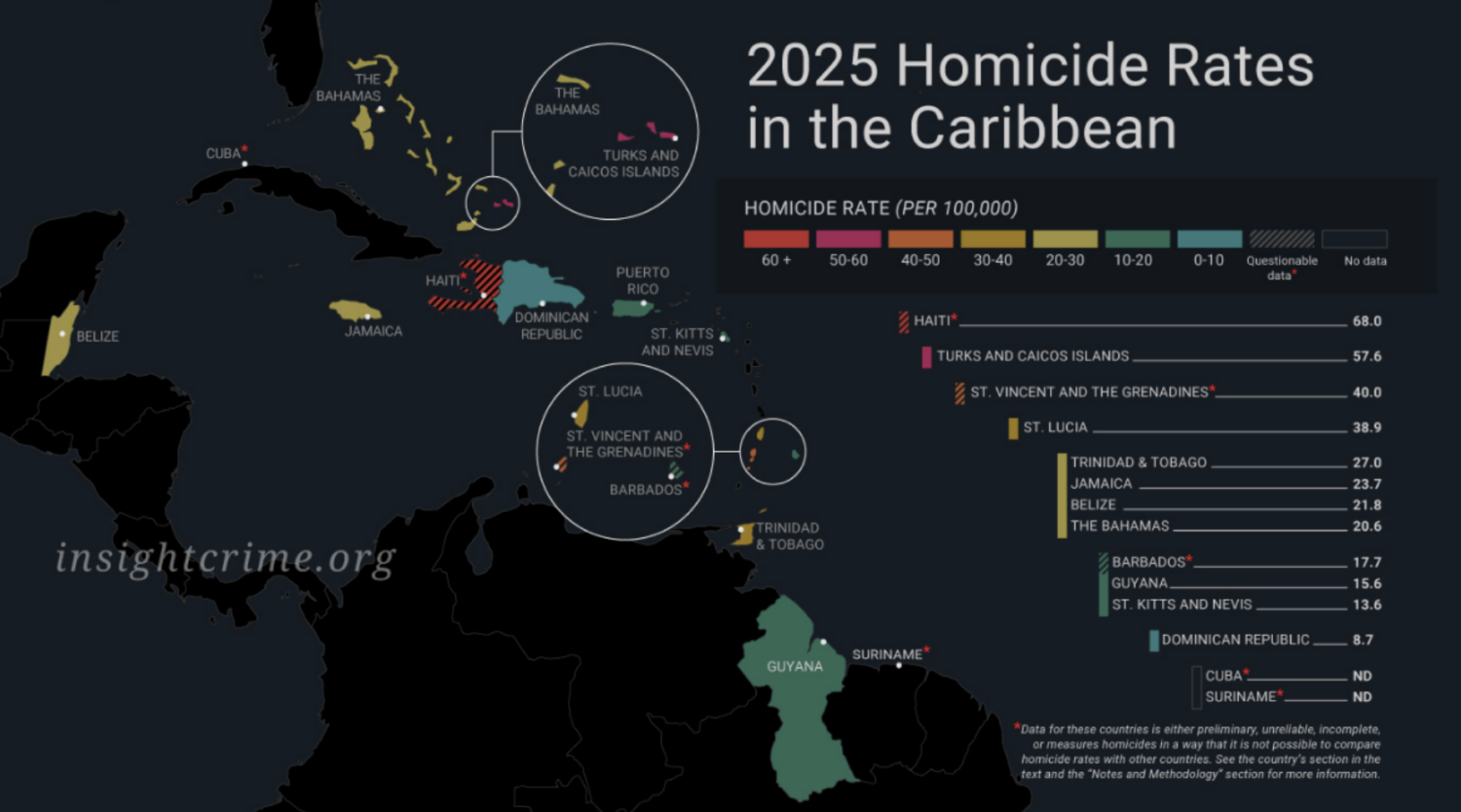
Figure 1
Source: Insight Crime (2025): https://insightcrime.org/wp-content/uploads/2026/03/Flagship-2025-Homicide-Rates-in-the-Caribbean-InSight-Crime-Mar-2026-3.jpg
Two other indicators measuring organised crime also map the issue in the Caribbean: average criminality scores and the prevalence of criminal actors.
Figure 2
Figure 2 tracks average criminality scores across selected Caribbean countries between 2021 and 2025. Trends are uneven. Some countries recorded declines, while Belize and Trinidad and Tobago saw increases. Jamaica and the Dominican Republic remained comparatively high.
Figure 3
Figure 3 examines the influence of criminal actors between 2021 and 2025. Criminal-actor influence also varies considerably. While several countries recorded declines by 2025, the Bahamas, Belize and the Dominican Republic saw increases, while Jamaica remained significant despite a decline from 2021.
Why this Matters for the Private Sector
The key point is not that higher scores automatically lead to tourism decline. It is that several countries consistently register scores of 4 and above, implying at least a moderate influence of criminal actors on parts of society and the economy. Some of these countries, such as the Dominican Republic and Jamaica, are also major tourism and investment destinations (Hope Research Group, 2026; UN Tourism, 2025). Criminal markets and operations, including weapons, human, and drug trafficking, are not only harmful, but where they overlap with tourism activity, they can create operational, reputational and social risks, potentially threatening the development of higher value, sustainable tourism.
The risk is not simply that crime exists, but that it is insufficiently integrated into planning for sustainable tourism. If social and security issues are treated as external to tourism strategy, several risks emerge:
- Reputational risk: insecurity and community opposition can damage destination brands and investor confidence.
- Operational risk: violence, extortion, corruption and trafficking can increase costs and disrupt operations.
- Social licence risk: development perceived as excluding residents or worsening living conditions can generate opposition.
- Long-term viability risk: tourism that prioritises short-term volume over inclusive development may be less resilient to external shocks.
Ignoring these risks undermines the opportunities for tourism to move towards a genuinely sustainable model.
Recommendations Going Forward: Integrating Crime Analysis into Sustainable Tourism Planning
Sustainable tourism planning should treat crime and security as core variables, not peripheral concerns. The following can operationalise this:
Add crime indicators to tourism and sustainability assessments. Tourism development projects, investment-risk analyses, and community consultations should be complemented by regular monitoring of organised-crime and related social indicators, including criminality scores, criminal-actor influence, homicide trends, corruption risks, job quality, community perceptions of safety, and local economic inclusion. This requires collaboration between governments, international organisations, private investors, and local communities.
Adopt country-specific risk analysis. Regional averages can obscure differences between countries. Investors and policymakers should therefore assess criminality, institutional vulnerability, and community dynamics relevant to each project. As highlighted by the Prime Minister of St. Kitts and Nevis, there is sometimes a tendency to generalise hemispheric security dynamics (Drew, 2024).
Make tourism investment deliver meaningful local benefits. This is a multistakeholder goal. It involves the private sector engaging with prevention initiatives recognised by the criminality literature, such as generating more formalised job opportunities targeting youth, incorporating local businesses into procurement, and better engagement with local communities to expand opportunities and raise the expected cost of crime (Tobón et al., 2025). Governments and local decision-makers must go beyond inviting public-sector engagement and utilise investment frameworks, partnerships, and policy spaces to establish expectations and prioritise local economic and community benefits in conversations around tourism investment.
For the Caribbean’s transition from volume-based tourism to be sustainable in the long term, stakeholders should consider serious engagement with crime and security. The data show that criminal influence is uneven but significant in several key tourism markets.
The central policy challenge is not simply to protect tourism from crime, but to ensure that tourism development contributes to the social and economic conditions that make destinations more resilient to insecurity. For investors, this means treating security as a core component of long-term value creation. For governments and international organisations, it means designing tourism initiatives that explicitly address social and security dimensions. Only then can the region’s tourism sector deliver on aspirations of sustainable, inclusive growth.
Bibliography
- Allen, M. “Lessons learnt from the experience of countries in the Caribbean in aligning tourism investment, business and operations with the United Nations Sustainable Development Goals (SDGs).” Worldwide Hospitality and Tourism Themes, Emerald (2020). https://doi.org/10.1108/WHATT-02-2020-0003
- Business and Human Rights Centre. “Jamaica: Communities challenge beach privatization benefiting luxury hotel chains.” 14 June, 2026. https://www.business-humanrights.org/en/latest-news/jamaica-communities-take-legal-action-against-the-privatisation-of-beaches-in-favour-of-luxury-hotel-chains/
- Caribbean Tourism Organization. “Caribbean Tourism Maintains Strong Growth in 2024, Surpassing Pre-Pandemic Levels.” April 28, 2025. https://www.onecaribbean.org/caribbean-tourism-maintains-strong-growth-in-2024-surpassing-pre-pandemic-levels/
- Conway, D. and Timms, B.F. “Re-Branding Alternative Tourism in the Caribbean: The Case for “Slow Tourism”.” (2010). Tourism and Hospitality Research, 10, pp. 329–344. https://doi.org/10.1057/thr.2010.1
- DiPierro Obert, J. “US funding cuts fuel child recruitment into Haiti’s armed groups’, The New Humanitarian.” August 19, 2026. https://www.thenewhumanitarian.org/news-feature/2026/08/19/us-funding-cuts-fuel-child-recruitment-haitis-armed-groups
- Drew, T.M. ‘Special Security Concerns of the Small Island and Low-Lying Coastal Developing States of The Caribbean’, presentation by the Honourable Dr Terrance M. Drew, Prime Minister of Saint Kitts and Nevis, Chair of CARICOM Council on National Security and Law Enforcement (CONSLE), 2 May (2024) https://scm.oas.org/pdfs/2024/CP49826Keynote.pdf
- Duncan, N. “The battle for access to Jamaica’s billion-dollar beaches.” The Guardian, July 3, 2026. https://www.theguardian.com/environment/2026/jul/02/down-to-earth-jamaica-beaches-public-access-privatisation-campaign
- FDI Intelligence. Tourism Investment 2024: Global greenfield investment trends in tourism. (2024). https://pre-webunwto.s3.eu-west-1.amazonaws.com/s3fs-public/2025-01/001-028_FDISUP_1124.pdf?VersionId=OoaSmRVVrZR03yXllOn2fQAkpslQhvSq
- Gallup. “What is the Law and Order Index?.” September 17 2025. https://www.gallup.com/analytics/694904/what-is-law-order-index.aspx
- Gibson, B. (2024) ‘Jamaica’s Crippled Tourism Industry Further Weakened by Worker Protests’, IR Insider, 3 December. https://www.irinsider.org/north-america-2/k64fs2cycfdattt-jc89j-dfkae-6y89r-pgppy-ae4ec-s9l7n-9aeyz-spw82-pbyf7-tr53n-ty4hf-et2p6-7cclj-ssmnm
- Global Partnership for Effective Development Co-operation. Private Sector Engagement. (n.d.). https://effectivecooperation.org/private-sector-engagement
- Hope Research Group.Caribbean Tourism 2025: Complete Industry Report, January 29 (2026). https://www.hoperesearchgroup.com/blog/caribbean-tourism-statistics-2025
- InSight Crime. Flagship 2025: “Homicide Rates in the Caribbean”, March 2026. https://insightcrime.org/wp-content/uploads/2026/03/Flagship-2025-Homicide-Rates-in-the-Caribbean-InSight-Crime-Mar-2026-3.jpg
- Le-Cour-Grandmaison, R. “Responding to organized crime in the Caribbean.” Global Initiative Against Transnational Organized Crime, December 23 2025. https://globalinitiative.net/announcements/responding-to-organized-crime-in-the-caribbean/
- Leotaud, N., Laidlow-Ferdinand, A., Clauzel, S. and Vaughan, N. Towards Sustainable Blue Tourism in the Caribbean: Policy Pathways to Support Community-Based Coastal and Marine Tourism. Blue Tourism Initiative Diagnostic Study. (2024) Port of Spain: CANARI. https://www.researchgate.net/profile/Nicole-Leotaud/publication/384860878_Towards_Sustainable_Blue_Tourism_in_the_Caribbean
_Policy_Pathways_to_Support_Community-Based_Coastal_and_Marine_Tourism/links/670a2dcdab024170996b66e5/Towards-Sustainable-Blue-Tourism-in-the-Caribbean-Policy-Pathways-to-Support-Community-Based-Coastal-and-Marine-Tourism.pdf - Love, H., Liu, A. and Krupicka, B. “The path to public safety requires economic opportunity: Trends and solutions in urban, suburban, and rural communities.” Brookings Institute, March 11 2025. https://www.brookings.edu/articles/the-path-to-public-safety-requires-economic-opportunity/
- Maday, M., García Sánchez, V., Duran-Fernandez, R. and Betinni Vicente, J. “Tourism in Latin America and the Caribbean: Five Concrete Actions to Turn Potential Into Results.” Inter-American Development Bank, April 28 2026. https://www.iadb.org/en/blog/trade-and-investment/tourism-latin-america-and-caribbean-five-concrete-actions-turn-potential-results
- Muhummed, A. “Beyond Tourism: A Policy Framework for Economic Diversification and Job Creation in the Caribbean”. International Labour Organization, May 21 2025. https://www.ilo.org/resource/article/beyond-tourism-policy-framework-economic-diversification-and-job-creation
- Murphy Marcos, C. ““The beaches belong to the people”: inside Puerto Rico’s anti-gentrification protests.” The Guardian, July 23 2022. https://www.theguardian.com/us-news/2022/jul/23/puerto-rico-beach-anti-gentrification-protests
- Nair, V. and McLeod, M. “Lessons learnt from the experience of countries in the Caribbean in aligning tourism investment, business and operations with the United Nations Sustainable Development Goals (SDGs).” (2020). Worldwide Hospitality and Tourism Themes, Emerald. https://doi.org/10.1108/WHATT-02-2020-0003
- Perez-Vincent, S.M., Puebla, D., Alvarado, N., Mejía, L.F., Cadena, X., Higuera, S. and Niño, J.D. The Costs of Crime and Violence: Expansion and Update of Estimates for Latin America and the Caribbean. (2024). Inter-American Development Bank. https://publications.iadb.org/en/costs-crime-and-and-violence-expansion-and-update-estimates-latin-america-and-caribbean
- Peterson, R.R. “Over the Caribbean Top: Community Well-Being and Over-Tourism in Small Island Tourism Economies.” (2023). International Journal of Community Well-Being, 6(2), pp. 89–126. https://doi.org/10.1007/s42413-020-00094-3
- Rival, L. “Socioenvironmental Justice and the Limits of Non-Sovereignty: Lessons from Guåhan and Puerto Rico.” UNPO Academy, February 17 2026. https://academy.unpo.org/socioenvironmental-justice-and-the-limits-of-non-sovereignty-lessons-from-guahan-and-puerto-rico/
- Schargrodsky, E. and Freira, L. “Inequality and Crime in Latin America and the Caribbean: New Data for an Old Question.” (2023). Economía LACEA Journal, 22(1), pp. 175–202. https://doi.org/10.31389/eco.413
- Sheller, M. “Reconstructing tourism in the Caribbean: connecting pandemic recovery, climate resilience and sustainable tourism through mobility justice.” (2020). Journal of Sustainable Tourism. https://doi.org/10.1080/09669582.2020.1791141
- Sustainable Travel International. Caribbean Islands. (n.d.) https://sustainabletravel.org/places/caribbean-islands/
- Tobón, S. and Sviatschi, M.M. “Organised Crime.” VoxDevLit, 11 September 2025. https://voxdev.org/voxdevlit/organised-crime/consequences-organised-crime
- Tobón, S., Sviatschi, M.M. and Cabra-Ruiz, N. “Organised Crime and Development.” (2025). VoxDevLit, 17(1). https://www.voxdev.org/sites/default/files/2025-09/Organised_Crime_Issue_1.pdf
- United Nations Development Programme “The importance of collaboration with the private sector.” (n.d.) https://www.undp.org/romecentre/private-sector-engagement
- United Nations Office on Drugs and Crime Caribbean Gangs: Drugs, Firearms and Gang Networks in Jamaica, Saint Lucia, Guyana and Trinidad and Tobago. (2024) https://www.unodc.org/documents/data-and-analysis/AOTP/Caribbean_Gangs_Drugs_firearms_and_gang_networks_in_Jamaica_
Saint_Lucia_Guyanaand_Trinidad_an_July_2024_Final.pdf - United Nations Office on Drugs and Crime and World Bank. Crime, Violence, and Development: Trends, Costs, and Policy Options in the Caribbean. (2007). Report No. 37820. https://openknowledge.worldbank.org/server/api/core/bitstreams/8c4b328d-8e67-5808-b95f-f8161cab1133/content
- UN Tourism. La inversión en el sector turístico de América Latina y el Caribe. (2025). https://www.e-unwto.org/doi/epdf/10.18111/9789284426003
- Woolston, S., Papadovassilakis, A. and Vincent Fernández, B. “Experts Say US Aid Slashes Will Hinder Anti-Drug and Crime Efforts in Latam.” InSight Crime, April 30 2025. https://insightcrime.org/news/experts-say-us-aid-slashes-will-hinder-anti-drug-and-crime-efforts-in-latam/
- World Bank. Rethinking Caribbean Tourism: Strategies for a More Sustainable Future. (2025). https://documents.worldbank.org/en/publication/documents-reports/documentdetail/099032425104521240
- World Bank. Rethinking Caribbean Tourism: Building a Sustainable, Inclusive, and Resilient Future. (n.d.). https://www.worldbank.org/en/events/2025/06/12/reimagining-caribbean-tourism-building-a-sustainable-inclusive-and-resilient-futur