Beyond the American Umbrella: Europe’s Strategic Response to American Uncertainty
As France and Germany increase investment in defense, President Trump remains hesitant about strengthening the NATO alliance it shares with its European allies and improving transatlantic relations.
On March 2, 2026, French President Emmanuel Macron made an announcement that is considered “the most significant overhaul of French nuclear policy in 30 years” (Landler, 2026). In a speech made in front of the formidable Ile Longue nuclear submarine base, Macron announced French intentions to boost its nuclear arsenal and cease the disclosure of French nuclear capabilities, which is a deviation from its past transparency policies (Al Jazeera Staff and AFP, 2026).
A month later, German Defense Minister Boris Pistorius announced a new defense strategy that is focused on developing the German military into the “strongest conventional army in Europe” by 2039. The ultimate aim of this strategic shift is to decrease European dependence on the United States for security against Russia (Lunday, 2026). By the end of the 2030s, Germany’s defense expenditures are projected to account for nearly ⅓ of the federal budget (Nostlinger, 2026).
These shifts are not simply isolated incidents of growing military ambition; rather, they are part of a trend of increased focus on military spending and regional defense cooperation across Europe. As the Trump administration makes threats about American NATO involvement, shifts in European military policy suggest a new era of strategic defense with Europe as a more self-sufficient player on the world stage.
American Hesitancy Under President Trump
With the United States distancing itself from traditional allies, such as NATO, the second Trump administration has marked a major alteration in American foreign policy. Since his first term as president, President Donald Trump has threatened to leave NATO numerous times, citing American disappointment in disproportionate military contributions between the United States and its European partners. This tension between the Trump Administration and the NATO alliance has only worsened within his second administration, especially as Trump has repeatedly threatened to invade Greenland (Cooke, 2026).
American hesitancy and the threat of retracted support present a large risk within the European security arena, especially as the war in Ukraine continues. European nations still largely rely on U.S.-made weapons and American military support, meaning that the disappearance of U.S. aid could leave the entire continent vulnerable (Clark, 2025).
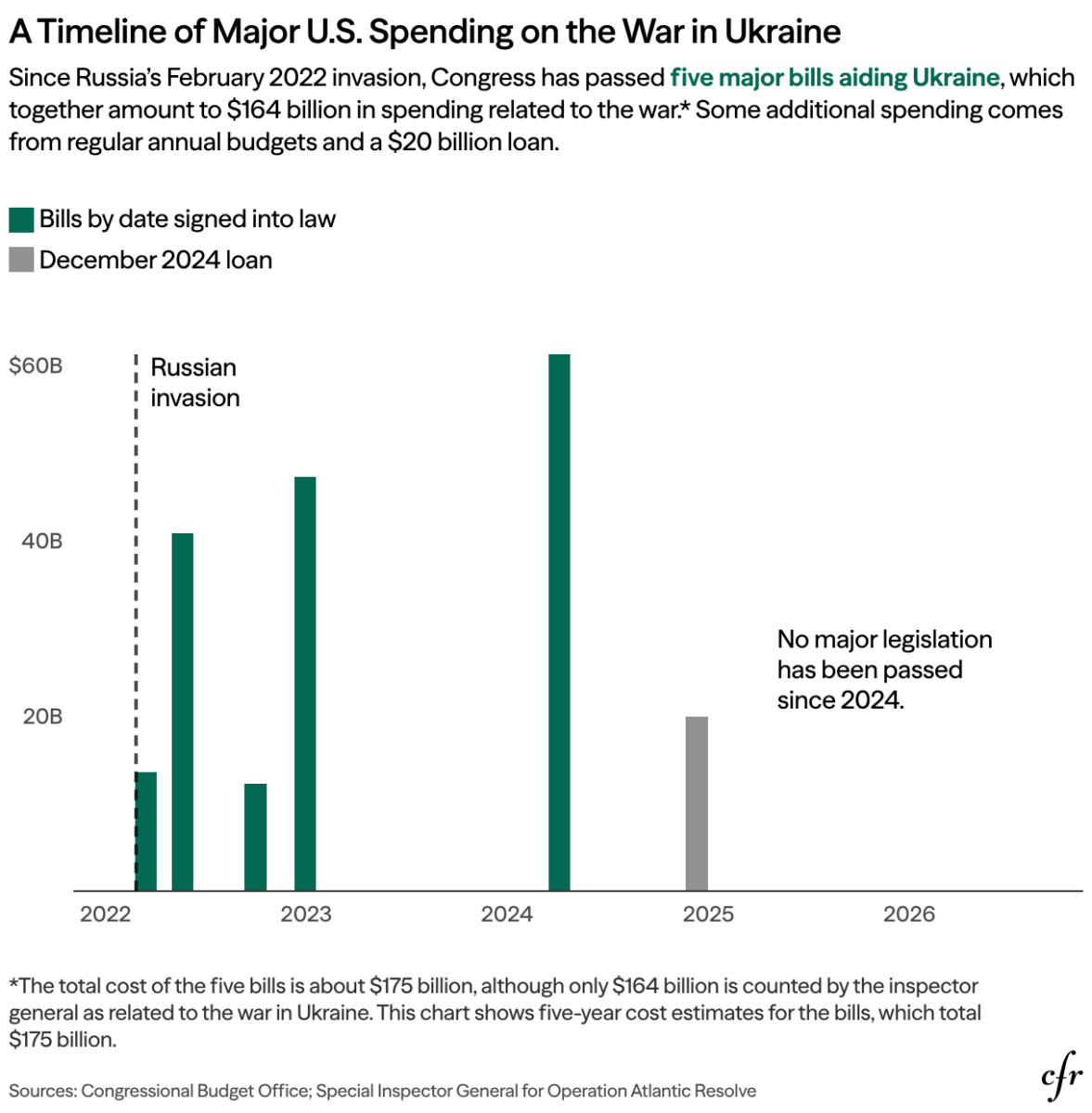
The weakening of American support can be seen in aid legislation records, with no significant aid legislation in support of Ukraine having been passed since 2024, the last year of the Biden presidency (Masters and Morrow, 2026).
Europe’s Strategic Response
European governments have responded to this uncertainty with significant increases in defense spending and military cooperation. According to the Stockholm International Peace Research Institute (SIPRI), military spending reached $864 billion in 2025, which is a 14% increase from the previous year (SIPRI, 2026). On the EU level, defense expenditures among member states rose by 75.3% between 2021 and 2026 (European Council, 2026). While Russia’s invasion of Ukraine initially drove these increases, it also reflected a broader effort to reduce Europe’s dependence on American security guarantees during the age of Trump.
Beyond increased spending, European governments have also begun to strengthen regional defense cooperation. Central to Macron’s new nuclear doctrine is a system of “advanced deterrence,” under which eight other European countries (the United Kingdom, Germany, Poland, the Netherlands, Belgium, Greece, Sweden, and Denmark) would participate in French nuclear exercises and host French nuclear aircraft (Schofield, 2026). Although Macron, among other European leaders, has emphasized that these measures are intended to complement NATO rather than to replace it, they represent a significant shift toward a more integrated European defense structure.
Rather than waiting to see whether the United States ultimately reduces its role in Europe, governments are already adapting their security strategies to account for that possibility. In this sense, uncertainty surrounding future U.S. commitments has become a political risk in itself, prompting European states to strengthen both their military capabilities and regional defense cooperation to prepare for a less predictable transatlantic alliance.
Conclusion
On a national and regional level, the recent shifts in European defense policy demonstrated that political risk extends beyond armed conflict and economic instability. It also stems from changes in political leadership and the uncertainty they can introduce into long-standing international alliances. While NATO remains the cornerstone of European security, recent tensions between the Trump administration and its European allies have shown how quickly assumptions about alliance cohesion can be challenged. Even without a formal withdrawal from NATO, uncertainty surrounding future American commitments has already begun to reshape European defense policy.
In response, Europe has increasingly invested money into strengthening its own military capabilities and expanding regional defense cooperation. Rather than undermining NATO, a more capable and self-reliant Europe can make the alliance more resilient while providing a fail-safe, should the alliance weaken further. Democratic governments naturally experience changes in leadership and foreign policy over time, making some degree of strategic uncertainty unavoidable. By developing stronger independent defense capabilities, European states are better positioned to adapt to future political shifts without compromising their collective security.
As the international system becomes increasingly volatile, building more robust and diversified security capabilities may prove to become one of Europe’s most effective tools for managing the political risks of an unpredictable geopolitical landscape.
Bibliography
Al Jazeera Staff and AFP (2026) France to increase nuclear warheads, lend nuclear aircraft to Europe allies | nuclear weapons news | al jazeera. Available at:
https://www.aljazeera.com/news/2026/3/2/france-to-increase-nuclear-warheads-lend-nuclear-airc raft-to-europe-allies (Accessed: 28 July 2026).
Clark, A. (2025) Armed by America: How Europe’s militaries depend on the US – a visual analysis | arms trade | the guardian. Available at:
https://www.theguardian.com/world/ng-interactive/2025/jun/24/visual-guide-can-europe-really-defend-itself-alone (Accessed: 28 July 2026).
Cooke, L. (2026) NATO chief Faces Challenge at Summit as Trump demands ‘loyalty’ and not just burden-sharing | PBS news. Available at:
https://www.pbs.org/newshour/world/nato-chief-faces-challenge-at-summit-as-trump-demands-loyalty-and-not-just-burden-sharing (Accessed: 28 July 2026).
European Council (2026) EU Defence in numbers – consilium. Available at: https://www.consilium.europa.eu/en/policies/defence-numbers/ (Accessed: 28 July 2026).
Landler, M. (2026) Macron expands French nuclear arsenal and vows protection for neighbors – The New York Times. Available at:
https://www.nytimes.com/2026/03/02/world/europe/france-nuclear-arsenal-macron.html (Accessed: 28 July 2026).
Lunday, C. (2026) Less America, more Europe in Germany’s new military strategy. Available at: https://www.politico.eu/article/germany-military-strategy-bundeswehr-boris-pistorius/ (Accessed: 28 July 2026).
Masters, J. and Merrow, W. (2026) Here’s how much aid the United States has sent Ukraine | Council on Foreign Relations. Available at:
https://www.cfr.org/articles/how-much-us-aid-going-ukraine (Accessed: 28 July 2026).
Nöstlinger, N. (2026) Germany ramps up defense spending in new budget plan ahead of NATO Summit – politico. Available at:
https://www.politico.eu/article/germany-ramps-up-defense-spending-in-new-budget-plan-ahead of-nato-summit/ (Accessed: 28 July 2026).
Schofield, H. (2026) France to boost nuclear arsenal and extend deterrence to European allies. Available at: https://www.bbc.com/news/articles/cj4zlnezrl7o (Accessed: 28 July 2026).
SIPRI (2026) Global military spending rise continues as European and Asian expenditures surge | sipri. Available at:
https://www.sipri.org/media/press-release/2026/global-military-spending-rise-continues-european-and-asian-expenditures-surge (Accessed: 28 July 2026).