How the 2028 Taiwanese Elections Could Determine Beijing’s Calculus in the Taiwan Strait
China’s growing alignment with the Kuomintang and the risk of election interference make Taiwan’s 2028 vote a decisive moment for regional stability.
In January 2028, the Indo-Pacific faces a vital election that could determine forthcoming regional tensions and diplomatic relations. Taiwan will have its paramount presidential election in 2028, which China is closely monitoring and potentially influencing.
Despite fears that China could militarily make a move on Taiwan in 2027, Beijing would be unwilling to conduct direct action due to the major international repercussions. Instead, China is eyeing a reconciliatory approach with their old longtime rival, the Kuomintang (KMT), which is becoming increasingly aligned with Beijing’s interests.
The Democratic Progressive Party (DPP) looks to ensure re-election amid cross-strait tensions and rapid regional changes. However, with the global rise of populism along with foreign interference in domestic elections via hybrid and informational warfare, Taiwan’s next several years could be determined by either a pro-Beijing government or the continuation of self-determination.
The 2028 Elections in Taiwan
Taiwan’s current Democratic Progressive Party is facing key challenges from a more mainland-reconciliatory KMT that is pushing the country into an inflexion point. Despite key improvements under the DPP such as an increased defense budget, a high trade surplus, and enhanced relations with America, Japan, and others, the ruling party faces setbacks that the Kuomintang could take advantage of.
Taipei’s political status could be described as both a deadlock and cracks in the country’s overall security apparatus. While the DPP won the presidency in 2024, the KMT and its allies of the Taiwan People’s Party (TPP) hold the majority in parliament.
Currently, the combined KMT and TPP coalition have 60 legislative seats compared to the DPP’s 51 seats. After a disastrous recall that only strengthened the opposition, the DPP has slowly lost confidence amongst a sizable portion of the Taiwanese population.
Lastly Taiwan’s localized elections in November 2026 could determine which party has momentum going into 2028 as the population is divided in socioeconomic gridlock akin to the Taiwanese parliament.

Why China Favors the Kuomintang
Initially, major rivals that fought each other for several decades, Taiwan’s Kuomintang has made reconciliatory strides with China’s ruling communist party (CCP). Furthermore, Taiwanese President Lai Ching-te faces continuous attacks by the Chinese government and his KMT rivals as Lai has proposed increased defense spending and promotes a separate national identity in Taiwan.The Kuomintang party is now the polar opposite of the DPP. Under the leadership of Cheng Li-wun, the KMT is promoting its former ties to the mainland and the CCP’s main ‘One China’ policy to grow cross-strait relations.
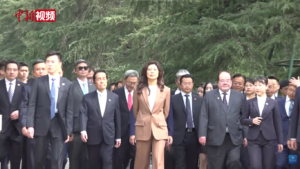
Despite being former wartime rivals, the Kuomintang sees itself as having a foot at the table regarding future policies on the mainland. Both the KMT and CCP have majority ethnic Han leadership, which is a key focus of why the Kuomintang sees itself as part of future ‘One China’ policies.
After decades-long oppressive rule in Taiwan ended in 1987, the KMT has gradually made steps to adhere to close relations with China, while the DPPstrives towards self-determination and a distinct identity.
Xi Jinping, the longstanding CCP chairman and Chinese premier, has overlooked Cheng’s cultural unification rhetoric and recently hosted a summit with Cheng Li-wun. The KMT’s obstruction of government is currently invaluable for Beijing as the party has stalled a major $40 billion defense proposal for Taipei.
Potential Election Interference
Amid the pivotal 2028 Taiwanese general election, there are fears of potential foreign interference by Beijing, which looks to use its close ties with KMT chairwoman Cheng Li-wun to its advantage. In late 2025, the Yomiuri Shimbun reported that GoLaxy, a company with ties to the CCP, used sophisticated Artificial Intelligence (AI) to influence campaigns in not just Taiwan, but also Hong Kong.
The report came against the backdrop of the Institute of National Security at Vanderbilt University, which obtained over 400 documents during an investigation of GoLaxy. As GoLaxy provides analyses of daily routines, values, and cultural norms, the AI model creates fictional characters that are used to influence a society’s opinions.
The Chinese government could attempt to deploy informational warfare in Taiwan as the Kremlin has done with countries with Russian-speaking populations. Akin to the Kremlin supporting pro-Russian candidates who advocated for annexation or closer ties in Ukraine and Georgia, Beijing could employ the same tactic with the KMT.
Furthermore, the Kuomintang are promoting not only a One China policy, but one ethnicity, as Cheng Li-wun openly promotes Chinese heritage as a basis for nationalism, while the DPP see Taiwanese as a distinct nationality. As seen in Ukraine, with Russian speakers and ethnic Russians seeing themselves as Ukrainian, you can be Chinese but see yourself as a Taiwanese national, and this self-determination identity is what China wants to negate, as Beijing is doing to Hong Kong.
How the Winning Party Could Shape Xi’s Cross Strait Calculus
A victory for the DPP would be a blow to China, which hopes for a more diplomatic coercive approach to unifying Taiwan rather than a militaristic option that would come with major international repercussions akin to Russia’s invasion of Ukraine. A potential KMT victory wouldn’t lead to direct unification—especially as many Taiwanese would be against the measures, but Beijing could exert greater influence on Taipei.
Growing CCP-KMT relations could help China influence key decisions in Taiwan such as continued stalling of the aforementioned supplemental defense increase bills and prolonging military partnerships with the United States and Japan. Enhanced trade and cultural institutions between the CCP and KMT would allow Beijing to continue to promote one identity as a way to negate self-determination.
Lastly, a KMT victory would bring Xi Jinping closer to peaceful unification, which is preferable over a costly war, and China would use the Hong Kong-style approach to Taiwan, having a close partner in charge of the island.
For the DDP, a victory in 2028 would help solidify self-determination in Taiwan, along with beating the KMT’s growing populist rhetoric, which is now being backed as the country’s top existential threat. Both the KMT and CCP would have to recalibrate their strategy to have strong cross-strait relations, as the DPP will continue to promote a Taiwanese identity over a Chinese national one.
A potential majority victory will allow the DPP to unblock the major defense procurement bill, which will be critical for Taiwan’s defense as China continues to build up its military capabilities. The DPP is also strong diplomatically with Japan’s Liberal Democratic Party and the U.S. government, which is crucial as Tokyo and Washington are two countries that will almost certainly directly militarily intervene to defend Taipei.
Assessment Conclusion
Taiwan’s 2028 election is not only pivotal for the country’s trajectory, but also existential for the future of how cross-strait relations will play out. A Kuomintang victory would allow China to have the close relations it wants with Taiwan, where a slow implementation of the Hong Kong takeover and influence would be preferable over a devastating blockade or direct amphibious assault.
The ruling Democratic Progressive Party can push back against hybrid and informational warfare that Beijing and the Kuomintang are utilizing against Taipei, which continues to look for a path of self-determination rather than past policies of connection to the Mainland.
Overall, one thing is clear—China will wait past 2027 and put chips on the table for the 2028 Taiwanese elections before making a critical decision over a closing window of diplomatic or forceful reunification.