The Floor That Isn’t There: Environmental and Systemic Risk in the 2026 Iran Conflict
This essay is a companion to The OPEC Endgame? which documented the structural logic of the 2026 US-Israel-Iran conflict. While that essay asked how we arrived at this point, this essay asks what might happen if the conflict’s current logic runs to its conclusion. It analyzes four principal severe and long-lasting potential consequences in turn: an Iranian denial strategy, hydrological risk, food supply chain disruption, and an irrevocable shift in nuclear weapon precedent.
The Conversation That Is Not Happening
There is a scenario embedded in the logic of the 2026 Iran conflict that public discourse has not yet named directly. It does not require a nuclear weapon. It does not require a decision made in Washington. It requires only that a regime under existential military pressure reaches a conclusion that cornered regimes have reached before: if we are going to lose everything, we will make sure our adversaries cannot enjoy what they came for.
The Islamic Republic of Iran controls, or until recently controlled, physical access to the most consequential body of water in the global economy. The Strait of Hormuz — through which approximately one-fifth of the world’s oil and liquefied natural gas passes daily, per Al Jazeera and the UK government’s own multilateral statement of April 2026 — is bordered on its northern shore by Iranian territory. The oil fields, pipelines, processing terminals, and export infrastructure of Saudi Arabia, the UAE, Kuwait, and Qatar sit in a Gulf that Iran can reach. The world’s densest concentration of petroleum infrastructure exists within range of a regime that has spent forty years building asymmetric capacity precisely for scenarios in which conventional military defeat was assumed.
The conventional framing of escalation risk in this conflict centers on nuclear capability — on whether Iran has a functional weapon, whether the US would use one, and whether Israel would. These are legitimate questions, yet they are not the most immediate ones. The more immediate question is what Iran does with what it already has and what it has already demonstrated it is willing to use: drones, missiles, proxy networks, and the straightforward option of destroying infrastructure it cannot keep but can deny. A regime that concludes it has nothing left to lose does not need a nuclear weapon to threaten civilizational consequences. It needs to set the Gulf alight.
The precedent exists. In 1991, retreating Iraqi forces set fire to approximately 700 Kuwaiti oil wells. Airborne studies conducted in the spring of that year, published in Science by Hobbs and Radke, found approximately 4.6 million barrels of oil burning per day at the fires’ peak — releasing soot at a rate of 3,400 metric tons daily and absorbing seventy-five to eighty percent of incoming solar radiation across regions of the Persian Gulf. The fires burned for ten months.
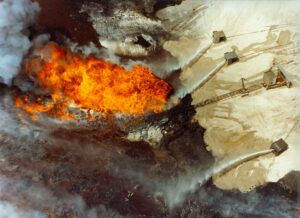
That was a conventional military force executing a denial strategy under defeat. It required no special weapons, no command authority beyond the order to destroy, and no modern technology. What Iran has available to it in 2026 — in terms of the geographic reach of its proxies, the density of infrastructure within range, and the sophistication of its asymmetric strike capability — makes the Kuwait comparison a floor, not a ceiling.
This essay examines what happens when that floor is activated. Not as prediction — Iran may yet find a path to negotiated survival that removes this calculus entirely. But as consequence modeling, offered in the belief that the scenario is sufficiently plausible, sufficiently under-discussed, and sufficiently catastrophic in its physical implications to warrant the serious public analysis it is not currently receiving. The four dimensions that follow — atmospheric, hydrological, food chain, and precedent — are not abstractions. They are the physical infrastructure of a world that assumes the Gulf continues to function. This essay asks what happens when a cornered regime decides it will not.
The Atmospheric Dimension
The 1991 Kuwait oil fires are the closest analogue available for what deliberate large-scale infrastructure destruction in the Gulf would produce. They are not a good analogue. They are simply the best one we have — and the gap between what happened in Kuwait and what is now conceivable in the broader Gulf is large enough to make the comparison clarifying rather than reassuring.
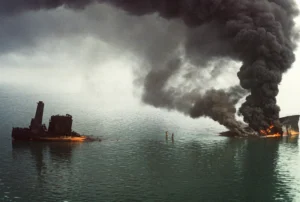
The airborne studies conducted by Hobbs and Radke in the spring of 1991, among the most rigorous scientific assessments of the fires, documented approximately 4.6 million barrels burning per day. The smoke absorbed seventy-five to eighty percent of solar radiation across regions of the Gulf. Smoke plumes reached altitudes of up to 6,000 meters. Eyewitness accounts from Damascus, 800 miles away, recorded black rain. The fires burned for ten months before the last well was capped. That was approximately 700 wells, in a single country, over a defined geographic area — ignited by a force with no particular technical capability for the task beyond the decision to do it.
What surrounds the Persian Gulf today is not a single country’s wells. It is the combined production, processing, and export infrastructure of the world’s most concentrated petroleum region, accumulated over decades, sitting at or near the coastline of a body of water that cannot clean itself. The Abqaiq processing facility alone handles a substantial fraction of Saudi Arabia’s entire oil output. Ras Tanura is among the largest export terminals on earth. Kharg Island handles the majority of Iranian crude exports. The UAE’s offshore platforms and onshore terminals, Kuwait’s production infrastructure, Qatar’s LNG facilities — taken together, this represents an energy geography with no equivalent anywhere. A denial strategy targeting this infrastructure does not require precision. It requires reach and intent. Iran has spent four decades developing the former and, at the nothing-left-to-lose threshold, would have an unambiguous supply of the latter.
The atmospheric consequences of sustained large-scale combustion at this scale would not be local. The research of Alan Robock, Distinguished Professor of Climate Science at Rutgers University, and colleagues including Owen Toon at the University of Colorado, has spent decades establishing what happens when significant quantities of black carbon soot are injected into the stratosphere. Their work — published across multiple peer-reviewed journals including the Journal of Geophysical Research and Nature Food — identifies consistent directional conclusions: stratospheric soot injection reduces incoming solar radiation, cools surface temperatures, disrupts monsoon precipitation patterns, and reduces agricultural growing seasons. The contested questions in this literature concern magnitude and duration. The direction is not contested. Robock’s 2007 paper, “Nuclear winter revisited with a modern climate model,” found these consequences persist for years to decades depending on injection scale. The 2022 Nature Food study led by Lili Xia and Robock modeled global food insecurity consequences across six war scenarios and found consistent catastrophic outcomes across all of them.
Those models address nuclear-initiated soot injection. The Kuwait fires established that large-scale petroleum infrastructure combustion produces soot injection at scale sufficient to measurably affect regional atmospheric conditions. A multi-site, sustained destruction campaign across the full Gulf petroleum geography — orders of magnitude larger than Kuwait 1991 — would inject particulate into the atmosphere at volumes the existing literature has not fully modeled for this specific scenario, which is itself a reason for concern.
Nuclear strikes on hardened Iranian facilities represent a separate atmospheric pathway that cannot be responsibly excluded. The distinction between an airburst and a ground burst is critical: a ground burst, required to collapse a deeply buried facility like Fordow near Qom — a city of approximately 1.3 million people — draws enormous quantities of soil and debris into the fireball and into the stratosphere, where it becomes radioactive and does not remain where it was detonated. The prevailing winds at altitude carry west toward Tehran and southeast toward Esfahan. Radioactive fallout does not stop at political borders. But the nuclear pathway requires decisions and capabilities that remain contested. The infrastructure pathway requires neither. It requires only the conclusion that denial is the last available strategy.
Whether the atmospheric dimension is triggered by the deliberate destruction of Gulf petroleum infrastructure, by nuclear exchange, or by both, the consequence shares a defining characteristic: it cannot be contained to the parties in conflict. Nations with no stake in this war, no vote in its prosecution, no voice in its escalation, would bear atmospheric consequences alongside those who made the decisions that produced them. That asymmetry — between who decides and who suffers — is almost entirely absent from the current public conversation.
The Hydrological Dimension
The Persian Gulf is not an ocean. This distinction, obvious on any map, carries consequences that are almost never discussed in the context of this conflict.
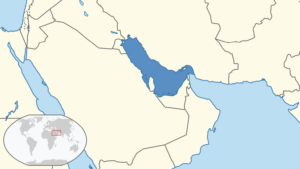
The Gulf is a semi-enclosed sea, approximately 990 kilometers long, with a mean depth of approximately 35 meters — confirmed by oceanographic literature including the Frontiers in Marine Science study published in 2020 — shallower, in many places, than a large river. It connects to the Indian Ocean through the Strait of Hormuz, approximately 33 kilometers wide at its narrowest point. Water exchange with the open ocean is governed by slow pressure differentials between the Gulf’s hyper-saline water and the Arabian Sea beyond. The Gulf’s water renewal cycle is estimated in the range of decades. It is, in environmental terms, a nearly closed system.
This would be significant under any circumstances. In the context of a denial strategy targeting Gulf petroleum infrastructure, it is potentially decisive in ways that extend far beyond economics.
The six Gulf Cooperation Council states — Saudi Arabia, the United Arab Emirates, Kuwait, Qatar, Bahrain, and Oman — are among the most water-scarce nations on earth. According to the UN Food and Agriculture Organization, Kuwait and the UAE each have access to fewer than 15 cubic meters of renewable freshwater per capita annually — against the 1,700 cubic meters threshold below which “water stress” is defined. Qatar has 20. Bahrain and Saudi Arabia have 75. These nations have no permanent rivers. Their aquifers are finite and being mined faster than they recharge. The mechanism by which tens of millions of people obtain fresh water is desalination. Per the Center for Strategic and International Studies, Qatar derives 99 percent of its drinking water from desalination. Kuwait and Oman, 90 percent. Saudi Arabia, 70 percent. The UAE, 42 percent — with desalination capacity set to cover over 90 percent of the country’s water consumption as groundwater depletes. Per CSIS, roughly 100 million people in the wider region depend directly on desalinated water.
A denial strategy does not need to target desalination plants directly to destroy their function. It needs to contaminate the water those plants draw from. The Gulf’s source water — already hyper-saline, already biologically stressed — has no capacity for rapid dilution of a major oil release. Its tidal flushing is minimal. Its renewal cycle, as noted, runs in decades. An oil release from the destruction of Gulf petroleum infrastructure would not behave as it would in open ocean. It would accumulate. Per the CSIS analysis, the Seawater Reverse Osmosis technology that predominates in today’s desalination plants is particularly vulnerable to clogged intakes and fouled filtration membranes — more so than the thermal processes common in the 1990s. The precedent from 1991 is instructive and under-appreciated: when Iraqi forces dumped oil into the northern Gulf as part of the same denial campaign that ignited the wells, it jeopardized water intakes for desalination plants in Kuwait and Saudi Arabia. After liberation, per CSIS, Kuwaiti authorities were forced to cut household water services to four days per week while relying on tanker ships and trucks for emergency supply.
The populations most immediately at risk are not combatants. They are the civilian populations of Gulf states — nations whose governments have walked careful diplomatic lines precisely to avoid direct involvement in this conflict. Per The Conversation’s analysis from March 2026, if a major desalination plant were taken out of operation, governments could face emergency water rationing for millions of residents within days, with hospitals, sanitation, food production, and industry all affected simultaneously. The physical logic of contaminating a closed sea does not honor diplomatic distinctions, and a regime executing a denial strategy at the nothing-left-to-lose threshold has no particular reason to want to honor these.
The Food Chain Dimension
The section of analysis most difficult to convey is not the atmospheric modeling or the hydrological engineering — those are complex but tractable. The most difficult to convey is simultaneity.
Human societies have developed reasonably sophisticated mechanisms for absorbing single shocks to food and water systems. Emergency reserves exist. Alternative supply chains can be activated. International aid mechanisms, however imperfect, have experience responding to regional disasters. What those mechanisms have almost no experience with — and what this conflict presents as a genuine possibility — is three simultaneous, mutually reinforcing shocks to the global food system, arriving together, with no buffer between them.
The first shock is the Strait of Hormuz. UK Foreign Secretary Yvette Cooper, chairing the April 2026 multilateral meeting on Hormuz with over forty countries, put it in terms that require no interpretation: “Liquid natural gas for Asia, fertilizer for Africa and jet fuel for the world.” The UK government’s formal chair’s statement confirmed that the Strait carries “fertilizers urgently needed to support farming in Africa” as well as the LNG that powers industrial production across Asia — including the production of the nitrogen fertilizers on which global crop yields depend. Traffic through the Strait had fallen, per Cooper’s account, from 150 ships per day to between 10 and 20. Fertilizer supply disruption does not produce crop failure immediately. It produces it with a lag of one to two growing seasons, in regions already operating at the margin of food security. The lag makes it politically invisible at the moment of crisis. It does not mean it doesn’t exist.
The second shock is a Russian foot-and-mouth (FMD) disease outbreak that has received almost no coverage in Western media relative to its potential scale. Reports from agricultural monitoring sources indicate a FMD outbreak spreading westward from Siberian livestock populations, the severity of which Russian authorities have not fully disclosed publicly. Foot-and-mouth disease does not kill humans. It devastates livestock — spreading with extraordinary speed across cattle, pig, and sheep populations, triggering international trade bans that cascade across agricultural export networks. A significant Russian FMD event arriving concurrently with a global food logistics disruption from Hormuz closure is not a coincidence that the food system is designed to absorb. It is a second simultaneous strike on protein supply at exactly the moment when reserves are being drawn down by the first shock. No deliberate coordination is required. The shocks are concurrent by circumstance.
The third shock is the Gulf environmental scenario described in the previous section. Desalination collapse does not only remove drinking water. It removes the operational capacity of the ports handling food imports. It destabilizes governments managing populations already under economic stress from the oil disruption the conflict has produced. It draws international humanitarian response capacity toward the Gulf and away from populations elsewhere that were already food-insecure before the conflict began.
These three shocks are not sequential. They are concurrent. And their interaction is not additive — it is multiplicative. A food logistics system under Hormuz pressure has reduced capacity to absorb a protein supply shock. A Gulf humanitarian crisis competes directly for the response resources that food-insecure populations elsewhere require. Governments facing acute food insecurity make foreign policy decisions that stable governments would not — decisions that can themselves become drivers of further instability. The populations most exposed to this cascade are in sub-Saharan Africa, in South and Southeast Asia, in the Middle East’s lower-income nations. They did not choose this conflict. They have no mechanism to influence its prosecution. They experience its consequences through the quiet failure of far-away food systems, weeks or months after the decisions that produced the failure.
The Precedent Dimension
Every section of this essay to this point has described severe and potentially long-lasting consequences. The atmospheric contamination from sustained large-scale combustion across the Gulf dissipates over years, not decades. The Gulf’s hydrological system, however badly stressed, retains some capacity for eventual recovery if the contamination source is removed. Food systems, however badly damaged, have been rebuilt before.
The nuclear non-proliferation architecture is different. It cannot be rebuilt. Once it is gone, it is gone.
The Nuclear Non-Proliferation Treaty (NPT) has governed the global management of nuclear weapons capability for more than fifty years. It is an imperfect instrument. Its enforcement mechanisms are weak. Its application has been uneven. Critics have noted, with justification, that the treaty created a world in which a small number of states retained nuclear arsenals while others were asked to forgo them permanently, in exchange for security assurances that have not always been honored. These are legitimate criticisms. They do not change what the NPT framework has accomplished: a world in which the number of nuclear-armed states has remained remarkably stable across half a century of geopolitical turbulence, during which the technical barriers to nuclear acquisition have continuously declined. As Robock documented in his 2023 opinion piece “How Nuclear Winter Has Saved the World, So Far,” the post-war period saw multiple near misses prevented in part by the shared understanding of what nuclear use would mean for the user as well as the target.
The precedent dimension in this conflict does not require nuclear use to be activated. It is already being written by the conflict itself. Every nation watching Iran absorb the US-Israeli military campaign is drawing conclusions about what security guarantees are actually worth, what the NPT framework actually provides, and what the cost of not having a nuclear deterrent actually is when a major power decides your government should not exist. Those conclusions were being drawn before the first strike on February 28. They are being sharpened with each passing day.
But the use of a nuclear weapon — by any party — would alter the framework permanently and irrevocably. Whether deployed by the United States against hardened Iranian facilities, or by Iran in the terminal logic of a regime with nothing left to lose, the signal transmitted to every non-nuclear state watching is identical. Nuclear weapons were used. They produced an outcome. The threshold is crossable. The nations that would hear that signal most carefully are not the ones already comfortable with American strategic leadership. They are the ones that have chosen, under the NPT framework, to forgo nuclear weapons programs despite possessing the technical and economic capacity to pursue them — and despite security environments that make that choice genuinely costly.
Japan possesses the technical capacity to develop nuclear weapons. So does South Korea. So does Turkey, Saudi Arabia, and Poland. These nations have made different calculations about the value of the American nuclear umbrella. A nuclear exchange in this conflict tests that umbrella in ways it has never been tested. It answers the question that every non-nuclear state with serious security concerns is quietly asking: if the threshold was crossable here, what does that tell me about my own situation? Robock’s documentation of the historical pattern is instructive: the number of nuclear-armed states grew at a rate of roughly one new state every five years through the Cold War before stabilizing. The NPT’s stabilizing effect, he argues, is real — and its dismantlement would not proceed in a controlled or reversible manner.
The stability-instability paradox — a well-documented dynamic in nuclear strategy — holds that nuclear parity can paradoxically increase conventional conflict by making nuclear escalation less credible. A corollary deserves attention here: when nuclear weapons are used to solve a problem that could not be solved by other means, the message received by every state with nuclear ambitions is not that nuclear weapons are unusable. It is that nuclear weapons work. A world with twelve nuclear-armed states is not twelve times as dangerous as a world with one. The interactions between programs — the accidents, the miscalculations, the crises managed by leaders with less experience and smaller safety margins than the established powers — scale non-linearly. The precedent set by nuclear use in this conflict is not a chapter in the story. It is the end of the story as it has been told for fifty years, and the beginning of one that has never been written.
The Cascade
Each of the four dimensions described in this essay would be significant in isolation. The argument this essay makes is that they are not isolated. They interact. And their interaction is recursive — in ways that the denial strategy logic makes not merely possible but structurally probable once a regime crosses the nothing-left-to-lose threshold.
Atmospheric contamination from the sustained destruction of Gulf petroleum infrastructure deposits particulate across agricultural regions, compounding the food chain shock already produced by Hormuz closure. Hydrological collapse in the Gulf destabilizes governments managing populations under simultaneous food and water stress — governments that, per the CSIS analysis, could face emergency rationing within days of a major desalination disruption. Governments facing existential instability make decisions about their own security — including nuclear security — that they would not make from a position of stability. And a world with more nuclear actors is a world in which the atmospheric risks are not a single-event scenario. They become a permanent feature of the geopolitical landscape.
What makes this cascade different from standard worst-case analysis is the threshold logic. Standard worst-case analysis assumes catastrophic outcomes require deliberate catastrophic decisions at the highest levels of power. The nothing-left-to-lose threshold removes that assumption. The cascade described in this essay does not require a decision to end the world. It requires a rational actor’s conclusion that the only leverage remaining to it is the willingness to deny. Iran does not need to destroy civilization to activate the four dimensions of this essay. It needs to destroy enough of the Gulf’s infrastructure, for long enough, in a body of water closed enough, that the consequences propagate outward through systems that were already operating without margin. The Kuwait precedent — 700 wells, 4.6 million barrels per day, ten months, regional atmospheric disruption — was prosecuted by a force with far less asymmetric capability than Iran has developed over the subsequent three decades.
This is the conversation that is not happening. The atmospheric modeling exists in the peer-reviewed literature of Robock, Toon, and their colleagues. The hydrological vulnerability exists in the environmental and oceanographic literature on the Gulf’s closed-system characteristics. The food security consequences are documented in the UK government’s own multilateral statement on Hormuz. The proliferation risks exist in decades of arms control scholarship. What does not exist — or exists only in fragments, without the structural argument connecting them — is the case that these are not separate problems requiring separate solutions. They are facets of a single systemic failure whose total consequence is exponentially worse than the sum of the parts, and whose trigger does not require anything more exotic than a cornered regime doing what cornered regimes have done before.
Concluding Thoughts
The foundational essay The OPEC Endgame? argued that the 2026 conflict has a structural logic — that it represents the culmination of a long-term strategic pattern, not an improvised response to events. If that argument is correct, then the conflict’s trajectory is not primarily a function of decisions made in the coming weeks. It is the product of decisions made over decades, now reaching their logical terminus.
This essay has argued something different, and in some ways more unsettling: that the terminus itself is not fixed. That the physical consequences of a regime executing a denial strategy at civilizational scale are not recoverable in the way that political and military outcomes are recoverable. That what is at stake is not who wins and who loses — a question that history has always eventually answered — but whether the conditions under which that question is answered remain recognizable as the world we inhabit now.
The nothing-left-to-lose threshold is not a prediction. It is a structural feature of conflicts in which one party’s survival is at stake and the military pressure being applied is sufficient to make that survival appear impossible. A regime at that threshold does not need nuclear weapons to activate consequences of civilizational scale. Per the documented record, it needs access to infrastructure it can destroy, a body of water that cannot clean itself, and a food system with no slack in it. All three conditions exist in the Persian Gulf today.
The floor is not guaranteed to be there. Whether it holds depends on decisions made under pressure, by leaders operating with incomplete information, in a conflict whose physical stakes have not been clearly named. This essay is an attempt to name them — in the belief that named risks are more likely to be managed than unnamed ones, and that informed citizens asking difficult questions is a necessary function of democratic society, even when those questions are uncomfortable, and especially when the conversation around them has not yet begun.
Bibliography
Hobbs, P.V., and L.F. Radke. “Airborne Studies of the Smoke from the Kuwait Oil Fires.” Science, vol. 256, 1992, pp. 987–991.
Robock, Alan, Luke Oman, and Georgiy L. Stenchikov. “Nuclear Winter Revisited with a Modern Climate Model and Current Nuclear Arsenals: Still Catastrophic Consequences.” Journal of Geophysical Research: Atmospheres, vol. 112, 2007.
Xia, Lili, Alan Robock, et al. “Global Food Insecurity and Famine from Reduced Crop, Marine Fishery and Livestock Production Due to Climate Disruption from Nuclear War Soot Injection.” Nature Food, vol. 3, 2022, pp. 586–596.
Robock, Alan, et al. “Opinion: How Nuclear Winter Has Saved the World, So Far.” Atmospheric Chemistry and Physics (preprint), 2023.
Nesterov, Oleksandr. “Multiple Salinity Equilibria and Resilience of Persian/Arabian Gulf Basin Salinity to Brine Discharge.” Frontiers in Marine Science, 2020.
Center for Strategic and International Studies. “Could Iran Disrupt the Gulf Countries’ Desalinated Water Supplies?” April 2026.
Middle East Eye. “Threats to Water Supply and Food Inflation Stalk Gulf States.” March 2026.
Al Jazeera. “How Much of the Gulf’s Water Comes from Desalination Plants?” March 2026.
The Conversation. “Iran and the Arabian Peninsula Depend on Desalination Plants to Survive — Why Water Has Become a Target.” March 2026.
UK Foreign, Commonwealth and Development Office. “Chair’s Statement on the Meeting on the Strait of Hormuz.” April 3, 2026.
NPR / KCCU. “Over 40 Countries Meet to Discuss Ways to Reopen the Strait of Hormuz.” April 3, 2026.(Cooper direct quotation: “Liquid natural gas for Asia, fertilizer for Africa and jet fuel for the world.”)
Association for Diplomatic Studies and Training. “Towering Infernos – The Kuwait Oil Fires.” April 2016.
UN Food and Agriculture Organization. Renewable Freshwater Resources per Capita Data, GCC Countries.
Featured image shows 1991 Kuwait oil fires.