NATO’s Eastern Sentry Meets the Black Sea: Romania’s Push for a Dedicated Mission and the Rising Hybrid Risks to Energy Infrastructure and Investments
Romania drives Black Sea Sentry to safeguard Neptun Deep
On the 19th of March 2026, NATO Secretary General Mark Rutte and Romanian President Nicușor Dan stood together in Brussels and delivered an important clear message, that Romania is no longer just a flank player, but is becoming the Alliance’s Black Sea anchor (NATO, 2026). Mr. Rutte explicitly praised Romania’s steadfast role and strategic importance on the eastern flank and in the Black Sea region and confirmed that Eastern Sentry, launched in September 2025 after Russian drone incursions, will be adapted and strengthened in response to Bucharest’s demands (NATO, 2026).
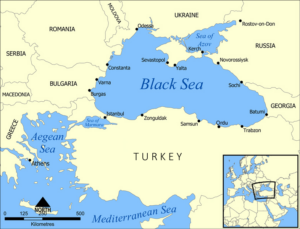
Romanian Defence Minister, Radu Miruță has also taken an unusually direct stance on the issue. In February, he called for the establishment of a dedicated Black Sea “Sentry,” emphasizing the need to redeploy critical capabilities, ranging from counter-drone radar systems and air-defence assets to enhanced underwater surveillance towards the southern flank. NATO officials have responded that the Alliance is already “working with Romania to strengthen this line of effort even further.” Yet, these calls reflect that the timing could not be more urgent as there is a rapidly deteriorating security environment in the Black Sea, where emerging threats continue to outpace existing defensive arrangements (Dumitrescu, 2026). Russia’s winter campaign of mass drone and missile strikes on Ukrainian energy infrastructure has proven the tactic works. The same hybrid playbook consisting in cheap drones, floating mines, GPS jamming and sabotage is already testing Romanian airspace and waters (Turgeon, 2025). Romania has recorded over a dozen drone incursions in its airspace since the invasion of Ukraine in 2022. These are not abstract threats. They are rehearsals for the next target: Romania’s offshore energy future (Dumitrescu, 2026). The prize at risk is Neptun Deep. Jointly developed by OMV Petrom and Romgaz, the field will deliver first gas in 2027 and turn Romania into the European Union’s largest gas producer (OMV Petrom , 2026). Located in Romania’s exclusive economic zone, its platforms and pipelines sit outside the clear protection of NATO Article 5 (Dumitrescu, 2026). Romania’s own 2025–2030 national defence strategy openly flags this vulnerability: Russian militarisation of the Black Sea endangers “the safety of navigation and the exploitation of energy resources.” (Kotseva, 2025)
Corporate risk is rising fast. Insurance premiums for Black Sea energy projects have already climbed. Investors are delaying follow-on phases. A single successful hybrid incident — a drone swarm on an offshore rig or a cable cut — could trigger capital flight, 6–12 month delays, and knock-on shocks to European LNG diversification plans. Corporate risk is rising fast. Insurance premiums for Black Sea energy projects have already climbed. Investors are delaying follow-on phases. A single successful hybrid incident like a drone swarm on an offshore rig or a cable cut could trigger capital flight, 6–12 month delays, and knock-on shocks to European LNG diversification plans (Saul, 2026) (POPA, 2026).
Three scenarios for 2026–2027
• Optimistic: NATO fast-tracks Black Sea Sentry enhancements before summer. Joint counter-drone assets arrive in Constanța and Mangalia. Risk premiums fall. Neptun Deep stays on schedule.
• Baseline: Eastern Sentry expands gradually. Persistent low-level incidents continue. Insurance costs rise, minor delays hit secondary phases.
• Pessimistic: A major spillover strike occurs before a decision is taken. Temporary capital flight and project postponement follow.
Author’s assessment based on current insurance repricing trends (Saul, 2026), NATO decision timelines, and EEZ vulnerability statements (Dumitrescu, 2026).
Sea Shield 2026, Romania’s flagship multinational exercise which launches on 23rd of March
with 2,500 troops and 48 vessels offers the perfect moment to turn rhetoric into reality (AGERPRES, 2026). Allies should use the exercise to announce concrete Black Sea Sentry commitments: shared early-warning networks with the private sector, integrated counter-drone coverage for EEZ assets, and clearer Article 5 guidance for economic infrastructure (Marica, 2026).
Eastern Sentry has already proven it can adapt from the Baltic to the Black Sea. Romania is now forcing the next evolution. The Alliance’s credibility and Europe’s energy security depend on whether it moves fast enough.
Eastern Sentry has shown it can adapt from the Baltic to the Black Sea. Romania is pushing the next evolution. NATO’s credibility and Europe’s energy security now depend on the speed of its response.
Bibliography
NATO, 2026. NATO Secretary General welcomes Romanian President to Headquarters. [Online] Available at: https://www.nato.int/en/news-and-events/articles/news/2026/03/19/nato-secretary-general-welcomes-romanian-president-to-headquarters?selectedLocale=
Dumitrescu, R., 2026. Romanian defense minister calls for NATO Black Sea mission to deter Russia. [Online] Available at: https://www.romania-insider.com/romanian-defense-minister-calls-nato-black-sea-mission-2026
OMV Petrom , 2026. Neptun Deep – A stronger Romania. With energy from the Black Sea.. [Online] Available at: https://www.omvpetrom.com/en/about-us/what-we-do/our-projects/neptun-deep
Turgeon, T., 2025. GNSS interference report: Russia – Part 4 of 4: Black Sea & Romanian airspace. [Online] Available at: https://spire.com/blog/space-reconnaissance/gnss-interference-report-black-sea-romanian-airspace/#:~:text=In%20May%202025%2C%20Romania’s%20Chief,far%20off%20established%20maritime%20routes.
Dumitrescu, R., 2026. Romania’s Neptun Deep project may not be covered by NATO security guarantee, army chief says. [Online] Available at: https://www.romania-insider.com/romania-neptun-deep-nato-security-guarantee-2026
Kotseva, A., 2025. Romania’s 2025–2030 defence strategy: securing Black Sea energy amid Russian threats. [Online] Available at: https://eualive.net/romanias-2025-2030-defence-strategy-securing-black-sea-energy-amid-russian-threats/?utm_source=chatgpt.com
Saul, J., 2026. Black Sea war insurance rates jump after tanker attacks, sources say. [Online] Available at: https://www.reuters.com/business/energy/black-sea-war-insurance-rates-jump-after-tanker-attacks-sources-say-2026-01-13/
POPA, A., 2026. ATTACK ON OFFSHORE TARGETS IN THE EXCLUSIVE ECONOMIC ZONE AND IMPLICATIONS FOR NATO COLLECTIVE DEFENCE. [Online] Available at: https://www.forumulsecuritatiimaritime.ro/attack-on-offshore-targets-in-the-exclusive-economic-zone-and-implications-for-nato-collective-defence/
AGERPRES, 2026. Troops from Romania , 12 other nations to participate in Sea Shield Black Sea exercise. [Online] Available at: https://agerpres.ro/english/2026/03/18/troops-from-romania-12-other-nations-to-participate-in-sea-shield-black-sea-exercise–1538762
Marica, I., 2026. Over 2,500 troops from Romania and 12 allied countries to take part in Sea Shield exercise in the Black Sea. [Online] Available at: https://www.romania-insider.com/sea-shield-exercise-romania-march-2026