Economic Relief in Syria: Is There Too Much Optimism?
There has been a flurry of activity related to economic reconstruction in Syria since President Trump met with the interim President Ahmed al-Sharaa last month. The US and the EU have announced partially rolling back sanctions, Saudi Arabia and Qatar have paid off Syria’s debt to the World Bank, and a consortium of Qatari, Turkish, and US companies have agreed to a $7 billion energy investment to nearly double Syria’s electricity output. The rollback of sanctions and influx of investments from a broad coalition of states suggest optimism that the transitional government can guide Syria down the path of recovery. However, with an inexperienced former jihadist leading a fragmented state, any investment remains high risk.
Ahmed Sharaa’s Fragile Coalition of Peace
Following his swift rise from an al-Qaeda-affiliated insurgent to interim President of Syria, Ahmed al-Sharaa relies primarily on the designated foreign terrorist organisation Hayat Tahrir al-Sham (HTS) and its allies to maintain control (Gritten, 2024). Many of these allies are foreign fighters who traveled to Syria to overthrow Assad and implement sharia law once victorious. Al-Sharaa’s willingness to meet with President Trump and other Western leaders has frustrated a contingent of these foreign fighters who are unwilling to moderate their ideology to integrate with the international community (Loveluck & Zakaria, 2025). Despite reported tensions, Sharaa continues to rely heavily on these foreign fighters to maintain his authority, having appointed six foreigners to senior positions in the Defense Ministry and most recently announced that 3,500 fighters would be incorporated into the national army (Azhari & Al-Khalidi, 2025).
His lack of control over his forces has been evident as Assad loyalists clashing with security forces in March led to harsh reprisals against the Alawite community of former ruler Bashar al-Assad, leaving scores of civilians dead (Reuters, 2025). Sharaa condemned the actions of the security forces and promised a truth commission to investigate the events, but no further action has taken place to hold the responsible parties accountable. Rockets fired into Israel from Syria, claimed by two militant groups, further underscored the lack of control Sharaa maintains over Syria (Sharawi, 2025). Volatility remains despite his efforts to project stability to the international community.
The need for foreigners to bolster the army underscores the fractious state of Syria after a decade-plus of civil war. Currently, the government holds roughly forty to fifty percent of Syria, with the Kurdish SDF, Turkish-backed SNA, and various other opposition groups controlling different areas of the country.
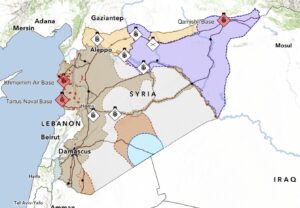
(Map provided by the Institute of War and American Enterprise Institute, 2025).
There is an agreement between the Syrian transitional government and the SDF to bring the Kurdish forces into the Syrian army, but issues such as regional autonomy remain barriers to implementation (Qadi, 2025). If Sharaa does succeed in integrating these forces into the Syrian army, it would boost his military capability and demonstrate his diplomatic prowess in resolving longstanding Syrian disputes.
International Community Provides Economic Lifeline
Despite Sharaa’s tenuous grasp on authority in Syria, the international community remains committed to flooding the country with investments designed to reconstruct the country. Following President Trump’s meeting with Ahmed al-Sharaa, the US announced the easing of OFAC sanctions on Syria, allowing for activities such as: exporting financial and other services to Syria; making a “new investment” in Syria; and engaging in transactions related to Syria-origin petroleum or petroleum products (Latham & Watkins, 2025). The next day, the EU announced lifting its economic sanctions with Kaja Kallas, former PM of Estonia and current High Representative for Foreign Affairs and Security Policy for the EU, stating, “This decision is simply the right thing to do, at this historic time, for the EU to genuinely support Syria’s recovery and a political transition that fulfils the aspirations of all Syrians” (Council of the EU, 2025). Western states are participating in the economic recovery of Syria with the express desire of a political transition representative of “all Syrians,” despite the many minority groups outside of the transitional government. The UN estimates that the lifting of sanctions on Syria could unlock more than $15 billion in assets, more than the total foreign investment in Syria before 2010 (Khatinoglu, 2025). The recent announcements do not fully lift all sanctions on Syria; however, it is a massive windfall for Sharaa, predicated on his rhetoric, more than his actions.
Regional states are joining the West in pouring money into Syria to drive economic reconstruction. Turkey has taken the lead in foreign investment in Syria, thus far, with its exports to Syria up 37 percent in 2025 and more promises of investments to come (Caglayan, 2025). Gulf countries are taking advantage of the peace to lead investments in telecoms, energy infrastructure, port development, and the erasure of international debt necessary for Syria to reintegrate into the global economy (Bris, 2025).
Conclusion
The rolling back of sanctions and increasing foreign investment to reconstruct the country are necessary for Syria to thrive after years of repression. However, extreme caution should still apply to spending hundreds of billions of dollars in the country, as there is plenty of risk and uncertainty with an untested leader. Ahmed al-Sharaa must prove that he can maintain his current power coalition and expand his authority to encompass the vast majority of territorial control through agreements with the Kurds and other communities. He has to demonstrate through his actions that his rhetoric can be trusted. He can do so by ensuring that money earmarked for rebuilding Syria flows where it is intended and minority groups are not excluded from the new power coalition.
References
Bris, A. (2025). Syria tilts West as Gulf capital drives post-Assad recovery. [online] The National. Available at: https://www.thenationalnews.com/business/2025/06/08/syria-tilts-towards-the-west-as-gulf-capital-drives-post-assad-recovery/ [Accessed 13 Jun. 2025].
Ceyda Caglayan (2025). Turkish firms see promise and peril in sanctions-free Syria. Reuters. [online] 29 May. Available at: https://www.reuters.com/world/middle-east/turkish-firms-see-promise-peril-sanctions-free-syria-2025-05-29/ [Accessed 13 Jun. 2025].
Council of the EU (2025). Syria: EU adopts legal acts to lift economic sanctions on Syria, enacting recent political agreement. [online] Consilium. Available at: https://www.consilium.europa.eu/en/press/press-releases/2025/05/28/syria-eu-adopts-legal-acts-to-lift-economic-sanctions-on-syria-enacting-recent-political-agreement/ [Accessed 13 Jun. 2025].
Gritten, D. (2024). What is happening in north-western Syria and why now? BBC. [online] 2 Dec. Available at: https://www.bbc.com/news/articles/c99x0l1d432o [Accessed 13 Jun. 2025].
Institute for the Study of War (2024). Interactive Map: Assessed Control of Terrain in Syria. [online] ArcGIS StoryMaps. Available at: https://storymaps.arcgis.com/stories/1933cb1d315f4db3a4f4dcc5ef40753a.
Khatinoglu, D. (2025). Reviving Syria’s Economy Can Push It Toward the Western-Leaning, Moderate Arab Bloc. [online] Middle East Forum. Available at: https://www.meforum.org/mef-observer/reviving-syrias-economy-can-push-it-toward-the-western-leaning-moderate-arab-bloc [Accessed 13 Jun. 2025].
Loveluck, L. and Zakaria, Z. (2025). Syrian leader faces the challenge of foreign militants who helped him win power. [online] The Washington Post. Available at: https://www.washingtonpost.com/world/2025/05/31/syria-sharaa-foreign-fighters-militants/ [Accessed 13 Jun. 2025].
Qadi, A. (2025). Syria and SDF Hold Constructive Talks in Damascus to Advance March 10 Agreement. [online] Kurdistan24. Available at: https://www.kurdistan24.net/en/story/843586 [Accessed 13 Jun. 2025].
Reuters Staff (2025). Damascus faces demands for accountability after civilian killings. Reuters. [online] 10 Mar. Available at: https://www.reuters.com/world/middle-east/syrian-defense-ministry-announces-completion-military-operations-against-assad-2025-03-10/ [Accessed 13 Jun. 2025].
Sharawi, A. (2025). Rocket Attacks on Israel Underscore Continuing Threat from Syria. [online] FDD. Available at: https://www.fdd.org/analysis/policy_briefs/2025/06/05/rocket-attacks-on-israel-underscore-continuing-threat-from-syria/ [Accessed 13 Jun. 2025].
Timour Azhari and Suleiman Al-Khalidi (2025). Exclusive: US gives nod to Syria to bring foreign jihadist ex-rebels into army. Reuters. [online] 2 Jun. Available at: https://www.reuters.com/world/middle-east/us-gives-nod-syria-bring-foreign-jihadist-ex-rebels-into-army-2025-06-02/ [Accessed 13 Jun. 2025].