New Standards for Deepfake Detection Unveiled Amidst U.S. Election Security Concerns
Introduction
Concern about the dangers of deepfakes, media that has been generated or altered by artificial intelligence (AI), has grown amongst American intelligence officials and policymakers in the past year. While deepfakes known to date are largely created for amusement or advertising, experts worry that they may be used in the near future to sow discord and promote election-related disinformation amongst online audiences. And as the United States prepares for its presidential election this November, a strong standard for deepfake detection has yet to be found.
Known instances where manipulated media was created and circulated with malign intent have proven to be successful in causing harm in the United States. In May 2019, a video of U.S. Speaker of the House Nancy Pelosi was altered to make her appear intoxicated while speaking at DC think tank Center for American Progress; Pelosi’s voice was merely slowed and distorted, thus the deepfake was easily identified as inauthentic. Despite the readiness with which it was detected, the video garnered millions of views and was even retweeted by public figures like Donald Trump’s personal attorney Rudy Giuliani.
A flurry of federal and state legislation aimed at criminalizing the creation or distribution of deepfakes has since been introduced throughout the country, although the efficacy and scope of these laws are contested. Only seven states have introduced or passed legislation targeting distorted images, videos, or audio recordings.
Deepfakes capitalize on American citizens’ growing distrust of the media, as well as of each other. Struggling to come to terms with its legacy of racial oppression amidst the coronavirus pandemic, the country’s political divisions and deeply rooted resentment toward its own institutions lay a fertile ground for exploitation. New enterprises aimed at curbing the creation of deepfakes have therefore assumed positions at the forefront of cybersecurity innovation.
This month, the Content Authenticity Initiative (CAI), a partnership between Adobe, the New York Times, and Twitter, unveiled its much-anticipated white paper that outlines one such system for combatting manipulated media. CAI endeavors to create a flexible, industry-wide standard that can be used to verify digital authenticity before media emerges online, and to track changes made to an image or video as it’s edited. The ultimate goal is to restore consumer trust in what they view online by providing a universal, coherent mechanism for detection and attribution.
Pitfalls of deepfake detection, and a new approach
CAI’s products, slated to enter the market by the end of 2020, present a new path forward for stakeholders in a field dogged by challenges. Detection efforts to date have yielded unreliable results, and even when a deepfake is correctly identified, it’s removal or labelling often lags far behind its rapid circulation online.
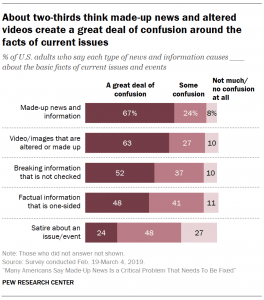
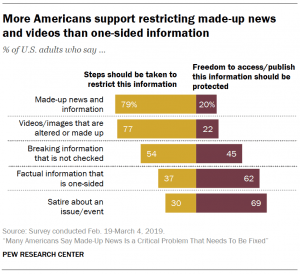
A significant number of Americans who rely on video and image-sharing platforms for news and political information have expressed concern about the circulation of deepfakes. 63% of U.S. adults, nearly two-thirds, say that manipulated media causes “a great deal of confusion” about current events. A further 77% of Americans think that “steps should be taken to restrict” videos and images that have been distorted or fabricated.
In June of this year, Facebook released the results of its Deepfake Detection Challenge, launched in December 2019, in an attempt to bolster its detection capabilities and mitigate the fear amongst consumers that what they see cannot be believed. However, when tasked with studying previously unseen deepfakes, Facebook’s tools were only able to identify manipulated media 65% of the time.
Detection methods are crucial in preventing the spread of deepfakes, but even the most trustworthy systems stop short of addressing distrust in media because consumers lack the resources to make confident decisions about inauthenticity. And while digital authentication apps, like Truepic, are available for download, the market still lacks a universal, industry-wide standard for content attribution.
CAI’s white paper, the culmination of two years of work on behalf of the group, offers a plan to implement an open standard for detecting and attributing deepfakes. The system, once built into hardware or software, would tag a video or image with a digital signature the moment it’s taken, and continue to do so if the media is altered in any way. It could record a signature identifiable to a particular person or device, or it could simply be used to verify that the image or video was not generated by AI.
The primary benefit of CAI’s approach is the universal and flexible nature of its standard. Attribution information, like whether or not an image was taken by a standard-compliant recording device, is vulnerable to manipulation because of its accessibility within the digital content’s metadata. Attribution must therefore be maintained and verified as the image is edited. Even when the information is continually authenticated, fact-checkers and moderators are often tasked with reconstructing the media’s history because the data is presented as incomplete. Consequently, CAI intends to provide a product that can be built into cameras, smartphones, or software like Photoshop, in order to coherently relay attribution data to stakeholders. CAI also envisions flexible implementation so that their product can be utilized industry-wide; end users can choose how they want their data to be stored, whether that be cloud-based or file-based, in order to accommodate privacy concerns.
Conclusion
CAI’s standard is an example of how both the private and public sectors should approach the threat of manipulated media, as more consumers begin to doubt and become disenfranchised from sources of information. While it is unlikely than any foolproof method for deepfake detection will be unveiled before November 3rd, manipulated media presents a lasting threat to the global population’s trust in democracy. As citizens grow to accommodate a new normal in the wake of the pandemic, online disinformation has the potential to severely undermine the legitimacy of elections and elected representatives. Providing access to irrefutable attribution information, to be adopted widely across devices, platforms, and users, is the first step in restoring faith in what we see.
References
AB 730 (California, 2019), Available at: https://leginfo.legislature.ca.gov/faces/billTextClient.xhtml?bill_id=201920200AB730.
AB 620 (California, 2019), Available at: https://leginfo.legislature.ca.gov/faces/billTextClient.xhtml?bill_id=201920200AB602.
Amy Mitchell, Jeffrey Gottfried, Galen Stocking, Mason Walker, Sophia Fedeli, “Many Americans Say Made-Up News Is a Critical Problem That Needs To Be Fixed”, Pew Research Center, June 5, 2019, https://www.journalism.org/2019/06/05/many-americans-say-made-up-news-is-a-critical-problem-that-needs-to-be-fixed/.
Andy Parsons, “CAI Achieves Milestone: White Paper Sets the Standard for Content Attribution”, The Content Authenticity Initiative, August 3, 2020, https://contentauthenticity.org/blog/cai-achieves-milestone-white-paper-sets-the-standard-for-content-attribution.
AO1855, (New York, 2018), Available at: https://nyassembly.gov/leg/?default_fld=%0D%0A&leg_video=&bn=A08155&term=2017&Summary=Y&Actions=Y&Text=Y.
Cristian Canton Ferrer, Brian Dolhansky, Ben Pflaum, Joanna Bitton, Jacqueline Pan, Jikou Lu, “Deepfake Detection Challenge Results: An Open Initiative to Advance AI”, Facebook AI, June 12, 2020, https://ai.facebook.com/blog/deepfake-detection-challenge-results-an-open-initiative-to-advance-ai.
Drew Harwell, “Faked Pelosi videos, slowed to maker her appear drunk, spread across social media”, The Washington Post, May 24, 2019, https://www.washingtonpost.com/technology/2019/05/23/faked-pelosi-videos-slowed-make-her-appear-drunk-spread-across-social-media/.
H.3366 (Massachusetts, 2019), Available at: https://malegislature.gov/Bills/191/H3366.
HB 198 (Maryland, 2020), Available: https://legiscan.com/MD/bill/HB198/2020.
HB 2678 (Virginia, 2019), Available at: https://lis.virginia.gov/cgibin/legp604.exe?191+sum+HB2678.
Josh Constine, “Truepic fights photo fraud on apps like Tinder and Airbnb”, TechCrunch, May 11, 2017, https://techcrunch.com/2017/05/11/truepic-photo-verification/?guccounter=1&guce_referrer=aHR0cHM6Ly93d3cuZ29vZ2xlLmNvbS8&guce_referrer_sig=AQAAALwrr1rpryk2nT6M2DSwmobBgLOfZJJ-Mx13anA8hYeLRfZECD5ERXxXJEbB297BFJrmERDN6r649–Q5p1XHjwj8oAgzWPpaGppUr6v79ucdlrhoCM7TeZu7MhXUjtCtnFPq3j7JY3r79FGeLtx0DUu7-B9fJnxvh3qWXzcZVC2.
Kyle Daly, “System for Thwarting Deepfakes Unveiled”, Axios, August 3, 2020, https://www.axios.com/system-for-thwarting-deepfakes-unveiled-d8fc760c-9a44-43fb-a92e-8a86498414d6.html?utm_source=newsletter&utm_medium=email&utm_campaign=newsletter_axioscodebook&stream=technology.
Mike Schroepfer, “Creating a data set and a challenge for deepfakes”, Facebook AI, September 9, 2019, https://ai.facebook.com/blog/deepfake-detection-challenge/.
Leonard Rosenthal, Andy Parsons, Eric Scouten, Jatin Aythora, Bruce MacCormack, Paul England, Marc Levallee, Jonathan Dotan, Sherif Hanna, Hany Farid, Sam Gregory, “Setting the Standard for Content Attribution”, The Content Authenticity Initiative, August 2020, https://documentcloud.adobe.com/link/track?uri=urn%3Aaaid%3Ascds%3AUS%3A2c6361d5-b8da-4aca-89bd-1ed66cd22d19#pageNum=1
SP 690 (Maine, 2020), Available at: https://legislature.maine.gov/legis/bills/getPDF.asp?paper=SP0690&item=1&snum=129.
SB 751 (Texas, 2019), Available at: https://capitol.texas.gov/tlodocs/86R/billtext/html/SB00751S.htm.
Susannah George, ““Deepfakes” called new election threat, with no easy fix”, Associated Press, June 13, 2019, https://apnews.com/4b8ec588bf5047a981bb6f7ac4acb5a7.
William A. Galston, “Is seeing still believing? The deepfake challenged to truth in politics”, Brookings, January 8, 2020, https://www.brookings.edu/research/is-seeing-still-believing-the-deepfake-challenge-to-truth-in-politics/.
Will Knight, “Deepfakes Aren’t Very Good. Nor Are the Tools to Detect Them”, Wired, https://www.wired.com/story/deepfakes-not-very-good-nor-tools-detect/.