Italy Between NATO Pledges and Domestic Politics
In September 2026, Italy asked the European Union for additional fiscal flexibility to raise defence spending under the National Escape Clause, and applied separately for a loan under the SAFE facility. By October, following domestic political considerations, Rome scaled back its plans, leaving the amount far shorter from what it had originally requested.
On 11 September, Italy submitted a request to the Council and the European Commission to activate the EU’s National Escape Clause (NEC) for defence and energy spending. The request was ambitious: it asked for headroom to raise defence expenditure by up to 0.9 percentage points of GDP by the end of 2028. Three weeks later, at a cabinet meeting, the coalition scaled back how much of that headroom it actually planned to use. Economy Minister Giancarlo Giorgetti said the roughly €29bn in combined fiscal space for 2027–28 would be split evenly between defence and energy (ANSA, 2026b); the defence increment for 2028 fell from 0.6% of GDP to 0.3%, cutting the two-year defence envelope from around €21–22bn to about €14bn. On 8 October, the Commission issued its formal opinion (COM(2026) 553 final), adopting a Recommendation for a Council Recommendation that positively assessed the original 11 September request rather than the reduced one (European Commission, 2026). The Commission therefore left the wider legal headroom intact. By then, Rome had already decided to use less of it.
How the National Escape Clause Works
The clause is often described as letting Italy run above the EU’s 3% deficit reference value without penalty. That description is misleading. Under Regulation (EU) 2024/1263, it lets a member state temporarily deviate from its agreed net-expenditure growth path for qualifying defence and energy spending; those deviations are excluded from the fiscal control account used to assess compliance, rather than suspending the deficit threshold itself (European Union, 2024). The permitted deviation is subject to an overall cap of 1.5% of GDP across defence and eligible energy spending, with energy alone limited to 0.3% annually and 0.6% cumulatively through 2028. Italy’s current domestic fiscal plan draws on a relatively modest slice of that headroom: about 0.3% of GDP in additional defence spending in both 2027 and 2028, well under the 0.6% the pre-cut plan had pencilled in for 2028 (see Figure 1).
Graph 1: Italy’s defence spending path under the National Escape Clause, before and after the 2 October coalition cut.
Domestic Political Context
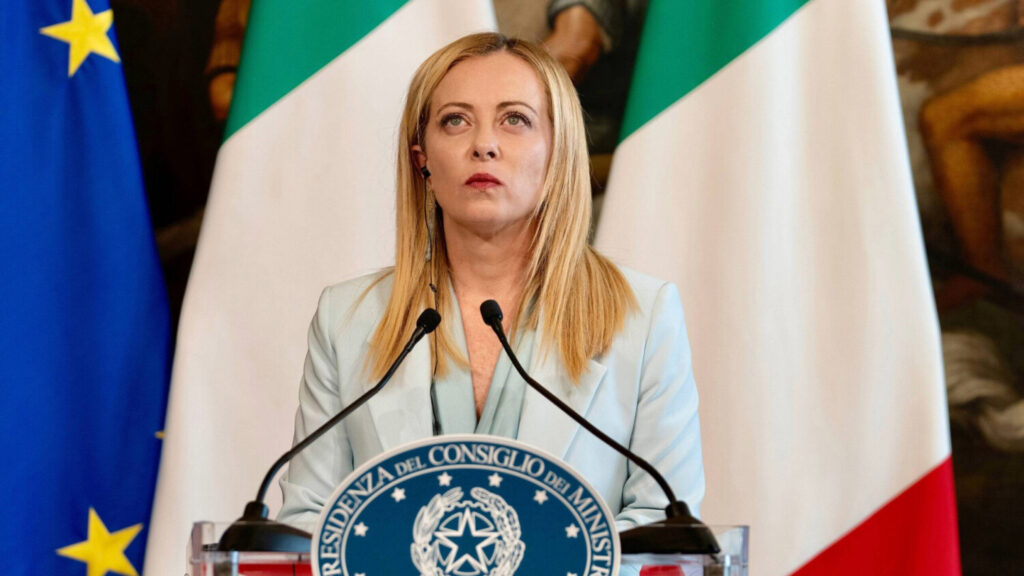
Coalition negotiation forced the reduction. Matteo Salvini’s Lega pushed for restraint, pointing to costs for households and business. Giorgetti called it fiscal prudence. Prime Minister Giorgia Meloni and Defence Minister Guido Crosetto accepted the smaller envelope; Crosetto, whose budget was cut, told reporters he understood the reasoning, even though the decision left his ministry with an eight billion euro reduction (ANSA, 2026c).
Opposition party Movimento 5 Stelle had just run an internal consultation of its membership. On the question of Ukraine armament, 39,770 members (37.2%) voted (Adnkronos, 2026); 91.7% opposed continued arms deliveries to Ukraine, 94.1% opposed the European rearmament plan, and 91.8% opposed higher defence spending (ANSA, 2026d). As M5S sits outside the governing coalition, this party-membership vote illustrates how strongly opposition to higher defence spending runs within one sizeable opposition constituency.
Italy’s Use of the SAFE Facility
SAFE (Regulation (EU) 2025/1106) shows something similar. It provides long-term EU loans for joint defence procurement, not grants, so Rome has reason to weigh how much to draw. After Italy’s application of 30 November 2025, the Council set its SAFE loan ceiling at up to €14.9bn (Council of the European Union, 2026). By August 2026, Commission sources said Italy was requesting €8bn under the facility, well below the €14.9bn maximum authorised by the Council (ANSA, 2026e). Foreign Minister Antonio Tajani has separately said Italy had booked almost nine billion euros. Nobody has publicly explained the gap. Leonardo has pushed in the opposite direction: Defense News reported that chief executive Lorenzo Mariani told the Chamber’s Defence Committee that SAFE mobilises substantial funding with fewer complications than earlier European schemes, and that he had submitted proposals on its use to the government (Kington, 2026).
NATO’s 2035 Target in Context
Behind both decisions sits a much larger commitment. NATO’s Hague Summit pledged to raise spending to 5% of GDP by 2035: at least 3.5% on core, NATO-defined defence expenditure, and up to 1.5% on broader defence and security-related spending, with allies required to submit annual national plans showing a credible incremental path, while the overall trajectory and balance will be reviewed in 2029 (NATO, 2025). Italy’s 0.3%-of-GDP NEC increment is small beside the 5% NATO target and should not be treated as equivalent to it. Rome has twice endorsed higher European and NATO defence ambitions while choosing not to maximise EU instruments that could help finance them.
Policy Recommendations
First, the Commission and national governments should report instrument take-up transparently, distinguishing authorised ceilings from formally requested sums, contracted amounts, and actual disbursements; a €14.9bn ceiling is too easily read as €14.9bn committed. Second, NATO’s annual incremental plans under the Hague pledge should be visible within national medium-term fiscal documents, so governments have to explain deviations from their own trajectory rather than restate the 2035 target. Third, when a government materially reduces its planned use of an authorised defence-financing or fiscal-flexibility instrument, it should say whether the reason is fiscal cost, procurement capacity, industrial bottlenecks or politics. Italy’s October decision offered part of that explanation, not all of it.
Bibliography
Adnkronos (2026) ‘M5s, programma in 20 punti: no all’invio di armi in Ucraina’, Adnkronos, 20 September.
ANSA (2026b) ‘Scostamento da 29 miliardi. Giorgetti: “Più prudenza sulla manovra”’, ANSA, 2 October.
ANSA (2026c) ‘Crosetto: comprendo le ragioni degli 8 miliardi in meno alla Difesa’, ANSA, 2 October.
ANSA (2026d) ‘M5S, il 91,7% è contro le armi. Conte: al governo faremo tabula rasa’, ANSA, 20 September.
ANSA (2026e) ‘Italy asks EC for €8 billion in SAFE funds, sources say’, ANSA, 26 August.
Council of the European Union (2026) Council Implementing Decision (EU) 2026/410, 17 February.
European Commission (2026) Recommendation for a Council Recommendation, COM(2026) 553 final, 8 October.
European Union (2024) Regulation (EU) 2024/1263.
European Union (2025) Regulation (EU) 2025/1106 (SAFE).
Kington, T. (2026) ‘Ukraine war fatigue fuels defense-spending downgrade plan in Italy’, Defense News, 2 October.
NATO (2025) The Hague Summit Declaration, 25 June.