Diplomacy: The Politics of Leaving the Room
Diplomacy is meant to speak when armies are silent. However, the growing display of delegates staging a diplomatic walkout implies that this art is becoming less appealing.
Diplomacy is shaped by sustained engagement. Multilateral diplomacy, on the other hand, is maintained through continued presence in the room and the preservation of channels of interaction (Rousseau, 2026; Pouliot, 2011). Diplomacy calls for intervention. It involves understanding divergent interests, identifying strategic advantages, and finding common ground. Drama in itself is not equivalent to diplomacy. While walkouts set the stage for a tense and highly symbolic scene, one of immediate significance that attracts substantial international media attention, they fail to find a solution. Hence, although symbolically powerful, walkouts carry limited political weight.
Protest Without Diplomacy
Delegates have legitimate reasons to protest. In this regard, states can convey their disapproval of policies they consider detrimental, unjust, or unlawful. Diplomatic protests therefore comprise formal objections by one state against another’s actions or policies. Whether verbal, written, or symbolic, protests are instrumental in international relations, as they convey objections without prompting an immediate escalation of hostilities (Chartrum, 2024).
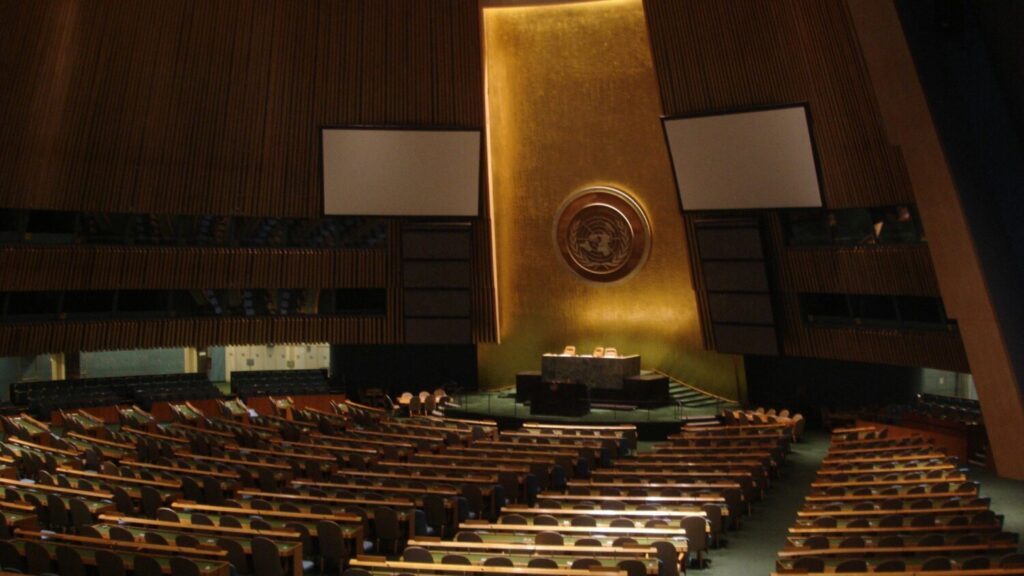
UN delegates have on numerous occasions taken part in coordinated mass walkouts as a form of protest, particularly during speeches by leaders from Iran, Russia, and, recently, Israel (Kehila, 2025). In reference to these cases, the outcome became a diplomatic version of two locked mirrors, where each side viewed its position as legally justified and reflected back at it, while the affected population remained outside the frame.
Sources: Ben Evansky; Stephanie Nebehay; Guardian News; Talek Harris & Sahar Al-Attar; MEE staff; Wikipedia; Anadolu Agency
Moreover, mass diplomatic walkouts go against multilateralism’s core practices and accepted diplomatic practice. By withdrawing from the proceedings, diplomats steer clear of interaction within the forum. Walkouts can thus be viewed as a coping strategy through which actors attempt to maintain the disrupted multilateral order while confronting the emotional, practical, and ethical tensions produced by that disruption (Rousseau, 2026). Analytically, walkouts signify ‘behavioural contestation’, whereby exit or empty-chair politics communicates a diplomatic position (Rousseau, 2026; Stimmer & Wisken, 2019; Eggeling, 2021; Cohen, 1987; Jönsson & Aggestam, 1999).
In international politics, walkouts can be equated to political quarantine, a declaration that certain actions or behaviour isolate a government from the international community. The walkout of delegates at an international forum therefore depicts the idea that empty vessels make the most sound. Empty seats, in a similar manner, can generate the same loud sound through the political image they portray. However, noise does not promote meaningful progress. Furthermore, this approach is contradictory, given that the UN exists by virtue of the international community’s fragmentation. Its objective is not to distinguish between states based on their compliance with international law but to maintain an institutional forum suited to accommodating parties to a conflict, victims, and critics.
If the UN establishes a foundation in which governments listen exclusively to their allies when challenged by those they oppose, or limit participation to sympathetic actors, the organisation ceases to operate as a mechanism for resolving conflicts and instead becomes a platform for competing political interests. Indeed, diplomatic practice may call for denouncing an act of aggression in one setting, but it also calls for maintaining dialogue with the aggressor in order to work towards finding a solution. This is not hypocrisy; it is simply the tough, practical reality of international diplomacy. The danger, however, lies in mistaking moral clarity for strategic effectiveness.
Food for Thought
Diplomacy is not merely a means of conveying disapproval. It is the complex discipline of bridging gaps through negotiated and mutually agreed-upon outcomes. Delegates exiting a chamber communicate disapproval but fail to address the fundamental issues or present practical solutions to find common ground. The diplomatic chamber is therefore turned into a stage, where the departing delegates become actors while the speech becomes a competition over which actor can claim the strongest moral authority through the most powerful image. In today’s world, this is a dangerous substitution, given that symbolism assumes the identity of strategy.
References
Chartrum. (2024, April). Understanding Countermeasures and Diplomatic Protests in International Law.
Cohen, R. (1987). Theatre of power: The art of diplomatic. signalling. Longman.
Eggeling, K. A. (2021). At work with practice theory, “failed” fieldwork, or how to see international politics in an empty chair. Millennium: Journal of International Studies, 50(1), 149–173.
Jönsson, C., & Aggestam, K. (1999). Trends in diplomatic signalling. In J. Melissen (Ed.), Innovation in diplomatic practice (pp. 151–170). Palgrave Macmillan.
Kehila, O. (2025, October 6). What to know about UN walkouts, and why they happen. MidEast Journal.
Pouliot, V. (2011). Multilateralism as an end in itself. International Studies Perspectives, 12(1), 18–26.
Rousseau, E. (2026). Walking out from multilateralism? Diplomatic coping at the OSCE after the Russian invasion of Ukraine. Review of International Studies, 1–20.
Stimmer, A., & Wisken, L. (2019). The dynamics of dissent: When actions are louder than words. International Affairs, 95(3), 515–533.
The Media Line Staff. (2026, September 25). Dozens of delegates walk out as Netanyahu addresses UN General Assembly. The Media Line.