The UK’s Future: Between Europe and America
Introduction
Since leaving the European Union (EU) in 2020, the United Kingdom (UK), has sought to redefine its place in the global order. Five years on since the pivotal Brexit vote, the UK finds herself at a crossroads; seek closer ties in the ‘special relationship’ with Trump’s America, or mend and reinforce the relationship with the EU? The outcome of this decision will shape the UK’s economic positioning, defence policy, and international influence in a rapidly evolving geopolitical landscape. With rising multipolar competition globally, the UK must evaluate its global role beyond the confines of Brexit. The European bloc offers economic stability, regulatory alignment, and enhanced diplomatic leverage, while the US remains the world’s largest military power and an indispensable security ally.
Fragmented Political Relations Post-Brexit
The UK’s diplomatic recalibration post-Brexit has led to fractured relations with the EU, particularly with key players such as France, Germany, and the Netherlands. Negotiations over trade, mobility, and security cooperation remain contentious, affecting the UK’s influence within European strategic initiatives, such as the Erasmus Student Exchange Programme. France, a leading EU power and nuclear state, has been particularly firm in demanding UK policy concessions on areas such as fishing rights, defence collaboration, and labour mobility. These disputes underscore deep-seated mistrust, with Paris and Brussels wary of Britain seeking an à la carte approach to European cooperation.
Economic Interoperability and Trade Frictions
In economic terms, the UK’s dependence on the EU remains undeniable. The EU accounts for 42% of UK exports and 50% of imports, making it the UK’s largest trading partner. Ward, M. and Webb, D. (2023). Out of the UK’s top trading partners, seven are member states of the EU, showing the intertwined nature of our economy with that of Europe.
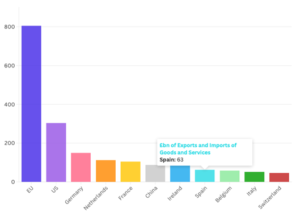
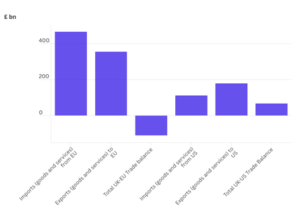
Since the July election of Labour, Chancellor Rachel Reeves is exploring avenues to reduce trade tensions with Brussels while maintaining British regulatory sovereignty. Reeves was the first Chancellor since Brexit to attend a meeting of EU finance ministers, signalling a commitment to rebuild and reset relationships with the EU. In contrast, the US accounts for 17.6 % of the UK’s exports and imports of goods and services (which is the largest single country), but this may be threatened by Trumps ‘America First’ policies, as Washington has historically pursued trade deals favouring US industries, making regulatory alignment complex. British concerns over US agricultural standards, such as chlorinated chicken, and pharmaceutical pricing, also pose barriers to a transatlantic economic pivot; furthered by Trump’s tariffs, which will cause further problems and uncertainty for UK-US trade if come to fruition. The UK’s economic future therefore appears strongly linked to European markets, with imports from the EU being four times higher (£466bn) than that of the US (£112.1bn), however still having key selective engagement with key US defence and technology companies.
In the realm of security and defence, the UK must navigate the competing demands of NATO, European defence autonomy, and the transatlantic alliance. In Trump’s first administration (2017-21), both nations experienced a decline in shared interests, arising from Trump’s nationalistic and protectionist policies, which clashed with the UK’s perspective, increasing diplomatic tensions. Xu, R. and Rees, W. (2021). Historically, the UK’s “special relationship” with the US has been pivotal to its military and intelligence operations. The Five Eyes intelligence-sharing alliance (UK, US, Canada, Australia, New Zealand) and joint military operations in Iraq, Afghanistan, and the Indo-Pacific reflect London’s deep-rooted security ties with Washington. However, European defence cooperation has gained momentum, with France and Germany spearheading initiatives for an autonomous EU military strategy, such as the Permanent Structured Cooperation, which was established in 2018, and seeks to “jointly develop defence capabilities, coordinate investments, as well as enhance the operational readiness, interoperability, and resilience of their armed forces”. NATO remains the UK’s primary defence framework, but its ability to adapt to regional challenges—particularly Russian aggression—depends on stronger European cohesion, which may be aided by EU governments pushing for a “coalition of the willing” involving the UK and Norway, attempting to bolster European defence cooperation. Foy,H., Hancock, A., Gross, A. and Milne, R. (2025). The UK cannot afford strategic isolation, making defence interoperability with both the EU and US a necessity rather than a choice.
Public Opinion Trends and International Perception
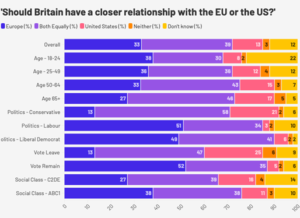
Public sentiment on the UK’s international direction has evolved significantly since Brexit. YouGov survey indicates a clear preference for a return to closer EU ties, reflecting a shift in voter priorities, but still polarised, with younger and traditionally more left-leaning parties prioritising Europe, with older and more conservative voters seeing to align closer with the US. (YouGov, 2024).
Meanwhile, the resurgence of Donald Trump in US politics has created uncertainty about the long-term reliability of the transatlantic partnership. Concerns over US isolationist policies, trade protectionism, and unpredictability have dampened enthusiasm for a full UK-US realignment.
Implications for Foreign Policy and Global Standing
The UK’s strategic orientation will determine its role in global economic governance, military alliances, and diplomatic initiatives. The three primary options are closer European integration, strengthening ties with the EU would stabilize trade with our largest trading partners, enhance the UK’s influence in European defence, and restore credibility in global diplomacy, but political concessions (such as regulatory alignment) would be required. We can also pursue closer transatlantic Alignment, bolstering defence and technology partnerships, but risks economic volatility under shifting US administrations, especially under Trumpist protectionism. The UK can also take a pragmatic hybrid approach, where the UK maintains economic integration with Europe while engaging in select US strategic alliances, which was proposed by Boris Johnson (Prime Minister from 2019-22), who championed the championed the policy of ‘Global Britian’ seeing to redefine herself on the global stage. This outlining strategic objectives, working closely with the US and the EU and looking to mirror Churchills ‘Three Majestic Circles’ strategy. (HM Government 2021). However, critics lacked clarity and substance, viewing it more as a slogan as opposed to concrete policy. Despite this, Johnson’s initiative represented a effort to redefine the UK’s foreign policy in the post-Brexit era.
Bibliography
- Ward, M. and Webb, D. (2023). Statistics on UK-EU trade. [online] House of Commons Library. Available at: https://researchbriefings.files.parliament.uk/documents/CBP-7851/CBP-7851.pdf.
- GOV.UK. (n.d.). Trade and investment core statistics book. [online] Available at: https://www.gov.uk/government/statistics/trade-and-investment-core-statistics-book/trade-and-investment-core-statistics-book#trade-balance.
- Xu, R. and Rees, W. (2021). America and the Special relationship: the Impact of the Trump Administration on Relations with the UK. British Politics, [online] 17(1). doi:https://doi.org/10.1057/s41293-021-00198-0.
- Ward, M. and Webb, D. (2023). Statistics on UK-EU trade. [online] House of Commons Library. Available at: https://researchbriefings.files.parliament.uk/documents/CBP-7851/CBP-7851.pdf.
- www.eeas.europa.eu. (n.d.). Permanent Structured Cooperation (PESCO) – factsheet | EEAS. [online] Available at: https://www.eeas.europa.eu/eeas/permanent-structured-cooperation-pesco-factsheet-0_en.
- Foy, H., Hancock, A., Gross, A. and Milne, R. (2025). EU opens door to UK and Norway for defence ‘coalition of the willing’. [online] @FinancialTimes. Available at: https://www.ft.com/content/303ad7b1-ec66-44f7-9fa5-897641c7ec51 [Accessed 10 Feb. 2025].
- Yougov.co.uk. (2024). Should Britain have a stronger relationship with Europe or the US? [online] Available at: https://yougov.co.uk/topics/international/trackers/should-britain-have-a-stronger-relationship-with-europe-of-the-us [Accessed 7 Feb. 2025].
- HM Government (2021). Global Britain in a Competitive Age the Integrated Review of Security, Defence, Development and Foreign Policy CP 403. [online] HM Government. Available at: https://assets.publishing.service.gov.uk/media/60644e4bd3bf7f0c91eababd/Global_Britain_in_a_Competitive_Age-_the_Integrated_Review_of_Security__Defence__Development_and_Foreign_Policy.pdf.