Europe’s Moment of Truth and Diplomatic Reset
Trade and international supply chains now play a far more prominent role than in the past. President Trump’s preference for bilateral trade agreements based on immediate economic returns, rather than strategic collaboration to address the ‘China challenge’, has upended long-standing assumptions among US allies in the West. His independent approach to foreign policy signals that US–China rivalry cannot be extensively at the centre of other countries’ bilateral and multilateral posturing with Washington.
As the European Union seeks to navigate the shifting international order increasingly shaped by the United States, China and Russia, it is simultaneously recalibrating its own posturing in the emerging global order. Thus, it has now started carving out an approach to frame EU-China relations rather than the role China may play in the EU’s relations with the US. Financial markets speculate that the US dollar’s dominance in global finance may be weakening and that the euro may accordingly develop a greater role as a reserve currency (Goldman Sachs, 2025).
EU-China Ties: Persisting Tensions
Following President Trump’s return to the White House, expectations initially rose for a diplomatic reset, or at least a gradual détente. In a speech to EU ambassadors in February, European Commission President Ursula von der Leyen even hinted at engaging China constructively (Europa, 2025). In the succeeding months as the US-China trade conflict intensified in the months that followed, her rhetoric towards Beijing toughened. Despite playing hardball with China, Europe could not secure a satisfactory trade deal with the US (Politico, 2025).
As outlined by von der Leyen earlier this year, the EU intends to rebalance and de-risk economically from China, while aligning on climate change and environmental issues (Politico, 2025).
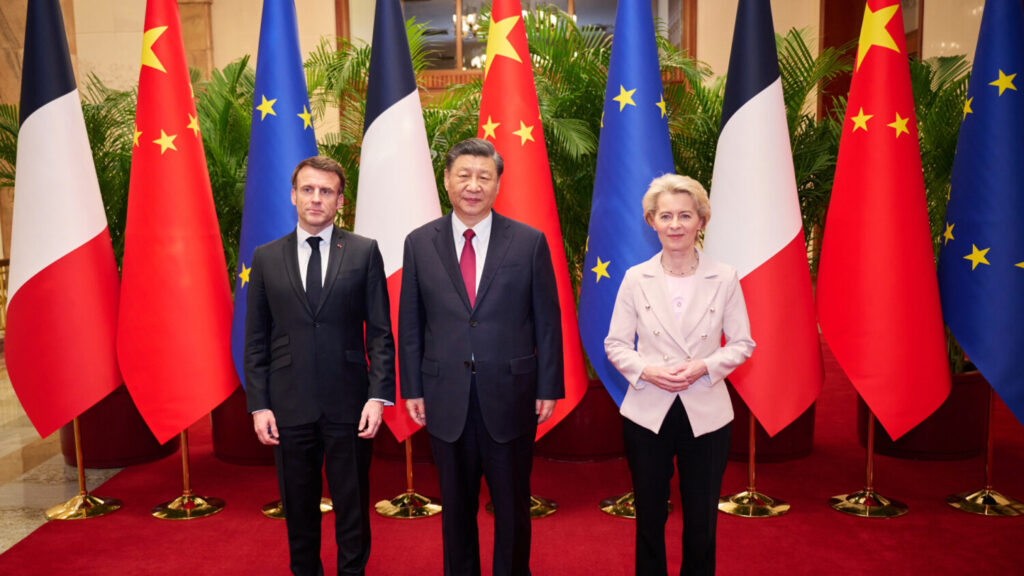
The EU-China summit in July 2025 was a testimony to the relationship defined by conflicting priorities. China continues to favour a major-power relations framework centred on stable ties with Russia, while the EU advocates a rules-based international order and opposes Beijing’s support for Moscow and its military assertiveness in the East and South China Seas.
Critical minerals and the volume of Chinese goods exports sit at the centre of EU-China dynamics. Facing restricted access to the US market, China actively seeks alternative outlets for its exports. European policymakers are increasingly concerned that EU markets could be inundated with competitively priced Chinese products, potentially undermining domestic manufacturing objectives, widening China’s trade surplus with the EU, and indirectly contributing to Russia’s war in Ukraine (Bloomberg, 2025).
On the other hand, China’s restrictions on exports of critical raw materials have intensified tensions in EU-China relations, particularly as the EU seeks to strengthen its domestic defence industrial base. In response, the EU is reportedly close to committing €3 billion to diversify supply chains (The Guardian, 2025).
Europe’s defence and economic engine, France and Germany respectively, are cautiously balancing their bilateral ties with China. While France strategically strives to cooperate with Asian counterparts to deter ‘revisionist’ China (IISS, 2025), economically it is willingly flexible to accommodate ‘differences’ and work out a trade and investment model agreeable to both (Global Times, 2025). Germany, under Chancellor Friedrich Merz, is expected to deepen its ‘de-risking’ agenda towards China while preserving cooperation in key sectors critical to both economies (China Briefing, 2025). Trade forecasts indicate that China will fall out of Germany’s top five export destinations for the first time since 2010, dropping to seventh place as exports decline to 10% to 81 billion euros ($95.04 billion) this year (Reuters, 2025). Meanwhile, the United Kingdom, under Keir Starmer, is renewing engagement with China and has put China in the centre of its foreign policy agenda (South China Morning Post, 2025).
To China’s dismissal, Russia’s Foreign Intelligence Service, according to media reports, claim that the UK, France and Germany are seeking to draw closer to China as a form of “blackmail and bargaining chip” against the US on the issue of Ukraine peace agreement (Global Times, 2025). President Macron’s recent visit to China followed reports that French intelligence agencies had warned of intensifying pressure stemming from China’s lead in artificial intelligence, quantum research and rare earths (South China Morning Post, 2025).
EU’s Asia Outreach
The EU’s trade-centric outreach to Asia in 2025, particularly towards India, Japan and ASEAN is demonstrative of its willingness to find stable and like-minded liberal partners amid global uncertainty and complex ties with China. President Ursula von der Leyen’s visits to both Japan and China is a testimony to this approach.
On the eve of the China summit, the EU delegation issued a joint statement with Japan reaffirming the EU’s willingness to further strengthen a stable and predictable rules-based free and fair economic order, reinforce a competitive business environment and enhance joint competitiveness in a strategic manner, reiterating joint opposition to “any unilateral attempts to change the status quo by force or coercion” in the East and South China seas and “the importance of peace and stability across the Taiwan Strait,” calling for peaceful resolution of disputes (European Commission, 2025).
The EU’s evolving relationship with India is multifaceted, carving out a dialogue ecosystem vocal about convergences and divergences. Senior EU leaders are scheduled to attend India’s Republic Day parade as chief guests on 26 January, followed by the India–EU summit the following day. After more than a decade of stalled negotiations, the India–EU free trade agreement is now in its final phase (Politico, 2025). Both sides are seeking to secure supply chains and reduce volatility amid rising US protectionism and shifting global trade alignments (South China Morning Post, 2025). The EU Council has recently approved conclusions on a ‘New Strategic EU–India Agenda’ that underscores the growing significance of India-EU ties in trade, technology, security, and global governance emphasising the ‘joint capacity and responsibility of the EU and India’ to safeguard multilateralism and the rules-based international order (Europa, 2025).
Beyond India, the EU is also seeking to deepen its strategic partnership with ASEAN by advancing a network of trade agreements and strengthening supply chain cooperation (Bernama, 2025). It has signed free trade agreements with Vietnam, Singapore and Indonesia, and is currently negotiating with Malaysia, the Philippines and Thailand. In a recent statement, EU Council President António Costa described that the EU’s partnership with ASEAN as a vital pillar in navigating an increasingly complex global environment (Bernama, 2025).
In order to grapple with geopolitical tensions and supply-chain disruptions, the EU is reworking its economic security doctrine, centred on promoting industrial strengths, protecting European interests, and partnering with like-minded countries (Europa, 2025). Designed to deter risks of a ‘reactive posture’ that has contributed to uncertainty in the current global order, an increasing synergy with democratic economies in Asia while managing differences is a win-win for both regions.
Bibliography
The White House, ‘ National Security Strategy’, December 2025, URL: https://www.whitehouse.gov/wp-content/uploads/2025/12/2025-National-Security-Strategy.pdf
Goldman Sachs, ‘The Dollar’s Shifting Landscape: From Dominance to Diversification’, June 2025, URL: https://am.gs.com/en-jp/institutions/insights/article/2025/dollars-shifting-landscape-from-dominance-to-diversification
Europa, ‘Speech by President von der Leyen at the EU Ambassadors Conference 2025’, February 2025, URL: https://ec.europa.eu/commission/presscorner/detail/en/speech_25_404
Politico, ‘Von der Leyen played hardball with China. Then she won a trade deal with Trump’, July 2025, URL: https://www.politico.eu/article/brussels-trade-deal-donald-trump-china-steel-production/
Politico, ‘Von der Leyen sets stage for contentious China summit’, July 2025, URL: https://www.politico.eu/article/ursula-von-der-leyen-contentious-china-summit-production-exports-russia-ukraine-eu-trade-xi-jinping/
Bloomberg, ‘China Forces Reckoning in Europe as Trade Turns Existential’, December, 2025, URL: https://www.bloomberg.com/news/articles/2025-12-12/china-forces-reckoning-in-europe-as-trade-boom-turns-existential
The Guardian, ‘EU looks at legally forcing industries to reduce purchases from China’, December 2025, URL: https://www.theguardian.com/world/2025/dec/03/eu-strategy-raw-materials-rare-earths-supply-chain-resourceeu
International Institute for Strategic Studies (IISS), ‘Keynote Address: President Emmanuel Macron – President of the French Republic’, May 2025, URL: https://www.iiss.org/globalassets/media-library—content–migration/files/shangri-la-dialogue/2025/transcripts-final/keynote/n/keynote-address_president-macron_as-delivered.pdf
Global Times, ‘Macron calls for rebalancing EU-China ties, warns against tariffs’, December 2025, URL: https://www.globaltimes.cn/page/202512/1350809.shtml
China Briefing, ‘China-Germany Economic Relations 2025: What Merz’s Leadership Means for Trade and Investment’, May 2025, URL: https://www.china-briefing.com/news/china-germany-relations-2025-merz-leadership-trade-investment/
Reuters, ‘China to fall out of Germany’s top five export destinations for first time since 2010’, December 2025, URL: https://www.reuters.com/world/china/china-fall-out-germanys-top-five-export-destinations-first-time-since-2010-2025-12-15/
South China Morning Post, ‘Despite Starmer’s ‘China threat’ rhetoric, UK seeks tighter Beijing ties’, December 2025. URL: https://www.scmp.com/news/china/diplomacy/article/3335230/despite-starmers-china-threat-rhetoric-britain-seeks-tighter-ties-beijing
Global Times, ‘Chinese FM responds to report that UK, France and Germany seek closer China ties as ‘blackmail and bargaining chip’ against US’, December 2025, URL: https://www.globaltimes.cn/page/202512/1350814.shtml
South China Morning Post, ‘Macron’s trip exposes Europe’s fractured China policy’, December 2025, URL: https://www.scmp.com/opinion/china-opinion/article/3335556/macrons-trip-exposes-europes-fractured-china-policy
European Commission, ‘Joint statement following the EU-Japan Summit 2025’, July 2025, URL: https://ec.europa.eu/commission/presscorner/detail/da/statement_25_1890
South China Morning Post, ‘India-EU trade pact nears finish line despite carbon tax dispute, Russia ties’, December 2025, URL: https://www.scmp.com/week-asia/economics/article/3335872/india-eu-trade-pact-nears-finish-line-despite-carbon-tax-dispute-russia-ties
Politico, ‘Trade talks with India to roll into the new year, EU trade chief says’, December 2025, URL: https://www.politico.eu/article/trade-talks-with-india-to-roll-into-the-new-year-eu-trade-chief-says/
Europa, ‘New strategic EU-India agenda: Council approves conclusions’, October 2025, URL: https://www.consilium.europa.eu/en/press/press-releases/2025/10/20/new-strategic-eu-india-agenda-council-approves-conclusions/
Bernama, ‘EU Seeks Stronger ASEAN Ties, Eyes Progress on Free Trade Talks-Antonio Costa’, October 2025, URL: https://www.bernama.com/en/news.php?id=2484298
Europa, ‘Commission announces strategic approach to strengthen Europe’s economic security’, December 2025, URL: https://ec.europa.eu/commission/presscorner/detail/en/ip_25_2889