Echo Encirclement: A Modern Border Defence Architecture
Conventional defence systems are proving inadequate against the multi-domain structures of hybrid warfare.
The growing use of drones and other advanced technologies in the Russia-Ukraine war and recurring drone incursions in South Asia highlight the weaknesses of current border defence systems (Azad, 2026).
In response, ‘echo encirclement’ has emerged as a crucial defence framework and counter-strategy: a multi-layered containment structure that integrates real-time intelligence and surveillance technologies to address the limitations of contemporary border defence systems.
Echo encirclement highlights the shift from traditional to intelligence-led security systems to counter possible cyber-attacks from adversaries. The word ‘echo’ refers to continuous surveillance, while ‘encirclement’ denotes the model’s concentric containment structure. This would be a chain reaction where one security layer (the outer shield) is a reflection of another layer and so on, creating near-impossible intervention. Instead of depending on fixed lines of defence, it seeks to create impenetrable interconnected layers. The system works in a continuous loop, including the detection, deception, disorientation, disruption, and containment. Each loop leads into another to establish a robust defence system.
Limitations of Contemporary Border Defence Architecture
Contemporary border defence architecture has several limitations that reduce its effectiveness in the era of hybrid warfare. One of the major flaws is its reliance on static border lines through which drone attacks are difficult to intercept. This leads to a delay in response, which is aggravated by fragmented intelligence systems that fail to provide a real-time security assessment.
Contemporary defensive measures are based on physical barriers like forests, mountains, rivers and troop positionings (IEEE, n.d.). In the era of artificial intelligence (AI), those natural terrains are less able to counter the attacks effectively as they did in the past. By coordinating AI with satellite imagery and warfare technology, adversaries can obtain sensitive information on any state, enabling sovereignty violations without needing boots on the ground.
There is a greater need for predictive defence, as opposed to reactive defence. To fulfil this need, a new border defence doctrine – which can counter both traditional and conventional attacks – is essential. In this context, echo encirclement serves as a comprehensive and robust mechanism which can counter attacks from unmanned technologies, and detect any kind of military intervention. Once detected, the system can easily contain incursions using deception and disruption techniques.
Structural Architecture of Echo Encirclement
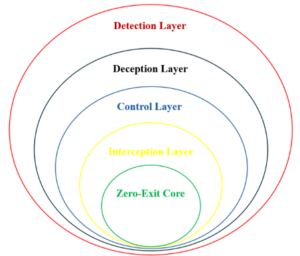
The key to echo encirclement’s potency is its five-layered structure consisting of the detection shield; deception layer; control grid; interception zone; and zero exit core.
1. The Detection Shield
The detection shield is the first and most important layer of the echo encirclement defensive model. It combines the use of satellites, unmanned autonomous vehicles (UAVs), and smart sensors to create an observation grid for identifying any movements or unusual activities from across the border. Aerial and ground-level technologies reduce blind spots and increase visibility to help detect possible threats.
2. Deception Layer
The deception layer is the counter-intelligence part of the echo encirclement model. While the detection layer focuses on awareness, the deception layer relies on ambiguity, disguising the surveillance mechanisms that the detection layer uses. The first element of the deception layer is decoy communication, where operatives conduct false surveillance to deceive adversaries, like the role of Russia’s Gerbera drones. These false movements misguide and confuse the attackers.
3. Control Grid
The control grid is the central nervous system of this defensive architecture. This layer receives information from the detection and deception layer and transfers intelligence to the interception zone (see below). It is the core of this model. It integrates AI, UAVs, sensors, and cyber intelligence to create a unified operational structure. Instead of fragmented intelligence systems, the control grid layer fuses the multiple intelligence systems into a single decision-making framework. It is beneficial in tracking and coordinating threats and informs forces before any real attack. This structure will lead to a vertical command system rather than a horizontal fragmented system where there is a lack of coordination.
4. Interception Zone
The interception zone is the strike belt of the echo encirclement model. It is the responsive layer. After an enemy strike is detected, the interception zone activates and contains a threat before it can penetrate deeply into the state. Tactical units are the core of this layer, responsible for mobility and deployment in the terrain. These troops intercept strikes using intelligence provided by the control grid. Speed and precision are paramount. The results is a predictive (rather than responsive) defensive model.
5. Zero-Exit Core
The zero-exit core is the innermost and decisive layer of this model. It is designed to ensure complete containment of any threat that has penetrated the outer rings of the architecture. It functions as the final security boundary and provides no exit pathway to hostile actors. At this stage, the focus is on immobilisation rather than only interception. This reflects a structured approach to security where layered defences progressively narrow operational space until full containment is achieved. At the centre of this structure lies the centralised command, which integrates the real-time information from detection, control, and interception layers. This hub ensures unified decision-making and final authorisation of containment actions.
Conclusion
Echo encirclement is a modern border defence architecture that fills the loopholes in contemporary defence systems, which mostly rely on physical barriers. The echo encirclement model operates on a multilayer structure including AI and cybertech. In an era where threats evolve rapidly and often operate below traditional detection thresholds, security effectiveness increasingly depends on system integration rather than physical presence alone.
This framework also reflects a broader transition from reactive defence to predictive containment, where potential threats anticipated as a result of continuous monitoring. Echo Encirclement aligns with the modern evolution of warfare by proposing a system where technological integration and operational response redefine the concept of border security in this critical political environment.
References
Azad, T. M., 2026. The Strategic Use of Drones in Pakistan–India Irregular Warfare. [Online]
Available at: https://www.irregularwarfare.org/india-pakistan-drone-warfare/
[Accessed 18 June 2026].
IEEE, n.d. High-Tech Border Security: Current and Emerging Trends. [Online]
Available at: https://publicsafety.ieee.org/topics/high-tech-border-security-current-and-emerging-trends/
[Accessed 18 June 2026].