Russia’s Accusation of U.S. NATO Expansionism from 1989 to 2025: The Broken Promises Narrative Today
The debate over NATO expansion and Russian security grievances has become one of the central geopolitical narratives shaping Eurasian security since the end of the Cold War. Moscow’s claim that the United States violated both the spirit and expectations of late-Cold War détente against NATO enlargement has become known as the Broken Promises Narrative. This narrative continues to shape Russia’s foreign policy worldview. Yet, as several studies show, the political motivations of post-Soviet states and the evolving dynamics of European security are more complex than the simplified version often presented by Moscow (Schimmelfennig, 2006; Hamilton & Spohr, 2019).
What Was and Was Not Promised: 1989-1990
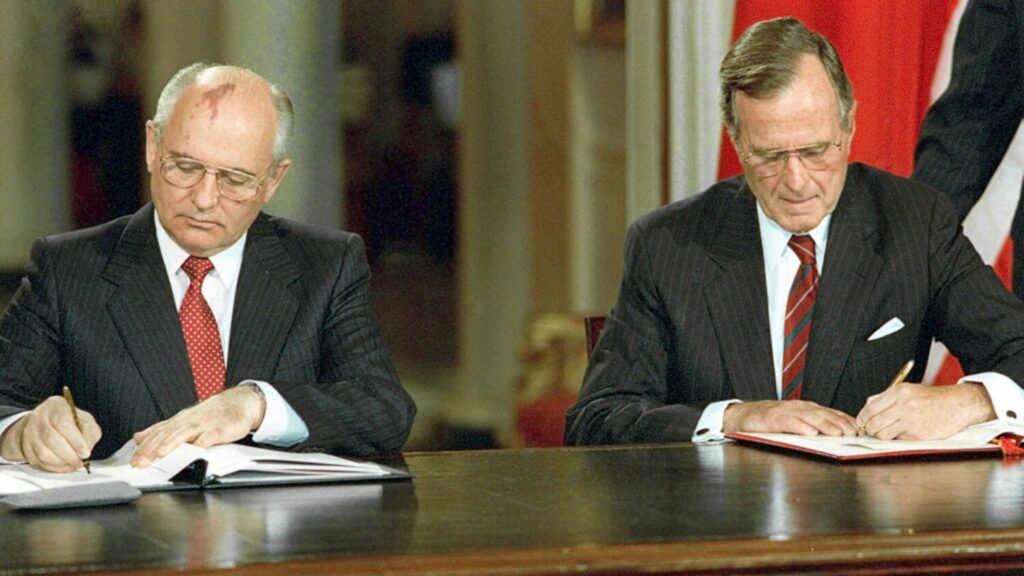
The origins of Russia’s grievance stem from the period surrounding German reunification. Throughout 1990, Western leaders and Soviet President Mikhail Gorbachev explored how NATO might incorporate a unified Germany without destabilising the European order. Moscow has since argued that the West pledged NATO would not move eastward. However, archival research by Sarotte (2009; 2014; 2021) demonstrates that no formal or legally binding agreement on halting NATO expansion was ever concluded.
Former U.S. Secretary of State Madeleine Albright similarly stated that no such commitment existed, an interpretation supported by Schneider (2025), who notes her emphasis on the absence of binding U.S.-Soviet guarantees. This highlights an important difference in diplomatic approaches. Soviet and later Russian leaders often emphasised implied understandings and the spirit of negotiation, whereas Washington approached diplomacy with a more legalistic and impersonal structure (Sarotte, 2021). These cultural differences contributed to decades of mistrust.
Whether the United States deliberately used the collapse of the Soviet Union to maximise its geopolitical advantage remains contested. Counterfactual analyses such as Marten (2017) suggest that early post-Cold War policy was characterised more by improvisation and uncertainty than by a premeditated strategy of dominance.
Agency of Central and Eastern European States
One of the most neglected aspects of the expansion debate is the political agency of the states that sought NATO membership. Experience with Soviet rule left many Central and Eastern European countries deeply insecure. For Poland, the Czech Republic, the Baltic states, and others, NATO membership was not a passive response to U.S. outreach; it was an active strategic choice shaped by historical trauma and fears of renewed Russian influence (Hamilton & Spohr 2019).
Research by Reiter (2001) and Schimmelfennig (2006) shows that enlargement was driven far more by the demands of Eastern European states than by any American expansionist impulse. NATO operates by consensus and requires aspirant states to request membership; thus, enlargement reflected strategic autonomy rather than U.S. coercion. Failing to recognise this agency reinforces Russia’s narrative by implying that sovereign states are incapable of independent geopolitical decision-making.
The 2004 Baltic Expansion
The 2004 enlargement, which brought Estonia, Latvia, and Lithuania into NATO, remains particularly significant. For Russia, the alliance’s move into the former Soviet space appeared to confirm long-standing fears of encirclement, a sentiment expressed in early Russian commentaries by Lieven (1995) and Pushkov (1997). Yet historical analyses of Baltic statehood demonstrate that their foreign policy after 1991 was explicitly shaped by existential concerns about renewed Russian dominance (Kasekamp, 2018).
From Moscow’s perspective, NATO’s presence near St Petersburg and Kaliningrad was evidence of Western encroachment. However, from the viewpoint of Baltic governments and NATO planners, enlargement was primarily defensive, a strategy to stabilise the region and lock in democratic reforms (Hamilton & Spohr, 2019). This divergence highlights fundamental opposing interpretations of the same geopolitical reality.
Putin’s 2007 Munich Speech
Vladimir Putin’s 2007 Munich Security Conference speech marked a clear escalation in the broken promises narrative. Putin accused Washington of pursuing a ‘unipolar world’ and ignoring Russia’s legitimate security concerns. Scholars such as Tsygankov (2012) argue that this reflects a deeper historical pattern in which Russian foreign policy is framed through the lens of great-power identity and perceived Western encirclement. The Munich speech signalled the end of the cooperative post-Soviet era and embedded the grievance of NATO expansion into Russia’s strategic doctrine. Marten (2023) notes that by the late 2000s, the narrative had become a core justification for Russian reassertion in the post-Soviet space.
This is subsequently seen in Russia’s annexation of Crimea in 2014, justified by Moscow as a defensive reaction to a Western-backed coup. This represented the most direct clash between NATO’s open-door policy and Russia’s sphere-of-influence doctrine. A British government analysis (2015) emphasises that, at the time, Ukraine was not close to NATO membership, undermining Russia’s stated rationale. The annexation triggered extensive Western sanctions and a profound shift in European security. Rather than halting NATO enlargement, Russian intervention accelerated it. Finland joined NATO in 2023, with Sweden following soon after, an outcome widely interpreted as a consequence of Moscow’s increasingly aggressive posture.
2022-2025: The Ukraine War and the Reassertion of NATO
Russia’s full-scale invasion of Ukraine in 2022 revitalised NATO. The United States and European allies increased defence spending, reinforced the alliance’s eastern flank, and reaffirmed collective security commitments. This regional reaction aligns with earlier predictions by Madeira, Hamilton & Spohr (2019), and Kaunert et al. (2024), who note that Russian aggression consistently pushes neighbouring states closer to Euro-Atlantic structures.
For many Eastern European governments, the conflict confirmed long-standing fears of Russian coercion. Their push for deeper integration into NATO, EU defence mechanisms, and U.S. security guarantees intensified accordingly. Meanwhile, Russia doubled down on its narrative of Western betrayal, perceived encirclement, and decades of supposed broken promises. These claims are widely disputed by archival evidence (Sarotte 2009; 2014; 2021) and by the political agency demonstrated by Ukrainian voters. Russia’s accusations cannot be dismissed purely as propaganda as they reflect genuine perceptions shaped by strategic culture, historical trauma, and mistrust of Western intentions (Tsygankov 2012).
The narrative persists because of:
- Domestic Legitimacy:
The Kremlin uses NATO expansion as a unifying theme to justify centralisation and maintain internal control (Tsygankov 2012). - Great-Power Identity:
Post-Soviet Russia has struggled with the loss of its imperial sphere of influence; NATO enlargement symbolises a diminished geopolitical role (Pushkov 1997; Lieven 1995). - Information Framing:
By emphasising informal, non-binding assurances rather than documented agreements, Russia shapes public perception, regardless of legal ambiguity (Marten 2023).
Understanding the foundations of the broken promises narrative is essential, not to validate it, but to navigate future diplomacy. Europe’s security environment will remain fragile unless policymakers acknowledge how historical grievances, strategic anxieties, and power transitions shape Russian behaviour, and how Eastern European states will persist in seeking security, with or without Washington.
Reference list
Britain., G. (2015). The EU and Russia : before and beyond the crisis in Ukraine. London: The Stationery Office Limited.
Hamilton, D.S., Spohr, K., Johns Hopkins University. Foreign Policy Institute, A, H. and H, P. (2019). Open door : NATO and Euro-Atlantic security after the Cold War. Washington, D.C.: Paul H. Nitze School Of Advanced International Studies, Johns Hopkins University.
Kasekamp, A. (2018). A history of the Baltic states. London Palgrave.
Kaunert, C., Bosse, G. and Vieira, A. (2024). EU, Security and The Eastern Partnership. Taylor & Francis.
Lieven, A. (1995). Russian Opposition to NATO Expansion. The World Today, [online] 51(10), pp.196–199. Available at: https://www.jstor.org/stable/40396653.
Marten, K. (2017). Reconsidering NATO expansion: a counterfactual analysis of Russia and the West in the 1990s. European Journal of International Security, 3(2), pp.135–161.
Marten, K. (2023). NATO Enlargement: Evaluating Its Consequences in Russia. Evaluating NATO Enlargement, pp.209–249. doi:https://doi.org/10.1007/978-3-031-23364-7_7.
Pushkov, A.K. (1997). Don’t Isolate Us: A Russian View of NATO Expansion. The National Interest, [online] (47), pp.58–63. Available at: https://www.jstor.org/stable/42896937.
Reiter, D. (2001). Why NATO Enlargement Does Not Spread Democracy.
Sarotte, M.E. (2009). 1989 : the struggle to create post-Cold War Europe. Princeton, N.J.: Princeton University Press.
Sarotte, M.E. (2014). A Broken Promise? : What the West Really Told Moscow About NATO Expansion. New York: Council On Foreign Relation.
Sarotte, M.E. (2021). Not one inch : America, Russia, and the making of post-Cold War stalemate. New Haven: Yale University Press.
Schimmelfennig, F. (2006). The EU, NATO and the integration of Europe : rules and rhetoric. Cambridge: Cambridge University Press.
Schneider, A.K. (2025). Madeleine Albright: The Original Madam Secretary. Future of business and finance, pp.475–490. doi:https://doi.org/10.1007/978-3-031-90367-0_24.
Tsygankov, A.P. (2012). Russia and the West from Alexander to Putin. Cambridge University Press.