Bosnia on the Brink
The peace in the Western Balkans since 2001 contrasts with the disorder of the Russo-Ukrainian War and Russia’s use of energy, migration, and sabotage in “hybrid warfare” against Europe. However, the Kremlin retains the option to stir latent tensions in the region—most notably in Bosnia and Herzegovina—and open a new front in the Europe-Russia confrontation. Rising political tensions in Bosnia will hinder the country’s integration into Euro-Atlantic institutions and draw in other countries attempting to carve out influence inside the Western Balkans.
The Domestic Environment
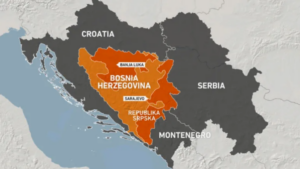
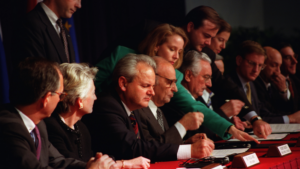
The 1995 Dayton Agreement established Bosnia’s complex political system and ended its civil war. The country is divided between the Bosniak and Croat Federation of Bosnia and Herzegovina and the Serb Republika Srpska (RS). These subnational entities have presidents and legislatures, which, in combination with the national legislative branch and rotating Bosniak-Croat Serb presidency, slow the pace of national policymaking (Security Council Report, 2024). The externally appointed Office of the High Representative can enforce legislation and judicial rulings when the country’s politicians are unable to do so (Mihalčatinová, 2022).
Convoluted politics are undermining Bosnia’s development. The decision to grant Bosnia EU candidate status in 2022 was made to draw the country away from Russia’s geopolitical orbit, despite it failing to meet the criteria necessary to open accession negotiations (EU, 2024). Ineffective coordination between Bosnia’s multiple legislative branches has slowed the pace of reform and prevented economic catchup with the rest of Europe (World Bank, 2024). Bosnia’s poor demographics- the result of an ageing population, low fertility rates and high emigration- threaten its long term economic viability (Karcic, 2022).
Bosnia’s External Affairs
The European Union (EU) has assisted Bosnia’s domestic reform programmes and deploys the multinational EUFOR-Althea military force to uphold the Dayton Agreement (UN, 2024). Stabilising Bosnia will facilitate its integration into the EU, reduce the impact of Russian influence, and minimise the likelihood of another civil war (Helić, 2025). NATO’s General Secretary Mark Rutte has criticised moves by the RS to ban state-level security forces from its territory, as turmoil within Bosnia could destabilise the Western Balkans and impact adjacent NATO countries (Emehet, 2025).
In contrast, Russia is attempting to subvert the Dayton Agreement. It aims to prevent Bosnia’s integration into NATO and the EU, as well as use crises in Bosnia and Ukraine to overwhelm NATO’s limited resources (Koseva, 2025). Serbia’s President Aleksandr Vucic has stood with Dodik to demonstrate his pan-Serb nationalism, but to preserve Serbia’s relations with the EU has not supported the secession of the RS from Bosnia (Maliqi, 2025). Dodik has also built rapport with Hungary’s Viktor Orban, who has provided RS with loans, diplomatic support, and police officers for Dodik’s security (Virag, 2025).
Lurching Toward the Abyss?
Bosnia’s crisis could escalate if the RS creates its own army and declares independence, or if Dodik is arrested by the Bosnian state police for ignoring the Office of the High Representative’s policies (Maliqi, 2025). In this scenario, Russia and Serbia could provide arms and logistical support to Bosnian Serb militias (Čančar, 2022). EUFOR-Althea troops in Bosnia may become involved in the conflict to prevent territorial gains or protect civilians from Bosnian Serb militias. Much like the previous civil war in Bosnia, Muslim-majority countries and Islamist fighters could provide assistance to Bosniak troops (IISS, 1997).
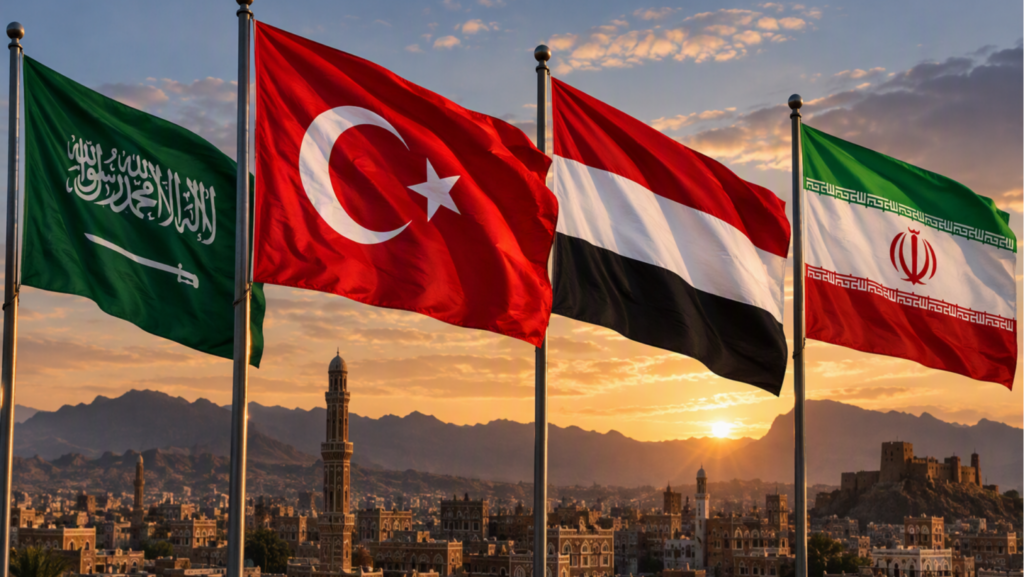
Stabilising Bosnia is a prerequisite for EU integration, supported by 68% of its population (EWB, 2024). Engagement with regional power Serbia is crucial to ensuring that Bosnia’s sluggish progress towards EU accession is not entirely derailed. The EU must stress to Serbia that its own EU accession is impossible if it militarily supports Serb nationalists in the RS or Kosovo. The ensuing conflict would be exploited by Russia and Türkiye to project influence in the Balkans, with such an outcome resulting in refugees, small arms, and potentially Islamic fundamentalists spreading across the EU (Miskovic, 2011).
Renewed efforts should be made by the EU to strengthen the rule of law in Bosnia and encourage long-term de-escalation. An effective Bosnian central government capable of implementing legislation would bring the country in line with EU economic and judicial standards and dampen the appeal of Dodik and other populist-nationalist politicians. Building the state’s institutional capacity would reduce its dependence on the High Representative, derided by many Bosnians as undemocratic, to implement legislation (Mihalčatinová, 2022). However, reform will be difficult as politicians in the subnational entities are unwilling to cede their autonomy to the central government.
Conclusion
Bosnia’s efforts to reform its moribund institutions and economy must be supported by the EU, NATO and individual Western states. Whilst the flawed institutions established by the Dayton Accords reinforce sectarian divisions, political reforms which reverse the equal standing of the country’s 3 ethnic groups will cripple renewed new state-building initiatives. Carefully balancing the country’s dire political, economic and demographic needs whilst guaranteeing the security of its ethnic groups is the only way to prevent Bosnia from becoming a bargaining chip in the Europe-Russia standoff.
Bibliography
Čančar, I. (2022). Russia’s New Front with the West in Bosnia. RUSI [online] Available at: https://www.rusi.org/explore-our-research/publications/commentary/russias-new-front-west-bosnia.
Emehet E. (2025). NATO Reaffirms Commitment to Bosnia Amid Rising Tensions. BalkanEU. [online] Available at: https://balkaneu.com/nato-reaffirms-commitment-to-bosnia-amid-rising-tensions/
EU Enlargement and Eastern Neighbourhood. (2024). Bosnia and Herzegovina. [online] Available at: https://enlargement.ec.europa.eu/enlargement-policy/bosnia-and-herzegovina_en.
EWB (2024). IRI poll: Most Western Balkan countries support EU membership, but many citizens are sceptical of the EU’s seriousness. [online] European Western Balkans. Available at: https://europeanwesternbalkans.com/2024/05/16/iri-poll-most-western-balkan-countries-support-eu-membership-but-many-citizens-are-sceptical-of-eus-seriousness/.
Helić, A. (2025). The EU needs a proactive approach in Bosnia. POLITICO. [online] Available at: https://www.politico.eu/article/eu-bosnia-western-balkans-europe-war-bih-crisis-serbia/.
IISS (1997) Strategic Survey 1996-97. Oxford.
Karcic, H. (2022). Bosnia is Becoming Depopulated – What to do About it? Balkan Insight. [online] Available at: https://balkaninsight.com/2022/11/15/bosnia-is-becoming-depopulated-what-to-do-about-it/.
Koseva, D. (2024). Bosnia becomes a new proxy for the struggle between Russia and the West. Intellinews.com. [online] Available at: https://www.intellinews.com/bosnia-becomes-new-proxy-for-struggle-between-russia-and-the-west-371050/
Maliqi, A. (2025). What’s at stake for Bosnia and Herzegovina as Milorad Dodik faces a political reckoning? Atlantic Council. [online] Available at: https://www.atlanticcouncil.org/blogs/new-atlanticist/whats-at-stake-for-bosnia-and-herzegovina-as-milorad-dodik-faces-a-political-reckoning/.
Mihalčatinová, C. (2022). The (un)democratic role of the High Representative in Bosnia and Herzegovina. Strategic Analysis. [online] Available at: https://www.strategicanalysis.sk/the-undemocratic-role-of-the-high-representative-in-bosnia-and-herzegovina/.
Miskovic, D. (2011). Assessing Militant Islamist Threats in the Balkans | Wilson Centre. [online] Available at: https://www.wilsoncenter.org/publication/assessing-militant-islamist-threats-the-balkans
Security Council Report (2024). Bosnia and Herzegovina. [online] Available at: https://www.securitycouncilreport.org/monthly-forecast/2024-05/bosnia-and-herzegovina-11.php
UN (2024). Security Council Renews for One Year Mandate of European Union-led Stabilisation Force in Bosnia and Herzegovina, Unanimously Adopting Resolution 2757 (2024) | Meetings Coverage and Press Releases. [online] Available at: https://press.un.org/en/2024/sc15884.doc.htm.
Virág, G. (2025). Hungary’s Neighbour of Honour: Bosnia and Herzegovina. atlatszo.rs. [online] Available at: https://atlatszo.rs/en/2025/02/06/hungarys-neighbour-of-honour-bosnia-and-herzegovina/
World Bank. (2024). Bosnia and Herzegovina’s Continued Progress Requires More Economic and Energy Reforms. [online] Available at: https://www.worldbank.org/en/news/press-release/2024/03/26/bosnia-and-herzegovina-s-continued-progress-requires-more-economic-and-energy-reforms.