Why NVIDIA Matters to Kazakhstan
Jensen Huang’s first visit to Astana shows how a resource-rich Central Asian state is trying to turn energy into token, and what must go right for the bet to pay off.
When President Kassym-Jomart Tokayev met Jensen Huang at the Akorda presidential palace on October 23, the NVIDIA chief left with a state decoration: the Order of Dostyk, First Class, awarded for his contribution to AI development in Kazakhstan (Birbayeva, 2026). It was the NVIDIA CEO’s first visit to the country, and it closed Kazakhstan’s month-long AI Month campaign (Zhakiyanova, 2026). The very same day, a signing ceremony at the palace sealed an investment agreement between the government and Firebird, a US-based AI infrastructure company that holds a US export license for 45,000 Grace Blackwell GPUs for its Kazakhstan build-out (Lebaredian, 2026). Why would the head of the leading AI chip company travel to the biggest Central Asian country?
The answer is that Kazakhstan is less a market for NVIDIA than a blue ocean frontier to expand its buyer list beyond the conventional hyper scalers: a country with abundant power, a government that has declared 2026 the Year of Digitalization and Artificial Intelligence (Birbayeva, 2026). And Kazakhstan has utilized its location, locating exactly between Russia, China and Middle East, to attract investments and join the on-going token war. Whether the bet pays off depends on delivery, customers and great-power politics more than on enthusiasm in Astana.
Why Kazakhstan
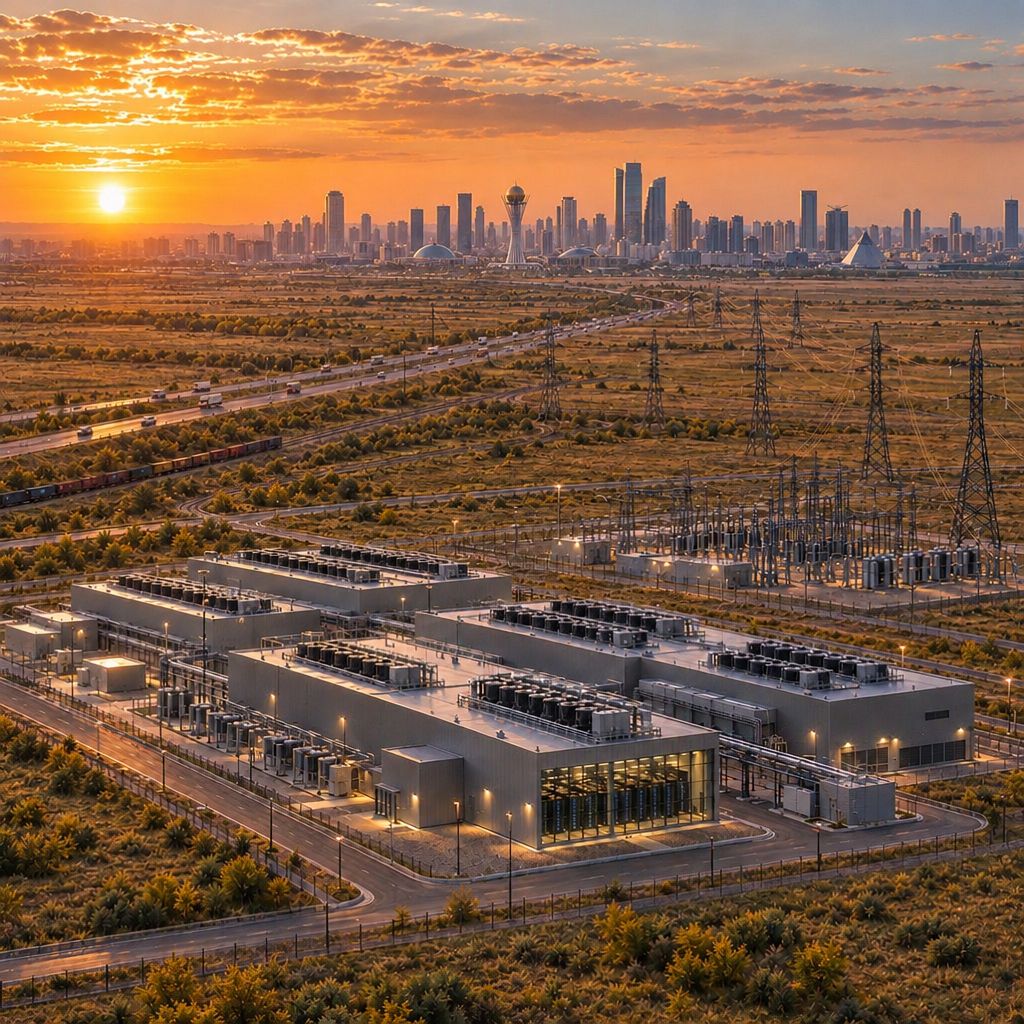
Power comes first. The centerpiece of the plan, Data Center Valley, sits in Ekibastuz, a coal and power hub in the northeast of Kazakhstan (Zhakiyanova, 2026). Officials describe the logic straightforwardly, as converting Ekibastuz fossil fuel into digital export revenue. In June, the government, Firebird and NVIDIA signed agreements worth up to $10 billion for a cluster of 100,000 GPUs, including GB300 and Vera Rubin chips, one of the latest models of the portfolio (Official Information Source of the Prime Minister of the Republic of Kazakhstan, 2026). The first 125-megawatt center is due in the first half of 2027, with a second of the same size planned for 2028. For comparison, all government data currently sits in a 6-megawatt facility in Astana (Bland, 2026).
Second, Kazakhstan already has an installed base. State-backed Kazakhtelecom has deployed 400 H200 and 480 B300 GPUs in Astana and Almaty (Lebaredian, 2026), and an H200-based national supercomputer arrived in 2025 (Sakenova, 2026).
Third, geography and connectivity. Huang himself singled out abundant energy (Lopez, 2026), existing data connectivity and growing computing capacity, and Astana is tying its data-center plans to Caspian fiber-optic projects that aim to connect Central Asia to Eurasian data routes (Cutler, 2025). Finally, there is talent and demand. Huang argued that physical AI needs energy and a population skilled in science, mathematics and technology, and that Kazakhstan has both (Baimurza, 2026).
Political will completes the picture. Tokayev has tied the project to the Digital Qazaqstan (Kazakhstan) strategy (Official website of the Government of the Republic of Kazakhstan, 2026), promised personal oversight, and framed it as part of the country’s digital sovereignty and a high-tech hub (Bland, 2026). For a chipmaker that needs permits, power contracts and export approvals to expand its market share, a head of state who treats a data-center campus as a personal priority is a rare asset, and one that is hard to find in the markets.
What happened in Astana
Huang’s headline proposal was that Kazakhstan become a global hub for Physical AI, the branch of AI that connects models to machines and physical environments (Birbayeva, 2026). At a public fireside chat, Deputy Prime Minister Zhaslan Madiyev pointed to factories, mines, agriculture, transport and logistics as places to train models for robots, and Huang agreed that physical AI could transform mining, mineral processing and agriculture (Lebaredian, 2026). He also urged the country to “transform energy into intelligence and export intelligence”, and told his hosts that national data is a natural resource that belongs to the country (Oil Price, 2026). Madiyev stressed work on Kazakh-language models.
The infrastructure announcements were more concrete. Firebird’s first phase is under construction with Kazakhtelecom, targeting commercial launch in the third quarter of 2027, and a second phase would bring its potential capacity in Kazakhstan to roughly 500 megawatts.
The geopolitical frame
Export control problems are hiding in every part of this story. The 45,000-GPU authorization is a permission, not a delivery schedule (Gupta, 2026). In the time-sensitive current data center industry, whether Kazakhstan can recoup the investment depends on how nimble the entire logistics are.
Kazakhstan’s alignment, however, is not simple. Astana joined the US-led Pax Silica initiative in June (Official website of the Government of the Republic of Kazakhstan, 2026) but has also joined a competing Chinese initiative, WAICO (Kazakhtelecom, 2026), raising questions about its membership, although Marco Rubio said Central Asian states can cooperate with any nation. Does Kazakhstan need to choose which side to take? That could be a bigger problem than business issues.
Regional rivals are moving too. Uzbekistan has launched its own NVIDIA partnership for an AI Center of Excellence and promotes a tax-free zone for data centers in Karakalpakstan, although analysts argue that Kazakhstan’s larger campuses and connectivity make it well placed to be the region’s dominant node (Cutler, 2025).
What to watch
Four questions will decide whether the announcements become infrastructure. First, delivery. Reports differ on when the first facility opens and how large it is, and the announcements do not explain how the previous US approval will be applied to the October’s agreement (Magica, 2026). Kazakhtelecom’s 880 deployed GPUs are small compared to the 45,000 licensed. Second, customers. Data centers are not manufacturing factories with thousands of laborers, they run with small teams, so the wider payoff depends on export customers using the capacity (Bland, 2026). Third, further approvals: one report flags a possible additional export approval for roughly 65,000 chips (Lopez, 2026). Fourth, power and bandwidth. A campus of this scale needs a grid that can deliver reliably all year and international links that match (Cutler, 2025).
For NVIDIA, Kazakhstan offers cheap energy, political commitment and a managed geopolitical position. For Kazakhstan, the visit is validation, but the validation is not actual earnings capacity. The test will be whether licensed chips become running data centers with paying customers by 2027, and whether Astana can keep Washington and Beijing comfortable at the same time. If it can, converting a resource economy’s energy into exported compute may become a model well beyond the steppe.
Bibliography
Credence Research. (2026). ‘Firebird Secures U.S. License for 45,000 NVIDIA GPUs for Kazakhstan AI Build-Out’, Credence Research, 24 October. Available at: https://www.credenceresearch.com/news/firebird-us-export-license-45000-nvidia-gpus-kazakhstan
Crypto Briefing. (2026). ‘Nvidia CEO Jensen Huang visits Kazakhstan to discuss AI hub plans’, Crypto Briefing, 23 October. Available at: https://cryptobriefing.com/nvidia-jensen-huang-kazakhstan-ai-hub/
Euronews. (2026). ‘Nvidia CEO sees Kazakhstan as potential AI hub for Europe’, Euronews, 30 October. Available at: https://www.euronews.com/2026/10/30/nvidia-ceo-sees-kazakhstan-as-potential-ai-hub-for-europe
Kazakhtelecom. (2026). ‘Kazakhstan Becomes a Founding Member of an International AI Organisation’, Kazakhtelecom, 30 July. Available at: https://b2b.telecom.kz/en/news/business/kazahstan-stal-odnoi-iz-stran-uchreditelei-mejdunarodnoi-organizacii-po-ii
Magica. (2026). ‘Firebird signs Kazakhstan AI deal; Nvidia cites clearance for 45,000 GPUs’, Magica, 22 October. Available at: https://magica.com/news/firebird-kazakhstan-nvidia-gpu-export-license
Official Information Source of the Prime Minister of the Republic of Kazakhstan. (2026). ‘Data Center Valley: Kazakhstan Government, Firebird, and NVIDIA Sign $10 Billion Package of Agreements in Artificial Intelligence’, Official Information Source of the Prime Minister of the Republic of Kazakhstan, 15 June. Available at: https://primeminister.kz/en/news/data-center-valley-kazakhstan-government-firebird-and-nvidia-sign-10-billion-package-of-agreements-in-artificial-intelligence-31516
Official website of NVIDIA. (2026). ‘Kazakhstan Expands Compute for Its AI Future’, Official website of NVIDIA Company Blog, 22 October. Available at: https://blogs.nvidia.com/blog/kazakhstan-ai-compute-ecosystem/
Official website of the Government of the Republic of Kazakhstan. (2026). ‘Kazakhstan has adopted the National Strategy “Digital Qazaqstan” until 2029’, Official website of the Government of the Republic of Kazakhstan, 10 June. Available at: https://www.gov.kz/org/maidd/press/news/details/1238140?lang=en
Official website of the Government of the Republic of Kazakhstan. (2026). ‘Kazakhstan Joins the Pax Silica Initiative to Develop AI Infrastructure and High-Tech Manufacturing’, Official website of the Government of the Republic of Kazakhstan, 26 June. Available at: https://www.gov.kz/org/maidd/press/news/details/1248924?lang=en
Official website of the President of the Republic of Kazakhstan. (2026). ‘President Kassym-Jomart Tokayev Meets NVIDIA Co-Founder and President Jensen Huang’, Official website of the President of the Republic of Kazakhstan. Available at: https://www.akorda.kz/en/president-kassym-jomart-tokayev-meets-nvidia-co-founder-and-president-jensen-huang-2392718
Oil Price.com. (2026). ‘45,000 Nvidia Blackwell GPUs Cleared for Kazakhstan Data Center’, Oil Price.com, 27 October. Available at: https://oilprice.com/Energy/Energy-General/45000-Nvidia-Blackwell-GPUs-Cleared-for-Kazakhstan-Data-Center.html
Shanraq.org (2026) ‘Tokayev and Jensen Huang discuss Kazakhstan’s AI development’, Shanraq.org, 24 October. Available at: https://shanraq.org/read/tokayev-nvidia-jensen-huang-kazakhstan-ai-cooperation-october-23-2026?lang=en
The Astana Times. (2025). ‘Supercomputer With NVIDIA Chips Arrives in Kazakhstan’, The Astana Times, 19 May. Available at: https://astanatimes.com/2025/05/supercomputer-with-nvidia-chips-arrives-in-kazakhstan/
The Astana Times. (2026). ‘NVIDIA CEO Proposes Kazakhstan as Global Hub for Physical AI’, The Astana Times, 23 October. Available at: https://astanatimes.com/2026/10/nvidia-ceo-proposes-kazakhstan-as-global-hub-for-physical-ai/
The Times of Central Asia. (2025). ‘Kazakhstan Turns from Pipelines to Processors’, The Times of Central Asia, 16 December. Available at: https://timesca.com/kazakhstan-turns-from-pipelines-to-processors/
The Times of Central Asia. (2026). ‘Kazakhstan Says $10 Billion AI Data Center Project Is Moving Into Deployment’, The Times of Central Asia, 14 July. Available at: https://timesca.com/kazakhstan-says-10-billion-ai-data-center-project-is-moving-into-deployment/