The Political Risk of Memory: Mladić’s Funeral and the Fragility of Balkan Peace
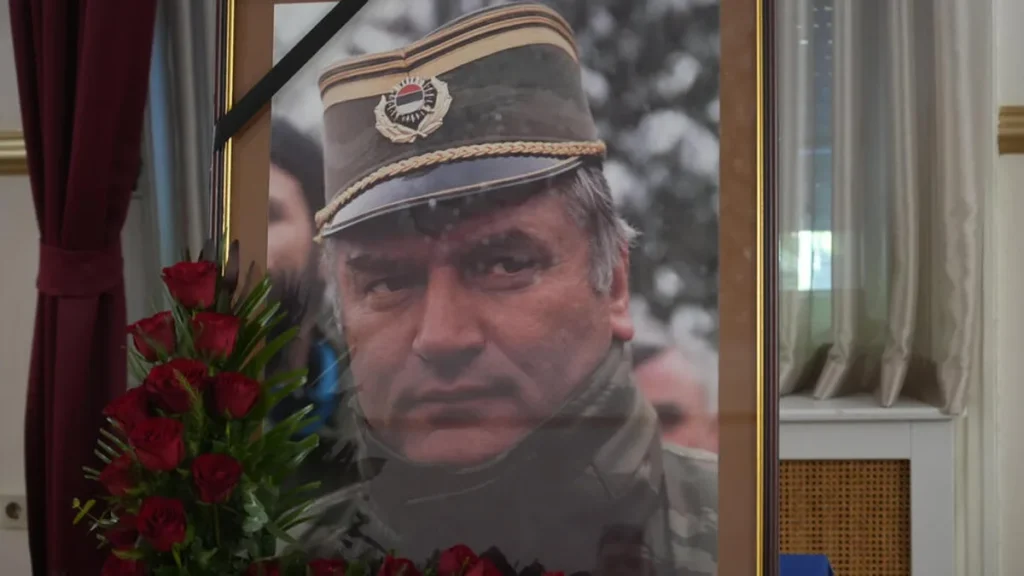
Three decades after the Srebrenica Massacre during the Bosnian War, the man held responsible, Ratko Mladić – condemned as a war criminal by Bosnia and the wider international community – was mourned by thousands during a state-sponsored funeral in Belgrade, Serbia. What are the political implications of such irreconcilable differences in memory, in which a man convicted of genocide in Bosnia is honoured and grieved as a national hero in his own country?
On September 8th, the Foreign Minister of Bosnia and Herzegovina, Elmedin Konakovic, announced the expulsion of two Serbian diplomats and foreign dignitaries from Bosnia, giving them 48 hours to leave the country (Sito-Sucic, 2026). This politically loaded decision came just one day after thousands of Serbians crowded the streets of Belgrade to attend the state-sponsored funeral of Ratko Mladić. A convicted war criminal, Mladić is a highly contentious figure, yet – as described by the head of the Serbian Orthodox Church, Patriarch Porfirije – he is “deeply etched in the memory and prayers of the majority of…Serbian Orthodox people, who feel and nurture a deep sense of gratitude towards him” (Pomeroy, 2026). This is in part due to the bias of dominant Serbian media, where selective memory favours Mladić as a dutiful soldier, neglecting to educate Serbians of the scale of his crimes. Similar patterns of denial and glorification can be seen in post-conflict societies where atrocities such as this have taken place (Pomeroy, 2026).
It is the celebration of his memory that prompted the recent severe breakdown in Bosnian-Serbian diplomatic relations. At the time of his death, Mladić was serving a life sentence in the United Nations Detention Unit (UNDU), having been found guilty of war crimes, genocide and crimes against humanity, a result of his pivotal role as military commander during the Srebrenica massacre (Pomeroy, 2026). During one of Europe’s worst atrocities since WWII, 8,372 Bosniak Muslim men and boys were killed by Serbian forces in the town of Srebrenica, an event that earned Mladić the nickname the “Butcher of Bosnia” (Remembering Srebrenica, 2026; Pomeroy, 2026). Mladić’s funeral is thus perceived by Bosnia (and many other members of the international community) as the glorification of a war criminal.
This sequence of events hints at a latent but powerful form of political risk: that of collective memory and the conflict that arises when different groups remember the same events differently. As memories take shape and diverge in post-conflict societies, differences in the interpretation of an event – and the key perpetrators involved – can provoke and intensify political turmoil in an already fragile situation.
A Short History of Conflict
Ethnic violence between Bosnia and Serbia has deep historical roots that go back most notably to the Second World War. Memories of earlier atrocities were revived and politicised during the Bosnian War, a conflict that erupted in the early 1990s amid the breakdown of Yugoslavia. Following the death of the famed dictator Josip Tito – a figure who had emphasized the importance of a multi-ethnic Yugoslav state and encouraged national cohesion – ethnic tensions resurfaced and were weaponized as different ethnic groups began to seek self-determination (Haas, 2022).
Following the secession of Croatia and Slovenia in 1991, the Bosnian Parliament followed suit and declared independence from Yugoslavia in 1992, a legislative decision that was boycotted by most of the Bosnian Serbs. Seeking to remain a part of Yugoslavia, Bosnian Serbs declared their own independence and established the “Republika Srpska”, a movement that triggered the Bosnian War. As with other Yugoslav wars of this period, the Bosnian War was characterized by brutal ethnic cleansing campaigns, particularly against Bosniak Muslims and Croats. In a series of ruthless assaults on minority communities, Serbian forces were responsible for the deaths of thousands of Bosniak Muslims and Croats (Haas, 2022).
Following increased pressure from NATO bombing campaigns, the conflict eventually came to an end on November 21, 1995, with the signing of the Dayton Agreement (Haas, 2022). Under this general framework of peace, Bosnia and Herzegovina, Croatia, and Yugoslavia (now Serbia) agreed to respect one another’s sovereign equality and settle disputes by peaceful means, while deep emotional scars remained. Within Bosnia, the agreement detailed military aspects, such as implementing a ceasefire and removing troops and weapons from hostile areas, as well as establishing an inter-entity boundary between the Federation of Bosnia and Herzegovina and the Republika Srpska. The Republika Srpska was given relatively significant autonomy, with its own government and judicial systems, while still falling under the larger Bosnian framework (University of Minnesota Human Rights Library, 1995).
Mladić’s Funeral and the Effect on Bosnian-Serbian relations
Even thirty years after a formal peace was established in the region, the events following Ratko Mladić’s state funeral demonstrates the fragility of inter-ethnic peace in post-conflict societies, and the far-reaching impact of individual diplomatic fallouts. Persisting distrust between ethnic groups means that even non-violent actions made with no physical affront can reignite ethnic rifts.
In addition to expelling the two Serbian diplomats, Konakovic announced that Bosnia would abstain from signing a memorandum on good neighbourly relations and cooperation between all Western Balkan countries, scheduled for October 1st (Sito-Sucic, 2026). Speaking on the decision, Konakovic declared that Serbia had “crossed all red lines” in its handling of Mladić’s death (Sito-Sucic, 2026). The Foreign Minister also announced that Bosnia would be withdrawing most of its staff from its embassy in Belgrade (Sito-Sucic, 2026).
The Implications of the Bosnian-Serbian Diplomatic Dispute and Memory as Political Risk in Post-Conflict Societies.
Given the Western Balkan region’s complex and interconnected nature, especially regarding ethnic tensions and political instability, the breakdown of Bosnian-Serbian relations could have serious consequences for maintaining wider regional peace. This fact could escalate the dispute surrounding Mladić’s funeral from a symbolic disagreement over historical memory into a situation of significant political risk. Bosnia’s subsequent withdrawal from diplomatic and regional initiatives may weaken the mechanisms designed to encourage cooperation among the Western Balkan states, while Serbia’s official participation in the commemoration of a recognized war criminal risks legitimizing narratives that have long obstructed postwar reconciliation in multi-ethnic states.
Although deeper reconciliation in post-conflict societies often proves difficult, given enduring trauma and persistent inter-group prejudices, this diplomatic conflict shows how failing to establish an accurate, shared understanding of past atrocities can hinder political integration and stability in the present. Although no weapons have been fired, the current diplomatic rift between Bosnia and Herzegovina and Serbia shows that collective memory and its political manifestations can be just as insidious in undermining political stability as physical conflict.
Bibliography:
Balkan Barometer (2025) Regional Cooperation Council. Available at: https://www.rcc.int/balkanbarometer/key_findings_2025/2/?utm_source=chatgpt.com (Accessed: 07 October 2026).
Haas, M. (2022) Bosnia conflict: Military history and science: Research starters: Ebscohost, EBSCO. Available at: https://www.ebsco.com/research-starters/military-history-and-science/bosnia-conflict/ (Accessed: 07 October 2026).
Pomeroy, G. (2026) Thousands turn out in Serbia for funeral of ‘Butcher of Bosnia’ Ratko Mladić, BBC News. Available at: https://www.bbc.com/news/articles/cn5dkk7yw74o (Accessed: 07 October 2026).
Remembering Srebrenica. (2026) Available at: https://srebrenica.org.uk/what-happened/list-victims (Accessed: 15 October 2026)
Sito-Sučić, D. (2026) Bosnia expels two Serbian embassy diplomats in protest over Mladić funeral. Available at: https://www.reuters.com/world/bosnia-expels-two-serbian-embassy-diplomats-protest-over-mladic-funeral-2026-09-08/ (Accessed: 07 October 2026).
Summary of the Dayton Peace Agreement on Bosnia-Herzegovina (1995), University of Minnesota Human Rights Library. Available at: https://hrlibrary.umn.edu/icty/dayton/daytonsum.html (Accessed: 07 October 2026).