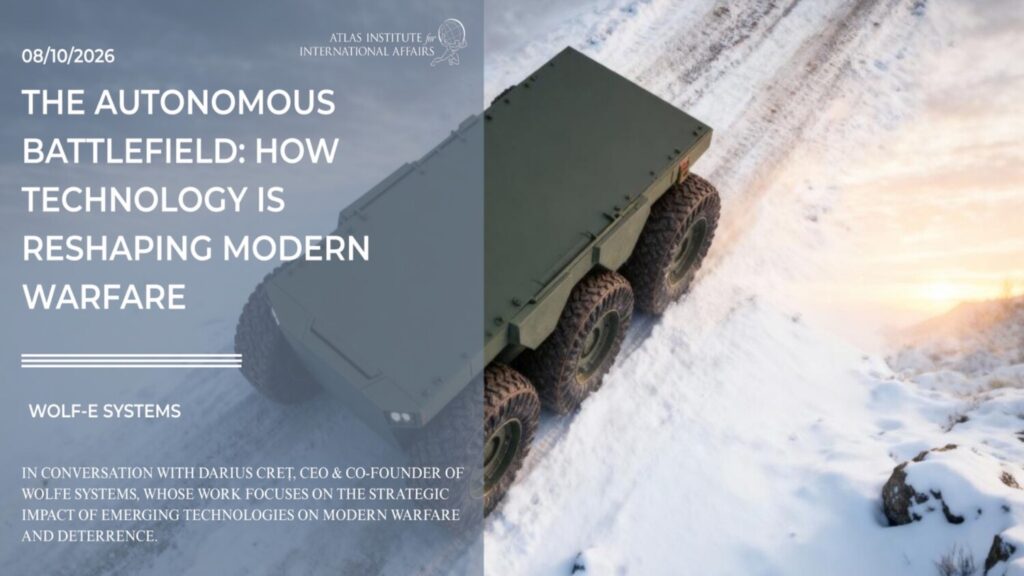
Event Report – The Autonomous Battlefield: How Technology Is Reshaping Modern Warfare
On 8th of October 2026, the Atlas Institute for International Affairs hosted a digital seminar featuring Darius Creț, Co-Founder and CEO of Wolf-e Systems, examining how emerging technologies are transforming modern warfare and reshaping the relationship between military capability, economic efficiency and geopolitical power.
The discussion explored the evolution of asymmetric warfare, highlighting how relatively inexpensive unmanned systems can challenge conventionally superior adversaries. Drawing on examples from Ukraine and Afghanistan, Creț emphasised that military advantage increasingly depends on adaptability, decentralised networks and the ability to impose disproportionate costs on an opponent. These developments challenge traditional assumptions about military superiority, demonstrating how technological accessibility and tactical innovation can enable less powerful actors to counter better-equipped forces.
A central theme was the shift from individual weapons platforms towards interconnected systems integrating drones, sensors, software, artificial intelligence and electronic warfare. Creț argued that the effectiveness of unmanned systems increasingly depends on their integration into wider networks capable of collecting information, supporting decisions and responding rapidly to changing battlefield conditions. While AI can accelerate this process, he noted that fully autonomous combat systems remain limited in their practical application, particularly in contested environments where electronic warfare can disrupt communications and navigation.
The seminar also examined the changing economics of warfare. The growing use of low-cost drones and unmanned surface vessels has created new opportunities to impose significant costs on more sophisticated military forces. Examples from Ukraine illustrated how relatively inexpensive systems can threaten high-value aircraft, naval assets and conventional defensive capabilities. This cost asymmetry presents a significant challenge for defence planners, who must balance investment in advanced platforms with the need to produce affordable systems at scale.
Beyond the battlefield, Creț explored the implications of defence innovation for procurement and military adaptation. He highlighted Ukraine’s decentralised procurement approach as an example of how frontline units can gain greater flexibility in selecting technologies suited to their operational requirements. Such models demonstrate the importance of shortening the distance between technological development and battlefield deployment, particularly in conflicts where systems must be continuously adapted to emerging threats.
The discussion further addressed the geopolitical importance of defence-industrial capacity and resilient supply chains. Creț drew attention to the dependence of European manufacturers on critical components sourced from China, illustrating how vulnerabilities in global supply chains can constrain the production of military technologies. He emphasised that technological innovation alone is insufficient without the manufacturing infrastructure, skilled workforce and reliable access to materials required to sustain production. In this context, industrial capacity represents not merely an economic asset, but an increasingly important component of national security and deterrence.
The seminar concluded by considering the future balance between sophisticated military platforms and inexpensive, rapidly adaptable systems. Rather than suggesting that one will replace the other, Creț highlighted the need for militaries to integrate both within resilient defence ecosystems capable of responding to evolving threats.
The central takeaway was that the autonomous battlefield extends beyond the development of individual weapons systems. Modern warfare is increasingly shaped by the interaction between technology, economics, industrial capacity and strategic adaptation. As states navigate an increasingly competitive international security environment, the ability to innovate, adapt and scale military capabilities may prove as consequential as technological superiority itself.