Recommendations
- 1Rearm conventionally, but stop treating it as the answer. The conventional buildup is necessary and should continue. But delivery timelines run past Russia’s expected peak threat, and even a fully rebuilt Bundeswehr cannot deter nuclear coercion. Rearmament buys time and credibility, not security on its own.
- 2Formalize a European nuclear consultation and planning framework now. Statements are not reassurance; institutions are. Germany should press Paris and London for a standing nuclear consultative body — modelled on NATO’s Nuclear Planning Group but independent of U.S. authorization. Credibility requires costly, visible commitments; this is the first one available.
- 3Keep the sovereign option latent — and do not brandish it. Germany has the infrastructure and money for its own bomb, but the costs are prohibitive: a near-certain Article 26 challenge, 64–90% public opposition, and the likely collapse of the non-proliferation regime. Paris and London can already see what European inaction would force; advertising it would only spend the credibility that makes Germany’s case persuasive.
- 4Build the umbrella for Russia’s doctrine, not for the textbook. France and Britain’s combined stockpile already exceeds what minimum deterrence requires. But Russia’s posture threatens limited nuclear use, which a purely strategic force answers poorly. The umbrella needs flexible-response options and the German delivery and basing role the F-35 and Büchel investments already make possible.
- 5Apply the German test elsewhere, starting with NATO and Canada. NATO should confront, before a crisis does, how an alliance built on U.S. power functions when Europeans carry the main burden. Canada should run this analysis on its own posture, Arctic sovereignty and alliance obligations. No ally’s assumptions should go unexamined.
Executive Summary
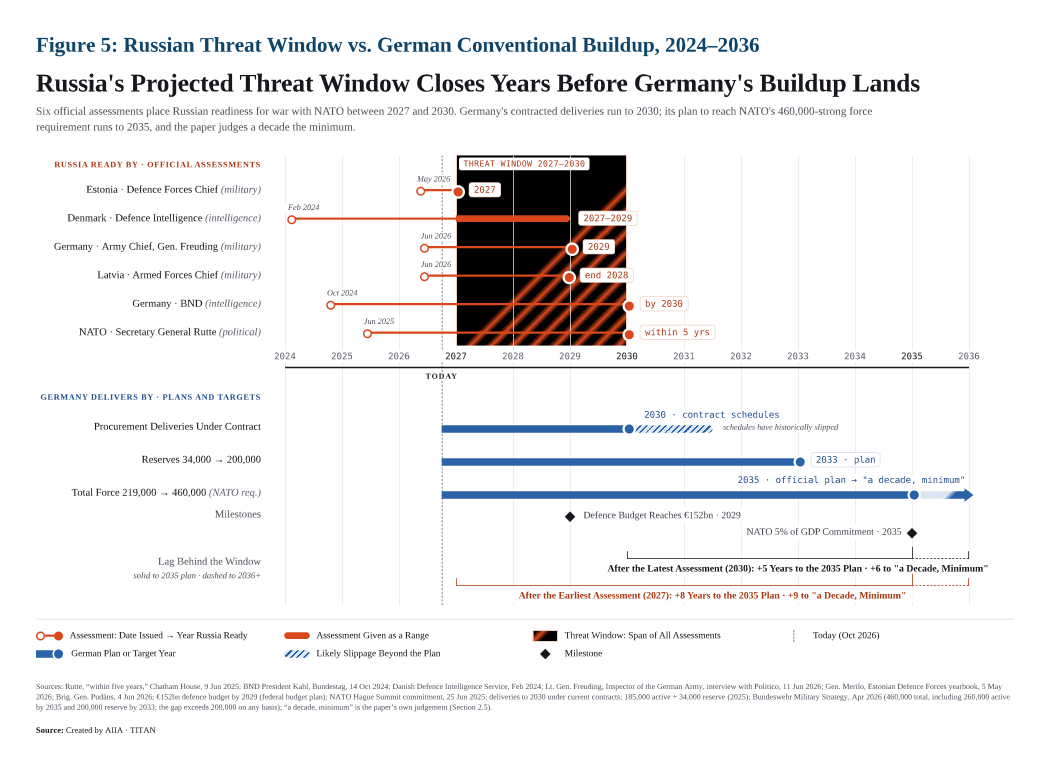
Since the founding of the Federal Republic, Germany’s security has rested on an American guarantee that can no longer be assumed. The United States accounts for roughly two-thirds of NATO’s defence spending and supplies the alliance’s nuclear umbrella, its strategic airlift and its intelligence architecture. But under the second Trump administration, Washington treats collective defence as negotiable. Russia, meanwhile, has demonstrated both the will and the capacity to wage aggressive war in Europe: it has moved to a war economy, it outproduces the United States and Europe combined in artillery shells, it holds the world’s largest nuclear arsenal, and it maintains what Western analysts characterize as an “escalate to de-escalate” doctrine — the threat of limited nuclear use to end a conventional war on Moscow’s terms. NATO’s Secretary General warns that Russia could be ready to attack alliance territory within five years; Germany’s foreign intelligence service puts the date at 2030; Estonian and Latvian military chiefs warn that the danger to the Baltic states could peak as early as 2027–28.
This paper asks whether Germany can rationally build sufficient capability to deter Russia without the U.S. guarantee, and if so, through what means. It evaluates the options through a rational choice lens, supplemented by deterrence theory and defensive realism, treating the problem as one of strategy rather than of normative debate. Its central finding is that the conventional rearmament now under way is necessary but categorically insufficient, and that Germany’s security future depends on a European nuclear umbrella that neither France nor the United Kingdom has yet committed to providing.
Germany can rearm conventionally, and is doing so. The constitutional and economic questions are settled. The Grundgesetz permits defensive buildup, the 2022 Zeitenwende created a €100 billion special fund, and the March 2025 reform of the debt brake exempted defence spending above 1% of GDP from the borrowing limit, underpinning €650 billion in planned defence spending between 2025 and 2029.
Conventional armament cannot substitute for extended deterrence within the threat window. Three barriers stand in the way that neither permission nor money can overcome. Delivery schedules run to 2030 and beyond, readiness is chronically low, and converting budgets into deployable military power takes a decade at minimum. NATO’s force goals require some 460,000 personnel against roughly 220,000 today, a gap that voluntary recruitment cannot fill and that a new military service law, voluntary unless parliament votes otherwise, has barely begun to close. At the same time, the roughly 36,000 U.S. personnel in Germany (about 5,000 of them now being withdrawn) bring airlift, command and intelligence architecture that cannot be reproduced in time. Beneath these lies a categorical problem: no number of tanks, aircraft or soldiers changes the asymmetry between a nuclear-armed Russia and a conventionally armed Germany.
A sovereign German bomb is possible in theory but not strategically viable. Germany could leave the NPT under its Article X withdrawal clause, though the Two-Plus-Four Treaty, which has no exit clause and confirms Germany’s borders, offers no clear legal route out short of renegotiation. It has latent capacity (the Gronau enrichment plant, world-leading centrifuge technology, restartable reactors, though no plutonium reprocessing) and the money: a program on the French or British scale would absorb roughly 6–12% of the current defence budget. The real barrier is political. Between 64% and 90% of Germans oppose a national bomb, a program would almost certainly be challenged under Article 26 of the Basic Law, and it would risk breaking the non-proliferation regime Germany has spent decades upholding.
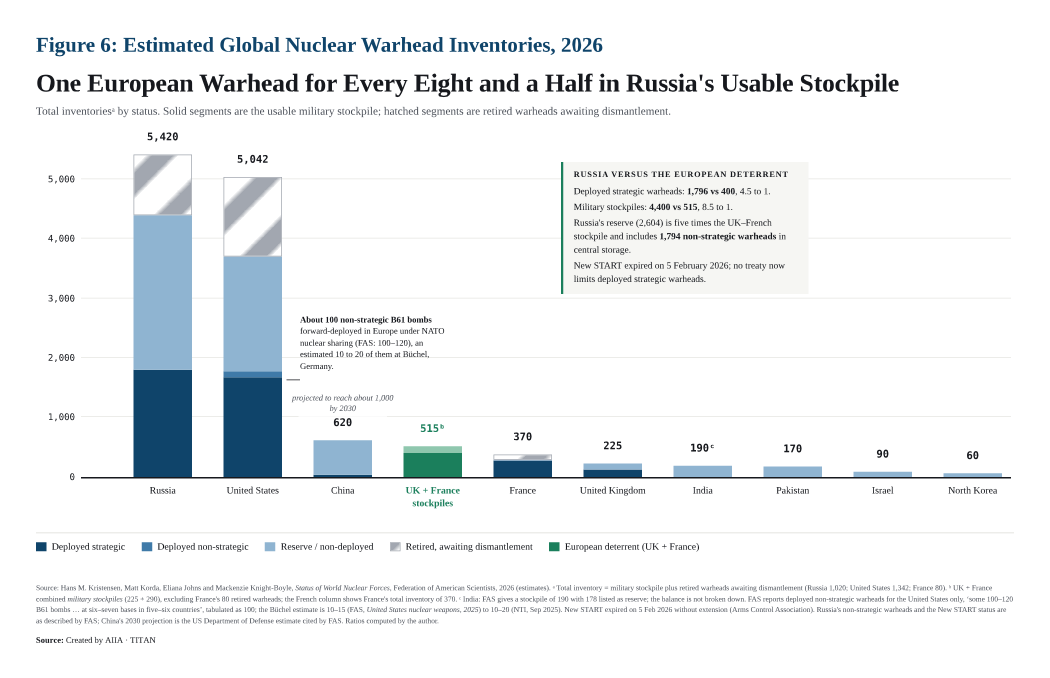
A European nuclear umbrella is the most coherent option, and it does not yet exist. Where Germans reject a national bomb, 64% support a European deterrent. France and Britain together hold roughly 515 warheads, comparable to China’s and well above the 200–300 that minimum deterrence requires, though Russia’s graduated doctrine would demand flexible-response options as well. Europe has the capability. What it lacks is commitment: neither Paris nor London built its deterrent to protect others, and the paradox weakening the American umbrella, that a promise to risk one’s own destruction for an ally is inherently hard to believe, applies to them with equal force. Macron’s March 2026 offer of “forward deterrence” is politically significant, but it extends no guarantee, and reassurance requires consultation and planning institutions that do not yet exist. The nuclear gap at the heart of European security is a gap of will and institutions, not of warheads.
The implications extend beyond Germany. Europe must formalize a nuclear planning framework independent of U.S. authorization. NATO must confront what it looks like when Europeans carry the primary burden of deterrence, and whether decision-making built for a U.S.-led model can adapt in time. And Canada, sharing a continent with the same unreliable guarantor, should read the German case as a warning: if Europe’s largest economy, surrounded by allies, cannot rely on the American umbrella, Canadian assumptions deserve the same scrutiny.
Germany’s rearmament is a rational response to an uncertain world, not a revival of militarism. Its lesson is that capability and will are not the same thing, that legal permission and strategic viability are not the same thing, and that Europe’s security will be determined by what Europeans are prepared to build for themselves.