Trade Under Pressure: The Houthi Threat to the Bab el-Mandeb Strait
Houthi attacks on the Bab el-Mandeb Strait threaten to compound the ongoing Strait of Hormuz oil crisis.
The Strait of Hormuz and Current Blockades
Since the end of February, the United States (U.S.) and Iran have been embroiled in a conflict that has remained a central issue within global geopolitics. Beyond shaping the future of the Middle East, the conflict between the U.S. and this regional superpower has also wreaked havoc on global trade routes, driving up prices and leaving markets uncertain. In retaliation against the U.S. and American allies in the Middle East, Tehran has not only carried out counterstrikes against its adversaries but has also closed the Strait of Hormuz, thereby blocking one of the world’s most pivotal oil trade routes (Butler, Mann, and Jackson, 2026). Before the conflict, the Strait provided passage for about 20% of the world’s oil and natural gas, with 20 million barrels of oil passing through in the year 2025 alone (Butler, Mann, and Jackson, 2026). The closure of this route into the Persian Gulf has had a massive impact on global trade, with oil prices skyrocketing.
The Bab el-Mandeb Strait: A Promising Alternative
Since the closure of this vital passageway, Saudi Arabia, among other Middle Eastern states, has turned to the Bab el-Mandeb Strait, a chokepoint connecting the Red Sea to the Gulf of Aden, as an alternative route (Khaled and Al-Haj, 2026). Instead of relying on direct transfer to ports in the Persian Gulf, Saudi Arabia has been rerouting millions of barrels of oil through a pipeline to the Red Sea (Elliott, Gamio, and Granados, 2026). As the number of ships passing through the Strait of Hormuz plummeted in early March, the Bab el-Mandeb remained a constant resource, with even small increases of shipping being seen in the region.
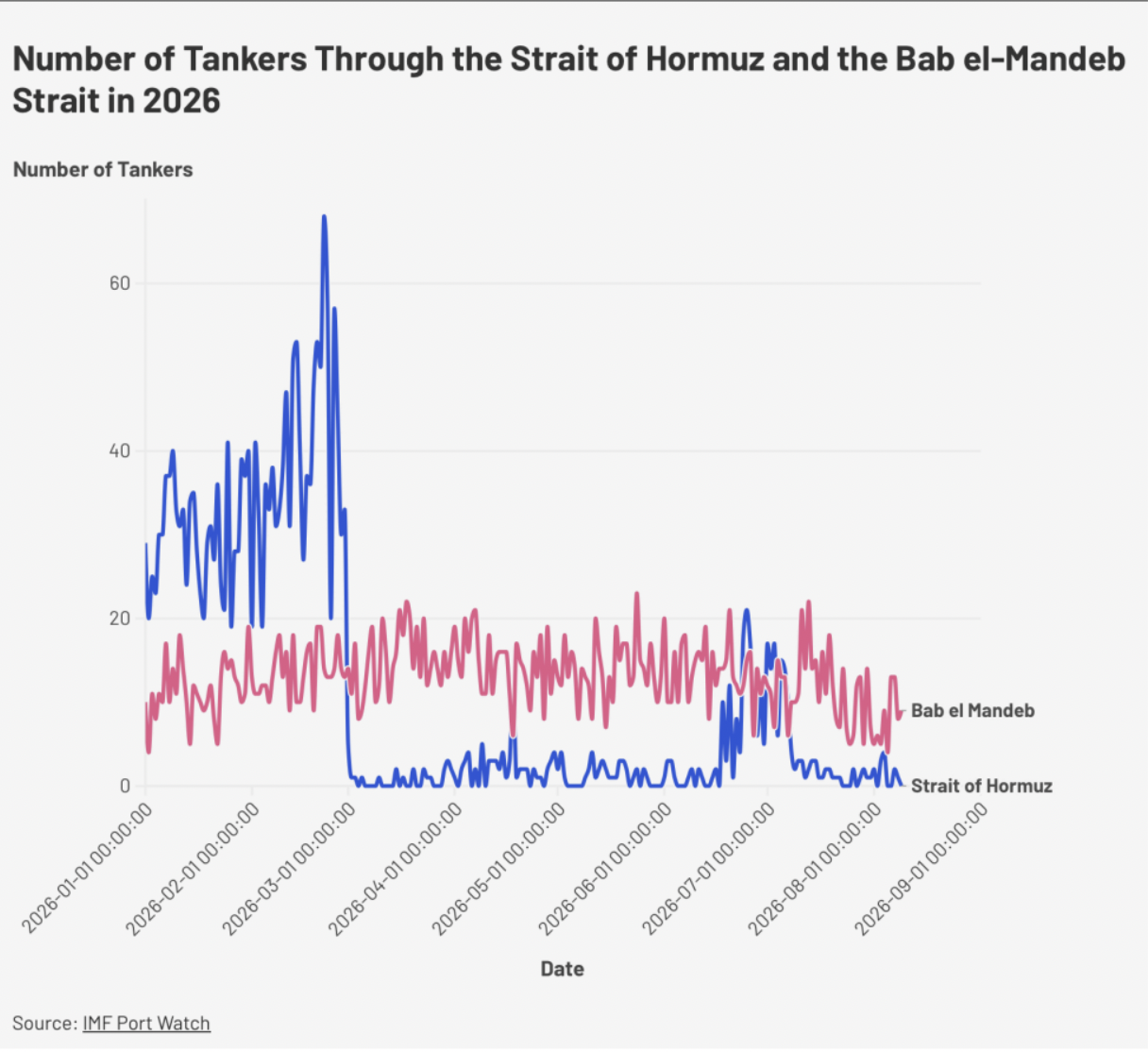
However, since the 20th of July, the Bab el-Mandeb Strait has been placed under threat. The Houthis, a Yemeni rebel group backed by Iran, announced a blockade of Saudi Arabia, including the necessary Bab el-Mandeb passageway (Howard, 2026). They later reinforced this threat with an attack on a Saudi oil tanker two days after it loaded at the critical Saudi port city of Yanbu (Howard, 2026). Although the Houthis have declared they will only place a blockade on Saudi Arabian ships, the conflict in the Strait of Hormuz has shown that even sporadic attacks on ships can be enough to close critical waterways due to heightened risk and insurance costs (Khaled and Al-Haj, 2026).
The Effect of Houthi Threats on Global Shipping
In an interview just two days after the Houthi announcement, Clionadh Raleigh, founder of ACLED, a conflict monitoring service, declared that should the Bab el-Mandeb Strait come under pressure at the same time as the Strait of Hormuz, it would effectively close off two of the world’s most important maritime routes at once (Khaled and Al-Haj, 2026). In June, more than 7 million barrels of oil transited the Bab el-Mandeb Strait per day, up from 4 million prior to the war in Iran. Saudi Arabia alone has been responsible for exporting 4 million of these barrels from Yanbu (Khaled and Al-Haj, 2026). As this data shows, even the closure of all Saudi Arabian exports due to Houthi threats would prevent a large portion of valuable oil exports from being shipped worldwide.
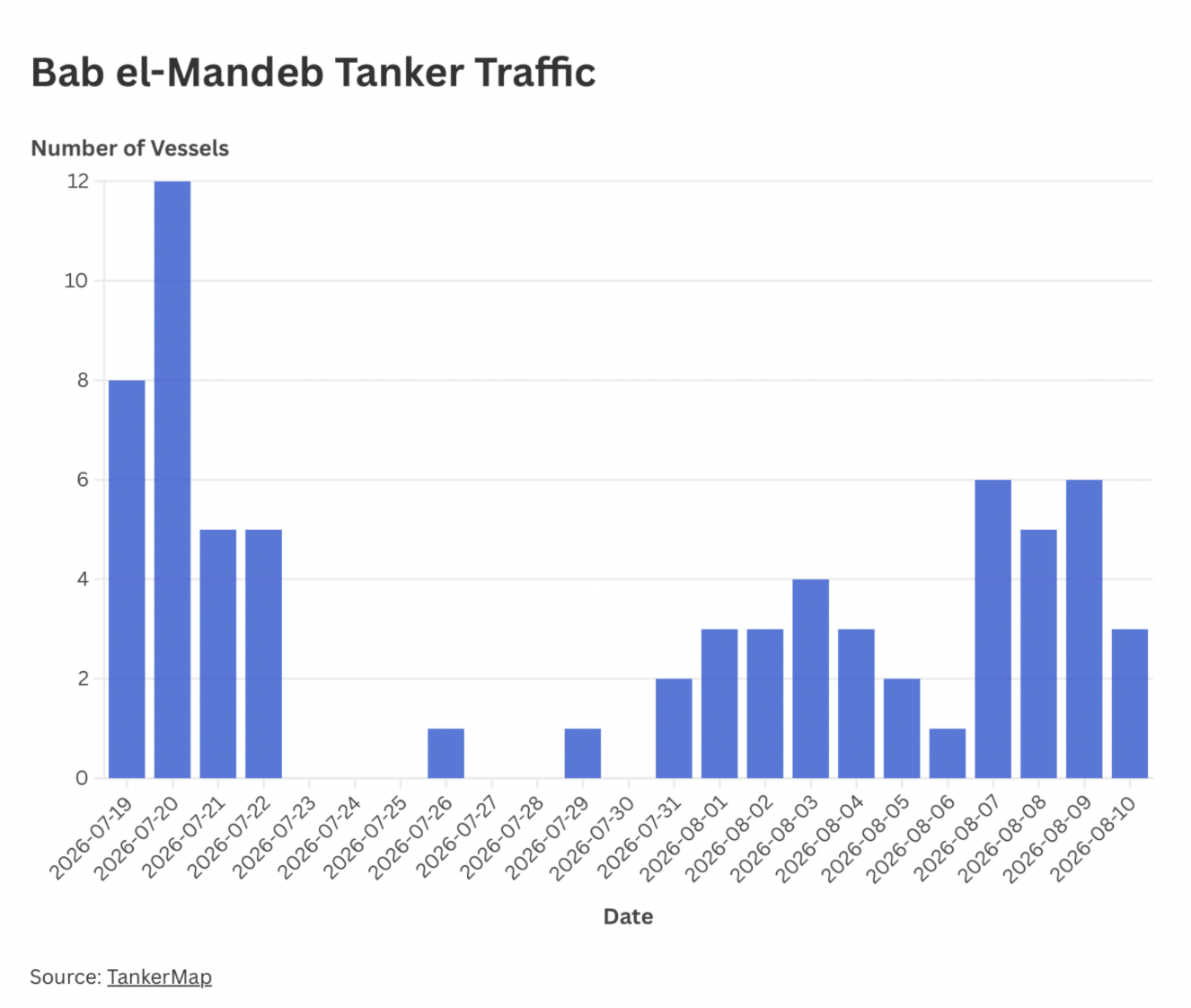
The effects of Houthi intimidation are already evident in the number of vessels transiting the Bab el-Mandeb Strait. The number of vessels passing through this chokepoint averaged 31 per day from July 25th to July 26th, down 50% from the already suppressed second quarter average in tonnage terms (Howard, 2026). If the Houthis manage to completely block Saudi Arabia from the Red Sea, they would take roughly 4% of the world’s oil off the market, risking a substantial increase in already high oil prices (Elliott, Gamio, and Granados, 2026). Although this conflict mainly concerns political conflict between regional powerhouses and their proxies, the effects of these maneuvers can be felt throughout the entire world due to the highly globalized nature of today’s economy.
Potential Alternatives to the Two Straits
While other alternatives to both the Persian Gulf and the Red Sea do exist, they are ultimately much more difficult routes and are exceedingly more expensive (Elliott, Gamio, and Granados, 2026). The Suez Canal, while another important shipping route, does not allow for the size of ships needed to transport crude oil. Additionally, it would take four more weeks to reach Asia through the Mediterranean Sea, as ships would have to go around Africa (Elliott, Gamio, and Granados, 2026). The extension of this route, along with the potential dangers faced by transiting the Cape of Good Hope face shipping companies with vast increases in cost given the longer routes and the increased insurance risk. Another alternative, the Egyptian pipeline of Sumed, cannot accommodate the sheer amount of oil that has been passing through the Bab el-Mandeb Strait (Elliott, Gamio, and Granados, 2026).
Saudi Arabia’s Response
On July 30th, Saudi Arabia announced a mission to form an international alliance to guard the Red Sea from Houthi attacks. According to Saudi sources, 13 countries have agreed, including Turkey, Kuwait, Bahrain, Qatar, Jordan, Egypt, Pakistan, Djibouti, Somalia, Bangladesh, Yemen, Sudan, and the Comoros (Lawal, 2026). This security pact has already had an influence over the situation, with increases in shipping being shown through the Bab el-Mandeb Strait. While this security alliance does seem the best solution for the immediate situation, it is uncertain how effective it will be in the long term and whether it poses a threat of recommencing hostilities between Saudi Arabia and the Houthi rebel government.
As conflicts across the Middle East show little sign of abating, the stability of global oil markets and vital shipping routes increasingly hangs in the balance. Disruptions in the Strait of Hormuz and the Bab el-Mandeb Strait are embedded in a complex web of interstate rivalries, regional conflicts, and competing security interests, with no straightforward resolution in sight. These crises also demonstrate the growing influence of non-state actors in international relations and foreign-policy decision-making. States are no longer the sole forces shaping the international system; armed groups can now disrupt global trade, influence energy prices, and draw major powers into regional conflicts. Policymakers must therefore navigate security challenges that do not fit neatly within the state-centered rules and institutions traditionally governing international affairs.
References
Butler, G., Mann, T. and Jackson, P. (2026) Iran war: What is the Strait of Hormuz and why does it matter?, BBC News. Available at: https://www.bbc.com/news/articles/c78n6p09pzno (Accessed: 24 August 2026).
Bab El-Mandeb – tanker traffic – daily transits & tonnage (no date) TankerMap. Available at: https://tankermap.com/analytics/straits/bab-el-mandeb (Accessed: 24 August 2026).
Elliott, R.F., Gamio, L. and Granados, S. (2026) See how Houthis put the Red Sea at risk as an alternative oil route – The New York Times, The New York Times. Available at: https://www.nytimes.com/2026/07/22/business/energy-environment/red-sea-saudi-arabia-houthis.html (Accessed: 24 August 2026).
EVENTC10000004 (no date) PortWatch. Available at: https://portwatch.imf.org/pages/cc317ba850e34c4dadbead6f7b336fb1 (Accessed: 24 August 2026).
Howard, G. (2026) Houthi threat brings Bab el-Mandeb crossings down another 50%, Seatrade Maritime News. Available at: https://www.seatrade-maritime.com/security/houthi-threat-brings-bab-el-mandeb-crossings-down-another-50- (Accessed: 24 August 2026).
Khaled, F. and Al-Haj, A. (2026) A new threat by Yemen’s Houthis could widen the Iran war and put another trade chokepoint at risk, PBS. Available at: https://www.pbs.org/newshour/world/a-new-threat-by-yemens-houthis-could-widen-the-iran-war-and-put-another-trade-chokepoint-at-risk (Accessed: 24 August 2026).
Lawal, S. (2026) Why is Saudi Arabia forming a coalition to protect the Red Sea?, Al Jazeera. Available at: https://www.aljazeera.com/news/2026/7/30/why-is-saudi-arabia-forming-a-coalition-to-protect-the-red-sea (Accessed: 24 August 2026).