A Clear Political Victory, a Strategic Test for Armenia
Armenia’s June 2026 elections delivered Prime Minister Nikol Pashinyan a renewed but limited mandate, tightening his political room for maneuver to address the country’s most difficult strategic questions. The result confirms Armenia’s continuation of its Western-oriented trajectory, while leaving the peace process with Azerbaijan, the future of TRIPP, and the country’s exposure to Russian pressure unsettled.
A Decisive Electoral Victory with Strategic Political Limits
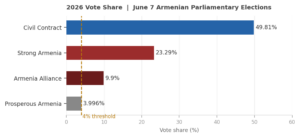
Armenia’s June 7, 2026, parliamentary elections delivered a decisive but somewhat constrained mandate to Prime Minister Nikol Pashinyan and his Civil Contract Party. Conducted against the backdrop of Russian economic coercion, an unratified peace framework with Azerbaijan, and accelerating EU institutional engagement, the vote functioned less as a standard legislative exercise than as a referendum on foreign policy and democratization. Three parties cleared the 4% threshold for National Assembly representation: Civil Contract with 49.81% of the vote, the pro-Russian Strong Armenia Alliance with 23.29%, and the also pro-Russian Armenia Alliance with 9.9% (CEC Armenia, 2026).
While Pashinyan is not a popular figure, his political survival is easy to explain. The opposition failed to produce a national leader capable of mobilizing and consolidating a broad segment of Armenian society. Many opposition figures were perceived as discredited and representatives of the old political order, associated with corruption and close ties to Russia. They were also accused of seeking to push Armenia toward another confrontation with Azerbaijan, a prospect many Armenians viewed as deeply dangerous given the stark imbalance in military capabilities between the two countries.
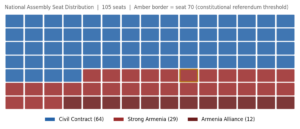
The seat allocation in the 105-member National Assembly reflects both the Civil Contract’s commanding margin and its institutional ceiling. Civil Contract holds 64 seats, Strong Armenia 29, and Armenia Alliance 12. Compared with the 2021 parliament, Civil Contract dropped from 71 seats, while Armenia Alliance contracted sharply from 29 to 12, a decline attributable in large part to the emergence of Strong Armenia as a competing vehicle for pro-Russian political sentiment (Schminke, 2026).
The procedural arithmetic carries significant weight because Armenia’s constitution requires a two-thirds supermajority, equivalent to 70 seats, to initiate a constitutional referendum. Azerbaijan has made precisely that referendum a precondition for formally ratifying the peace deal initialled at the White House in August 2025. Baku’s demand centers on the removal of constitutional language it interprets as an implicit territorial claim over Nagorno-Karabakh. The result is a parliament where Civil Contract commands a working majority for ordinary legislation and governance but faces an effective veto on the single most consequential item on its peace agenda.
Source: CEC Armenia (2026)
Source: CEC Armenia (2026)
Between Russian Coercion and Western Backing
From mid-May onward, Russia imposed near-daily restrictions on Armenian agricultural imports, targeting alcoholic beverages, mineral water, fish products, and fruits and vegetables precisely as peak export season began. Foreign information manipulation and interference operations, attributed primarily to actors affiliated with Russia, have intensively employed tactics including cloned media platforms, coordinated inauthentic behavior, and AI-generated content (Lyndell and Kanev, 2026). In addition, Russia and other members threatened to initiate a formal review of Armenia’s EAEU membership with a December suspension deadline. The Kremlin separately recalled its ambassador to Yerevan for consultations over Armenia’s pro-EU course (Barabas and Brezar, 2026).
Moscow’s underlying logic was made clear: Armenia’s preferential gas access, governed by a 2013 agreement with Gazprom, is contingent on EAEU membership, and EU accession is institutionally incompatible with that status. Armenia imports more than 80% of its natural gas from Russia (Mutafyan, 2025). Moreover, Armenia’s annual trade with Russia accounted for 36% of its foreign trade in 2025 (Abdullah and Vartapetov, 2026), making economic diversification a multi-year challenge regardless of the electoral outcome. This structural dependency constitutes Moscow’s primary soft lever, producing measures coercive enough to impose real economic costs while stopping short of the kind of rupture that would accelerate Armenia’s distance and further alienation from Russian-managed institutions.
Meanwhile, active Western engagement afforded Pashinyan an important political advantage ahead of the vote. In the months before the election, Armenia’s relations with both the European Union and the United States became more visibly institutionalized. Brussels advanced a Strategic Partnership Agenda with Yerevan, backed by substantial financial support for reform, economic resilience, and connectivity, while also framing Russia’s trade restrictions as a form of political pressure.
Washington, for its part, deepened its regional involvement through the Trump Route for International Peace and Prosperity (TRIPP) initiative, which provided the United States with a more strategic stake and operational role in the region’s transport and energy architecture. In light of this major reconfiguration process, the election was not merely a party-politics contest within the Armenian domestic political landscape. The latter also served as a broader test of Armenia’s strategic direction: whether the country would continue forging closer ties with the EU and the United States, or move back toward Russia’s sphere of influence.
Strategic Uncertainty after the Vote
The period ahead is likely to be shaped by three overlapping sources of strategic uncertainty. The most immediate is the unresolved constitutional dilemma. A referendum question remains difficult to envisage unless Azerbaijan softens its demands or opposition actors in Armenia unexpectedly shift their position. In the absence of either development, the more likely outcome is a managed stalemate: technical work on border delimitation, transport links, and trade may continue, but without the legal closure that a final peace treaty would provide. Such an arrangement would keep the political and diplomatic process alive, yet it would also leave TRIPP operationally fragile and open to renewed obstruction or escalation.
A second source of pressure will come from Russia’s economic and trade leverage. The more visibly Armenia diversifies and advances its sovereign foreign positioning with alternative actors, the more likely Moscow is to activate hybrid pressure to raise the burden of that “divorce.” Western financial assistance can help cushion economic strain and signal political support, but only within clear limits, since it cannot quickly offset Russia’s vital role in Armenia’s energy and economic security.
The third issue concerns the future of TRIPP. Although construction is expected to begin in the second half of 2026, the project is moving ahead in a political environment in which the broader peace agreement remains unratified. That creates a mismatch between strategic ambition and strategic certainty. Unresolved issues in the implementation framework, particularly those related to sovereignty and control along the corridor, could complicate both construction and long-term operation. Washington’s commercial involvement and Yerevan’s interest in regional connectivity make the project politically significant, but they do not remove the underlying risks. For now, TRIPP should be understood less as a settled achievement than as a contingent project whose success will depend on whether the diplomatic arrangement around it can be stabilized.
Ultimately, Armenia emerges from the election with a mandate for continuity but also with limited political capacity to settle the core questions that shape its strategic future. Domestically, Pashinyan can continue to govern and advance the technical elements of the peace agenda and the normalization process with Azerbaijan; geopolitically, he can further consolidate Armenia’s Western-oriented course. Yet the constitutional threshold, the balance of forces inside parliament, Russia’s coercive leverage, and the unresolved status of TRIPP will all limit how far this momentum can go. The likely trajectory is therefore neither breakthrough nor collapse, but a prolonged phase of conditional progress – Armenia will move further along its chosen path while remaining exposed to constitutional constraints, implementation gaps, and external dependencies that could still derail it.
References
Abdullah, A., and Vartapetov, K. (2026) ‘Armenia Outlook Revised To Positive On Growth’, S&P Global Ratings, 20 February. Available at:
https://www.spglobal.com/ratings/en/regulatory/article/-/view/type/
Barabas, P. and Brezar, A. (2026) ‘Russia recalls ambassador to Armenia over closer EU ties days before decisive elections’, Euronews, 29 May. Available at:
https://www.euronews.com/2026/05/29/russia-led-eurasian-economic-union-urges-armenian-referendum.
Central Electoral Commission of Armenia (2026), ‘National Assembly Elections, 2026’. Available at: https://www.elections.am/Elections/Parliamentary?utm
Demytrie, R. (2026) ‘Armenia votes as Russia piles pressure on pro-West government’, BBC, 7 June. Available at: https://www.bbc.com/news/articles/c3626n1epd5o
Kanev, S. (2026) ‘Grabbing him by the “Beard”: The Insider identifies the FSB, GRU, and SVR agents Russia sent to Armenia to take on PM Nikol Pashinyan’, The Insider, 19 May. Available at: https://theins.press/en/inv/292740
Lyndell, D. (2026) ‘”Pashinyan’s illness,” “looming war with Russia,” and “gas chambers on Mount Ararat”: Moscow floods Armenia with disinfo ahead of elections’, The Insider, 29 May. Available at: https://theins.press/en/inv/293081
Mutafyan, G. (2025) ‘Armenia’s economic dependence on external powers’, Genesis Armenia, 3 November. Available at:
https://genesisarmenia.am/en/armenias-economic-dependence-on-external-powers/
Schminke, T.G. (2026) ‘National parliament election in Armenia 2026’, Europe Elects, 9 June. Available at:
https://europeelects.eu/2026/06/03/national-parliament-election-in-armenia-2026/
United States Department of State (2026) ‘Joint statement on the publication of the U.S.-Armenia Implementation Framework for the Trump Route for International Peace and Prosperity (TRIPP)’, 13 January. https://www.state.gov/releases/office-of-the-spokesperson/